Photos: Grief overpowers Eid in Jammu and Kashmir’s Poonch

Ahmed Mir and Sarthak Parashar
On the eve of Eid-ul-Adha, several people, mostly the mohallawallas, have gathered at the deceased Muhammad Akram’s largely plasterless house in Poonch’s Sukha Katha locality. A maulvi recites the prayer for maghfirat or divine forgiveness for the deceased.
There is a power cut. Soon, mobile flashlights fill up the room with dim radiance as the dua continues, uninterrupted. In one corner of the room, with her head low and tilted, sits Akram’s widow, Fareeda Bi (39), with her four daughters and two sons.

Fareeda lost her husband in the early hours of 7th May to shelling from Pakistan’s side of the border while he was taking his children to the toilet outside their house. Her eldest daughter, Afreen Firdaus, 19, was heavily injured while Akram died on the spot.
“I moved my husband’s dead body aside to take my injured daughter to the hospital,” she says with multiple lumps in her throat.

For Fareeda and her children, Eid will never be the same again. She says, “It’s Eid tomorrow. Earlier, 40-50 people would gather at our place to celebrate the festival. The kids would be blessed and given Eidi first thing in the morning by their father. Our sons would dress up to join him for the Eid namaaz. This time around, there is no Eid without their Papa.”
Akram, a daily wage labourer, was the sole breadwinner of his family of six. Without him, Fareeda worries about her children’s school fees and other basic expenses. On May 30, Home Minister Amit Shah visited Poonch to hand over government job letters to Fareeda and other victims of shelling. She has also received a monetary compensation of ₹16 lakh, even as she asks, “Can anything replace my husband?”

Around an hour and a half away from Poonch city is Loyal Bela, a remote village in the Loran inter panchayat. With no road connectivity, one has to trek for a few kilometres to get to the house of Muhammad Abrar (38, deceased).
Abrar, a bus driver who helped in the evacuation of many villagers during the shelling, was hit by a shell on his chest on the night between May 8-9. The explosion killed him at the spot after he had just helped in evacuating a specially abled neighbour.
The eldest son, Waide Abrar, aged fifteen, has a lot of angst in him. He challenges the mainlanders sitting in their AC rooms and rooting for war between the two nations to spend a day at the border. No glistening Pathani suit for Badi Eid, only a mud-brown skull cap on his head, he only has one question,“Who will look after poor orphans like us?”

Abrar’s younger brother Israr Ahmed fears that the 12 lakh compensation isn’t enough for a family of four (one wife and three children) that Abrar has left behind. The local MLA, Ajaz Jan of the Jammu and Kashmir National Conference (the ruling part of the union territory, chaired by Omar Abudllah, the Chief Minister) neither picked up his call when he needed his help to get his injured Bhabhi to the hospital nor paid a visit to them later, he alleges.

“There were no sirens, medical facilities or bunkers (underground shelters) available to protect us during the shelling. I lifted my brother’s dead body without telling my parents. If they had known about their son’s demise, they wouldn’t care about the shelling and come out of the house,” he laments. “The army helped us with the dead body on the morning of May 9,” he adds.
For both Ahmed and Waide, there is no Eid, only mourning. Ahmed repeatedly points to the poverty of their family to make sense of the lack of media coverage and administrative help towards them.

Some victims attracted more attention than others, Qari Muhammad Iqbal (47, deceased) being one of them. A Quran teacher at the Zia-ul-Uloom Madrasa in Poonch city, he was declared a terrorist, a member of the Lashkar-e-Taiba, a terrorist organisation that initially took responsibility for the Pahalgam attack, by mainstream media channels like Republic TV, News 18, Zee News.
He was injured because of shelling near his Madrasa and was transferred to the hospital, where he succumbed to his injuries on the evening of May 7, around 7-8 PM, says his younger brother, Qari Farooq Ahmed. According to him, Pradeep Sharma, a former BJP MLA, was present during Qari Iqbal's final moments—he died in Sharma’s arms.

“My brother had done so much for the community, imparting knowledge to kids. He was a really good citizen. Of all the news channels that defamed him, only one asked for forgiveness. Not only was my brother killed, but his reputation was also smeared,” he said with a lot of disappointment in his voice.
Qari Iqbal has left behind two wives and eight children. The government has so far allocated them a clerk job and a compensation of 13.5 lacs. His family aims to file a defamation suit against the news channels in the Supreme Court.

This Eid for Qari’s family was shadowed by grief; the food, his nephew Mumtaz said, tasted like blood. “The expectations kids have from their father, they cannot have it with anyone else,” he says as he starts tearing up.
Poonch is one of the country’s most backward districts, making these families disadvantaged in multiple ways. Only adding to that is the shelling that took away their loved ones and damaged their houses. In this valley with no active tourism industry, the resulting serenity seems to be a mere facade that hides decades of geopolitical tensions.
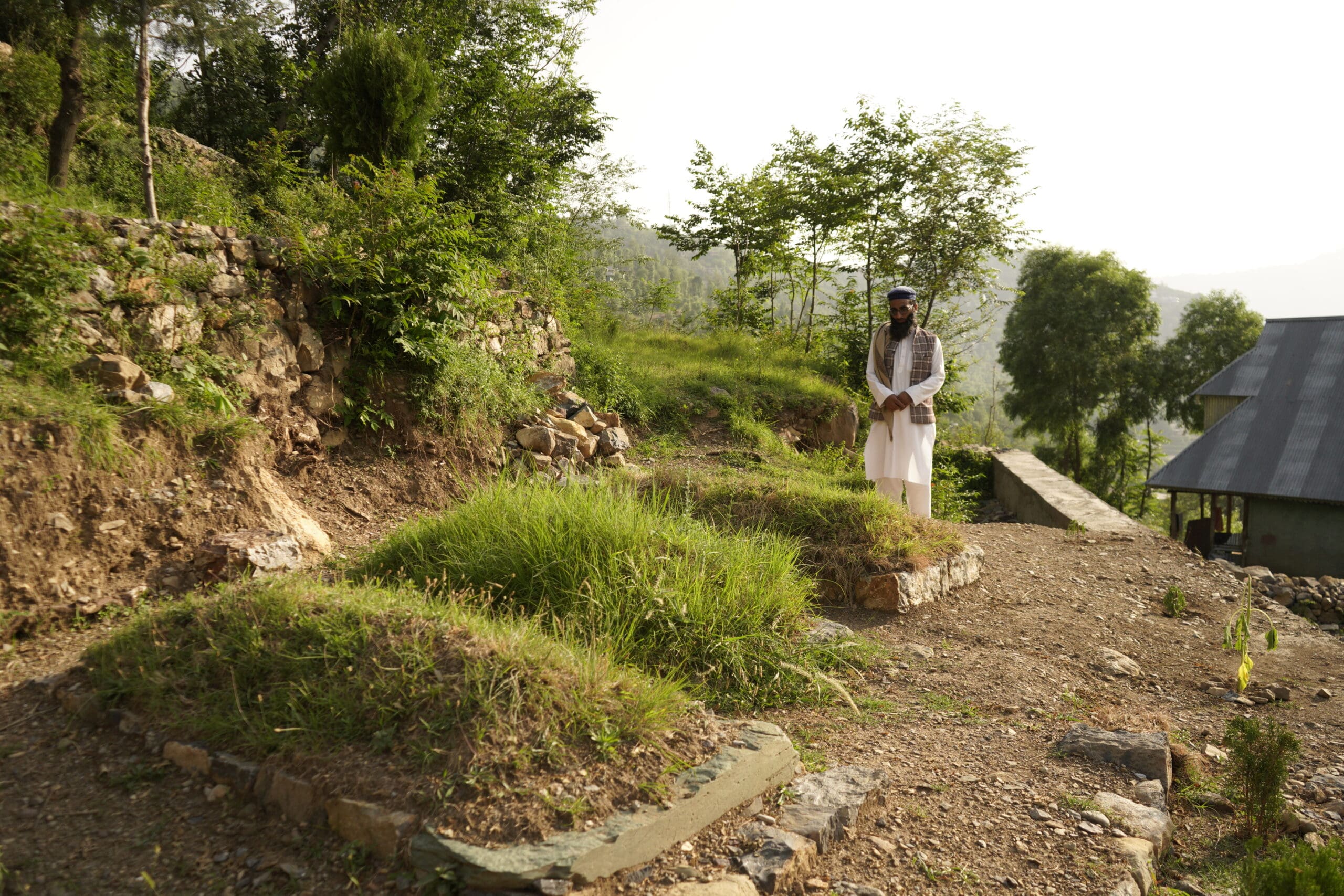
On the morning of Eid, the men go to pay respects to the dead of the family. This ritual, called Fateha Khwani, involved a fresh grave for all of these families, not more than a month old. These people have lived in Poonch for decades. When asked if they wish to leave for safer areas, they either do not have the resources or the will. Despite the varying compensation amounts and socio-economic backgrounds, there is a thread of loss, an incessant appeal for bunkers and medical facilities that connects them all. So much so that Israr Ahmed doesn’t mind being buried in a bunker, with no fatal artillery to pierce his chest or an older brother to lose to it.
Sarthak Parashar is a freelance journalist based in Delhi. He writes about films, culture and more. Ahmed Mir is a freelance photojournalist currently based in Delhi.