Bulldozing a home and the fragile “four walls of hope”

Eviction. Bulldozer justice. Brutality has become a formal, legitimate pursuit in India. Homes bulldozed in the name of food, for posting something on social media, or for being a responsible journalist. Bulldozed even for being a Muslim. Homes of accused terrorists are being razed in Kashmir, with no regard for other members of the family. Or, the unending scores of homes evicted in Assam, particularly of the Miya community.
Taking a strong exception to the inhumanity of the process, Supreme Court judge, Justice Ujjal Bhuyan equated the demolition of properties of people to bulldozing the constitution itself. Justice Bhuyan was speaking at Bharati Vidyapeeth New Law College, Pune, when he expressed his concern regarding bulldozer justice and acts of arbitrary demolitions. His exact words were:
“According to me, using a bulldozer to demolish a property is like running a bulldozer over the Constitution. It is a negation of the very concept of rule of law and if not checked, would destroy the very edifice of our justice delivery system”
Poets have reflected on such loss, trauma, and scars that bulldozer justice causes in the lives of the victims. In particular, I am referring to the two Palestinian poets—Mourid Barghouti and Mahmoud Darwish, and their poems “midnight” and “the house as casualty”, respectively.
Midnight
Barghouti’s “Midnight” is not just any poem. Its sentiments are going to last forever and a day. What makes this poem critical is its politics of refusal and an appeal to build life from a place of nothingness and emptiness. Bulldozing houses is one aspect facilitating such nothingness and emptiness. Midnight is a poem, as Paul Padel aptly puts it, “an affirmation of life in the face of total loss.”
The poet writes, “Life is hidden somewhere, / I know, / not far from here.” “I, who have lost my battles, / have nothing left but to work in construction, and to build/ with my two desperate hands, / four walls of hope.” Not violence but hope of life and freedom, perhaps from the pavement—a place the poet claimed to be his.
The rule of law and justice are at stake, but there is also life — emotions and feelings. Midnight is a poem that opens many windows, and the poet shares certain memories and visions with us. I take from it one window that he opens to reflect on the experience of a home being bulldozed. How does it feel to have one’s home demolished? Barghouti writes after a house is bulldozed:
“After the dust and smoke
have cleared from the house that once stood there,
and as I stare at the new emptiness”
A new emptiness grips the homeless, a homelessness that has been imposed brutally by destroying everything. A grandfather consoles his grandson:
“He hugs me and maintains a silent gaze,
As if his look
Could order the rubble to become a house,
Could restore the curtains to the windows,
And my grandmother to her armchair
As if it could retrieve her colored medicine pills,
Could lay the sheets back on the bed,
Could hand the lights from the ceiling,
And the pictures from the walls,
As if his look could return the handles to the doors
And balconies to the stars,
And persuade us to resume our dinner,
As if the world had not collapsed,
As if Heaven had ears and eyes.
He goes on staring at the emptiness.”
The emptiness is due to enforced homelessness. The very fact that you have lost a shelter, with which you have had an emotional attachment, can haunt you psychologically. But it is so much more. We build attachments to things in a home; the home needs those things in it to be called a home. The home has so many components—windows, doors, kitchen sink, a balcony, stairs, grills, pickles, birth certificates, photographs, citizenship documents, door handles, salt, cotton, etc. The fact is, that even as an inanimate thing, a home is a symbol of care. We care for it, but it also, in its own way, provides us care.
To destroy a home is to show hostility—the opposite of hospitality. With the absence of the home, you lose the ability to host someone—your capacity for hospitality. It is an abyss that only its victim can understand.
Barghouti’s midnight potentially symbolises the loss of home and having to spend the night without one’s home. The four walls of our homes protect us from the darkness of the night that may enter our lives. Loss of a home exposes us to that darkness beyond the safe confines of the walls. Hence, his insistence on “four walls of hope” in the poem. Truth becomes like a “wet-match box”, he claims. Violence is no longer counted as evil; death becomes only a passerby. States kill infants and children and get away. Only certain victims are remembered and become legitimate martyrs.
The House as a Casualty
Justice Bhuyan was absolutely right in pointing out that even if one is convicted, there is no right to destroy their homes because the other family members of the convict may live there. He argued:
“In that house, all right, we assume that this person may be an accused or he may be a convict, but his mother stays there, his sister stays there, his wife stays there, his children stay there. What is their fault? If you demolish that house, where will they go? It is right taking away the shelter over their heads, I would add, why only them? What about the accused? What about the convict? Just because somebody is an accused in an offence or a convict, that doesn't mean that his house should be demolished.”
Destroying a home is a violation of natural justice and asserts a certain kind of lawlessness. It is arbitrary and an abuse of power.
Darwish also echoes similar sentiments in his poem 'The House as Casualty'. He aptly qualifies bulldozing of homes as mass murder, ‘even if it is empty of its inhabitants.’ Losing a home to bulldozing is akin to living a life being in pain, even for the objects of the house—olive jars to antidepressants, and passports to toothbrushes. “And houses are killed just like their inhabitants.” Memories too.
Objects. They find themselves separated from the people. And buried separately. Darwish paints a portrait of what we now call domicide:
“All these things are a memory of the people who no longer have them and of the objects that no longer have people—destroyed in a minute. Our things die with us, but they aren’t buried with us.”
Violence with impunity is the norm now. Apathy has grown skyward. Rubble of homes is its witness.
Connoisseurs of the camp
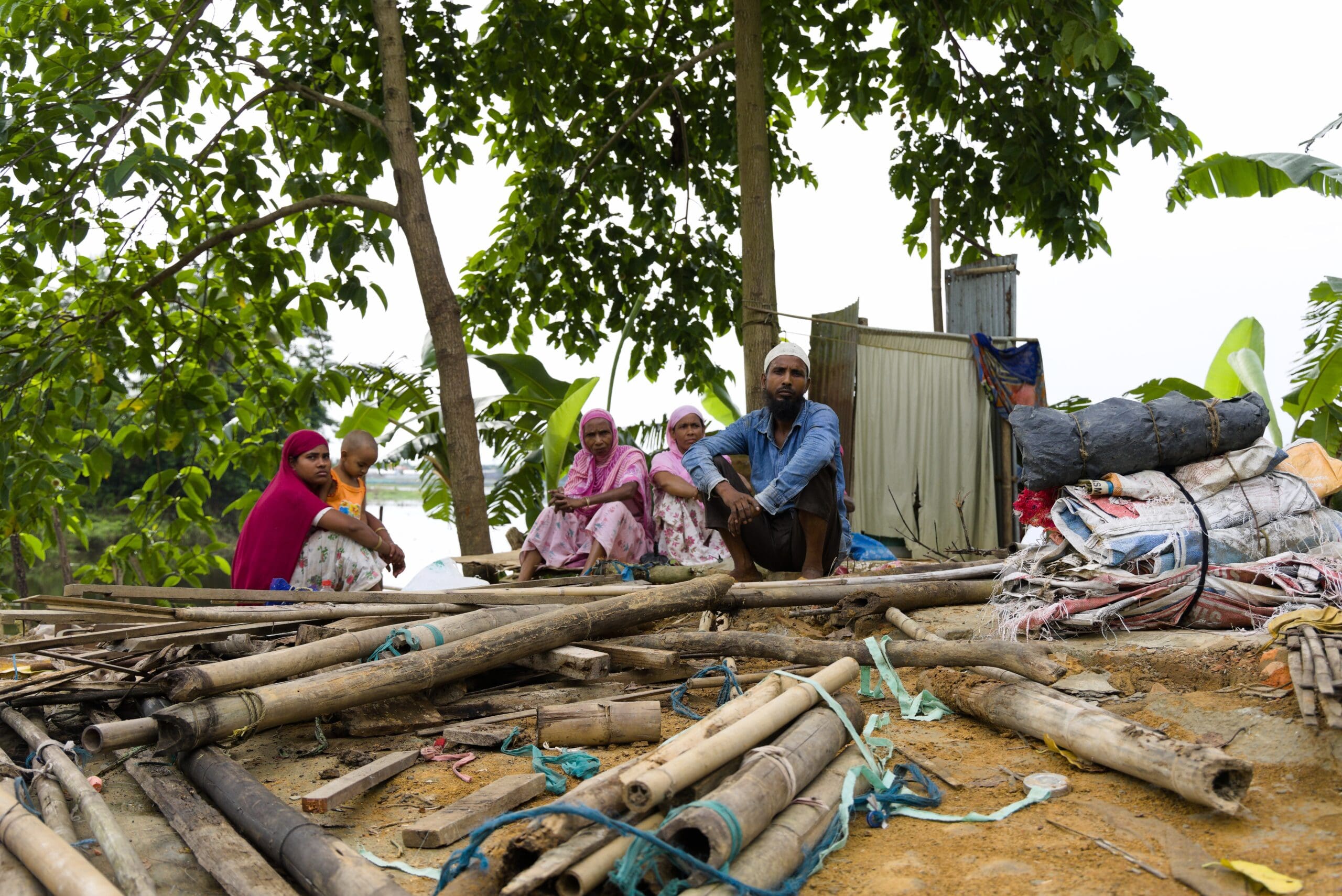
The road from demolition and eviction often leads to the camp. Not perhaps in the designated camps, but in a camp, in one form or another. Eviction is another tool to dispossess the Miya Muslims, as if the cuts and lesions from snatching citizenship were less. The ongoing mass eviction in Assam has to be seen politically, historically and culturally.
Historically, this tool extends the logic of the Line System in Assam—an administrative tool to segregate the immigrants from the local population. It was a tool to enclave and disposesses them. We continue to enclave them—both minds and their bodies. Not just bodies, but minds and bodies as Achille Mbembe reminds us.
Culturally, we have become benumbed to the cuts and lesions visited on the bodies and minds of the accused foreigners with disturbing regularity and impunity. As NRC became inadequate to produce the desired number of excluded, new tools, such as eviction, were manufactured to hurt them. It is one of many such tools. Culturally, the apathy we see toward the migrant figure has made us connoisseurs of the camp. No scandal seems to scandalise us anymore. Not even the idea of the camp. The bigger the scandal, the more astounding the silence and apathy toward it.
Where do we go from this darkness? Where shall we take shelter?
Suraj Gogoi teaches at IIM Kozhikode. He is a political sociologist interested in culture, citizenship, and nationalism. The views expressed in the piece are personal and don’t represent the institution.