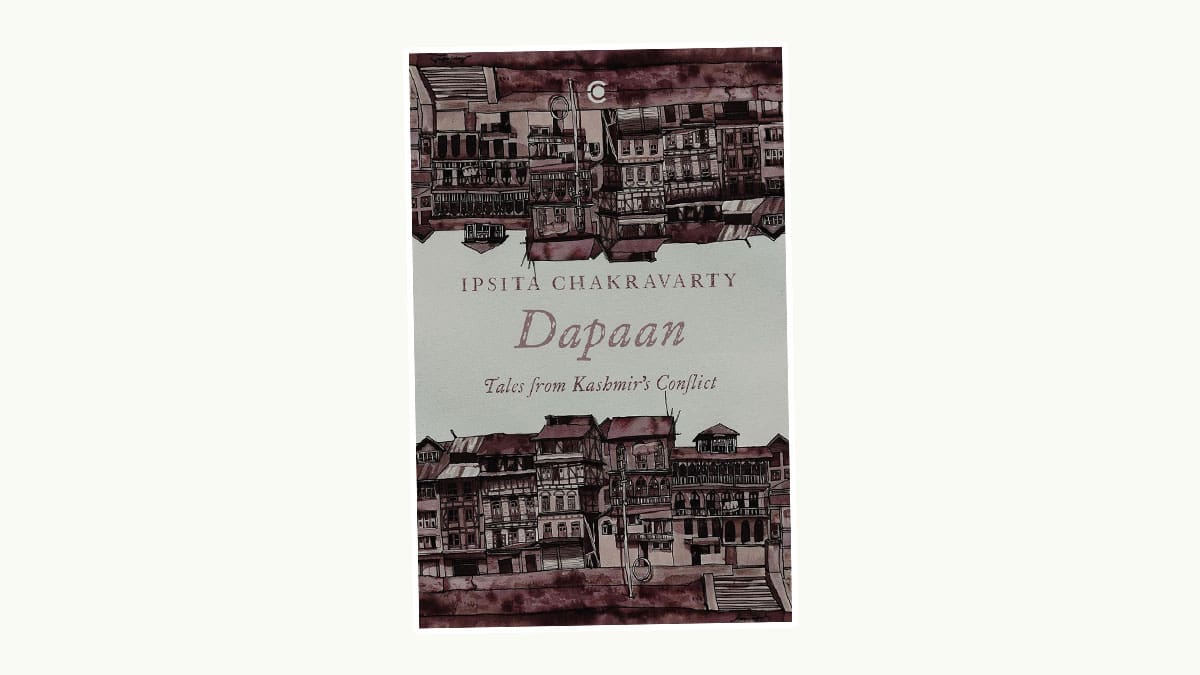
Excerpt from Dapaan: Tales from Kashmir's Conflict by Ipsita Chakravarty

SK woke up one morning to the announcement, ‘Sisterfuckers are saying get out of the house.’ It was Arif Moet, using the loudspeakers of the local mosque. This was downtown Srinagar in the nineties.
SK pieced together what must have happened. The army must have cordoned off the area for a search operation. They were following the usual drill: get someone to announce the crackdown from the local mosque and have all the men in the neighbourhood out in the street before the search begins. Evidently, they had not been able to find the imam or the head of the mohalla committee, someone trusted in the
neighbourhood. Instead, they had chosen Arif Moet for the job. True to his name, Arif Moet had not minced words. For centuries, every village and town in Kashmir has had a moet, a version of the holy fool who is touched with divine madness, who speaks his mind because he cannot tell the difference between truth and civility. Arif Moet was perfectly amiable, but could not tell the difference either. His brother Ahmad was the same. The third brother was a serious man. He had joined the Jammu and Kashmir Liberation Front early on in the tehreek.
SK remembers one of the first crackdowns in downtown Srinagar, sometime in 1990. Men had been forced out of their homes in the morning and ordered to crawl for part of the way. Then they were told to walk with their hands behind their heads and taken to a narrow alley where they were made to line up, facing the wall.
SK and the others stood in silence, wondering what was going to happen next. The silence was broken by Ahmad, who suddenly decided to burst into song. For this impromptu performance, he had chosen ‘Jaago Jaago Subah Hui’, Wake Up, Wake Up, It Is Morning. It was a popular anthem of the Tehreek, often sung during protests or played on mosque speakers. Ahmad, however, was not singing in defiance. He was singing because he felt like it.
The men in the line-up were convinced they were going to die that day. One old man turned to Ahmad’s brother, the JKLF militant, and asked him sorrowfully, ‘What was your mother eating when she had him?’
When the soldiers had forced men out of the house that morning, the JKLF man had taken his chances and joined the line-up. Those were early days and not many people knew he had become a militant. He survived that day, but later on he would be arrested and tortured so badly that he lost his manhood, as SK puts it. A cat must have given him away.
In the dramatis personae of crackdowns—the soldiers who circled the neighbourhood; the officer who barked out orders; the militants trying to blend into the crowd; the men in the parade worrying about wives and children at home; the OGWs, overground workers who secretly helped militants, trying to arrange their faces at neutral—‘cats’ played the most pivotal role. They were the ones who did the watching.
Informers were called cats. The word probably came from a security term imported from counterinsurgency operations in Punjab in the eighties. According to a former police officer in Kashmir, it might have been short for ‘concealed anti-terrorism squad’. Or it might not have been a short form at all. In Punjab, writes one security analyst, counterinsurgency was a ‘cat and mouse game’. Small-time criminals, former militants and militant sympathisers were forced or induced to become police informers and embedded in militant groups; set loose the cat to catch the mice.
The word caught on quickly in Kashmir, entering the new argot of conflict along with crackdown and curfew. In 1993, Greater Kashmir, a local daily, ran a series of articles with the headline, ‘Kashmir—Victim of C’, a potted dictionary of words brought in by the haalaat, all beginning with C, as though that particular letter had malign powers.
The word ‘cats’ may or may not have been handed down by the forces, but once it entered the Kashmiri public, it became a potent phir kath of the time, loaded with meanings that would make no sense to anyone outside. Cats had heritage; cats had history in Kashmir. The spies of the Dogra king might have been decommissioned after 1947, but the continuing battle between this markaz and that, the insurrections within, had made the government watch closely for signs of disaffection.
It is said, Bakshi Ghulam Muhammad consolidated an army of vigilantes who patrolled the streets at night. Having ousted Sheikh Abdullah with some help from Delhi, Bakshi was particularly nervous of dissidents. Apart from old political rivals, the National Conference itself was drained of members who did not approve of the direction taken by the party and who now formed the Plebiscite Front to keep alive the demand for self-determination.
Excerpted with permission from Westland's book Dapaan: Tales from Kashmir's Conflict by Ipsita Chakravarty.