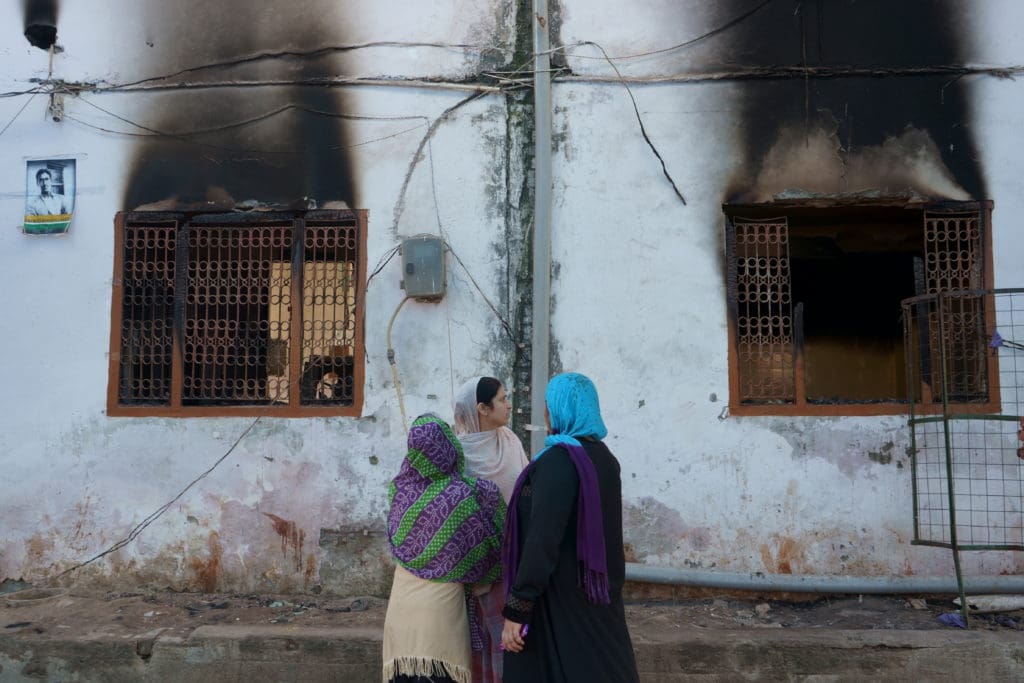
Delhi violence, Delhi riots or Delhi pogrom?

23 February this year will mark six years since large-scale, communally motivated violence claimed more than fifty lives and adversely affected thousands of others in Delhi’s Northeast district. These events brought a premature end to the local chapters of a nationwide protest movement against the Citizenship Amendment Act that had been ongoing for close to three months. The memory of what unfolded in the national capital in February 2020 is still fresh in the minds of those who witnessed or survived it, and the events continue to be discussed in Delhi and beyond as though they occurred only yesterday.
Debates regarding who should be held responsible for the violence in Northeast Delhi are still fiercely raging on both in the courts of law as well as academic and media narratives. A plethora of questions remain unanswered — some by design and others by a lack of serious examination. To this day, there is no consensus on what to call the events that unfolded in Northeast Delhi in February 2020. Some tag it as the Delhi violence, while others tag it as the Delhi riots, and still others, although only a few, argue that the most accurate term to define what happened in northeast Delhi from February 23 to 29 is a ‘pogrom.’
One commonly used label for the happenings in Northeast Delhi is ‘Delhi violence.’ Human Rights Watch, for instance, in its coverage of the incidents, used this term. Violence is an expansive category, capable of encompassing an immense number of actions and phenomena. It is thus not necessarily a defining term but a wider concept within which smaller, better-defined categories of actions that harm a victim(s) can be placed. The term violence, while being overarching, can also sometimes perform the function of blurring the truth if not hiding or erasing it. In cases like Delhi, the use of the inclusive term violence can become a tool for deliberate ambiguity. It has the potential to become a neutralising term. It may hide the nature of what has occurred and may invisibilise the identities of the perpetrators and the victims, which a more specified term may be able to capture.
A more popular term used to describe the violence that occurred in Northeast Delhi is the ‘Delhi riot.’ This is the term used by international media platforms like the BBC and prominent Indian newspapers like The Hindu. ‘Riots’ is a more explanatory, descriptive, and specific term than ‘violence.’ According to American sociologist Charles Tilly, the use of the term ‘riot’ indicates collective action which is marked by popular participation. The contestations that occurred between the anti-CAA protestors and the pro-CAA groups mobilised against them most definitely involved public participation. Stone pelting incidents involving multiple parties of large crowds were very common in the initial phase of the violence.
However, as far as the techniques and motives of mobilisation are concerned, even ‘riots’ is too wide a term. It can mean anything from a pre-political form of protest against the government, as Eric Hobsbawm defines it, to what Paul Brass calls ‘institutionalised forms of collective violence.’ On that count, the use of the term ‘riots’ for the occurrences in Northeast Delhi requires thorough scrutiny. Moreover, the common understanding of the word ‘riot’ suggests a contestation between groups, without accounting for the power differential between them. Most popular definitions of a riot, excluding the one provided by Paul Brass, suggest that riots involve little to no state participation. Thus, four arguments can be made against categorising the Northeast violence as riots based on how they were organised, the identity of the majority of the victims, the involvement of state agencies, and the shoddy nature of the investigations.
Organised nature of the violence
Following visits to the affected area after the February 2020 violence, the chairman of the Delhi Minority Commission alleged that nearly 1500 to 2000 people from outside Delhi were brought into the Northeast district during the violence. CPI(M)’s fact-finding mission said that to mobilise the locals against anti-CAA protestors, rumours were spread via WhatsApp messages and phone calls. These observations point to the possibility that the violence was planned and not spontaneous, as the common usage of the term ‘riot’ implies. In a confession to the media platform Newsclick, one individual described how he and his companions urged people to act against the ‘Muslim reign of terror.’ He recounted meetings in which strategies to inflict the maximum damage to Muslims were discussed. He also stated that Gujjars from neighbouring areas of the city assisted with the distribution and use of firearms.
Additionally, the fact remains that speeches inciting violence and creating fear and panic had been delivered by the leaders of the ruling dispensation regularly in the build-up to the violence. This was recognised by the Delhi High Court when it directed the police to register FIRs with regard to these speeches on February 26. There is thus significant evidence in reports and even in the observation of the courts suggesting that the violence was organised. The extensive use of firearms and explosives further reinforces this claim. It is well reported that one in every three deaths in the Northeast Delhi violence was caused by gunshot wounds.
Deliberate targeting of Muslims
A case was made both by the Delhi Minority Commission Report and the CPI(M) fact-finding report that very little police protection was provided to the Muslim localities, which led to the residents of these areas fending for themselves when they came under attack, leading to clashes. There were numerous complaints by the victims that the police accompanied the mobs when they attacked the anti-CAA protest sites. It was evident that coordinated assaults were launched on residences, businesses and places of worship of the Muslims. The overall losses faced by Muslims in terms of lives and property were also disproportionately greater. On these bases, a conclusion could be drawn that what occurred in Northeast Delhi in February 2020 was not a spontaneous riot, since the majority of the attacks were carefully directed at a group defined by its religious identity.
The BBC similarly reported that not only was there mounting evidence that Muslims were targeted in a planned manner, but there were also numerous well-documented examples showing some police aiding the rioters or simply looking the other way.
Role of the police and administration
Police negligence or complicity is of critical importance to understanding the Northeast Delhi violence. It is the most defining factor that separates a spontaneous riot from an organised pogrom. There are some chilling accounts of the role the Delhi police played in the build-up to the violence, and then during and after it. When it comes to the role of the police and administration, important questions have been raised about their role and conduct during the violence. Firstly, it was reported that the initial attacks at the anti-CAA protest sites were conducted by the police and the mobs together. During confrontations, the police, almost as a rule, sided with the pro-CAA groups. There were also reports of police inaction and complacency.
If one tries to summarise the role played by the security forces in the Northeast violence, the following points stand out. The deployments to stop the violence were delayed. Thousands of distress calls went unanswered. In the instances where the security forces were present, some of them were paralysed by the lack of clear instructions, while some openly sided with the mobs attacking the anti-CAA protest sites and Muslim neighbourhoods. Even instances of firing at unarmed protestors are mentioned in the victims’ complaints. Later, when the victims lodged police complaints, the police allegedly asked the complainants to anonymise the narratives, omit the names of the attackers or to go for a settlement or deliberation without lodging an official complaint, the term used for which was ‘compromise.’ The police also supposedly asked the victims to omit the mention of explosives that were used by the attackers. Later, a remarkable arbitrariness was on display when the Delhi police arrested anti-CAA protestors, blaming them for the violence. Six years later, many anti-CAA activists remain in jail without trial.
Questionable investigations
The Delhi police, in their July 2020 counter affidavit, stated that anti-CAA protests caused communal disharmony in the city. This was in response to pleas by political activists like Brinda Karat and Harsh Mander that demanded, inter alia, that FIRs be lodged against leaders of the BJP for delivering provocative speeches preceding the violence. To pin the blame on the sit-in protests, which used the constitution of the country as its primary insignia, when evidence of hate speech by government-affiliated actors is available in the public domain, is something that raises serious questions about the integrity of the Delhi Police’s investigations in the matter. While the aim of the violence perpetrated on the anti-CAA activists, both by the state and non-state actors, was to put an end to the three-month-long protest movement, the questionable investigations played the part of discrediting the movement itself and disincentivising any such future mobilisation.
There are numerous instances when the judiciary has pulled up the police for the biased, incompetent or shoddy nature of the investigation into the Northeast Delhi violence. In November 2020, the Additional Sessions Court at Karkardooma, while granting bail to anti-CAA activist Khalid Saifi, rebuked Delhi police, calling their chargesheet an example of ‘non-application of the mind which goes to the extent of vindictiveness’. In September 2021, Additional Sessions Judge Vinod Yadav called police investigations into the Northeast Delhi violence ‘callous,’ farcical,’ and ‘absurd,’ and the chargesheets filed by the police ‘half-baked. In 2023, a local court acquitted three Muslim persons, expressing suspicions that the police may have manipulated evidence. There is an abnormally low level of conviction amongst the people arrested for involvement in the Northeast Delhi violence. The lawyers defending the accused say that many of the arrests were made hastily, with a focus on proving the pre-determined narrative that the violence was caused by anti-CAA activists.
More pogrom than riot or violence
The available evidence indicates that the violence that was seen in Northeast Delhi was organised, mainly directed at one religious community, and involved either the collusion or complacency of the police and the administration. In light of these arguments, we can say that the use of the term ‘riots’ to describe the Northeast Delhi violence may not only be inadequate but also misleading. Since there are at least some elements of ‘connivance or participation of authorities’ that give this violence the look of a semi-official riot, ‘pogrom,’ as Donald Horowitz defines it, may be a better term when it comes to defining the 2020 Northeast Delhi violence. Another possibility is to define the early clashes that occurred between two groups as riots that took the form of a ‘pogrom’ later, when state representatives entered the scene and acted in a demonstrably biased manner.
Bilal Ahmad Tantry is a PhD Scholar at Shiv Nadar University