The necrosis of AMU body politic: A romantic alternative
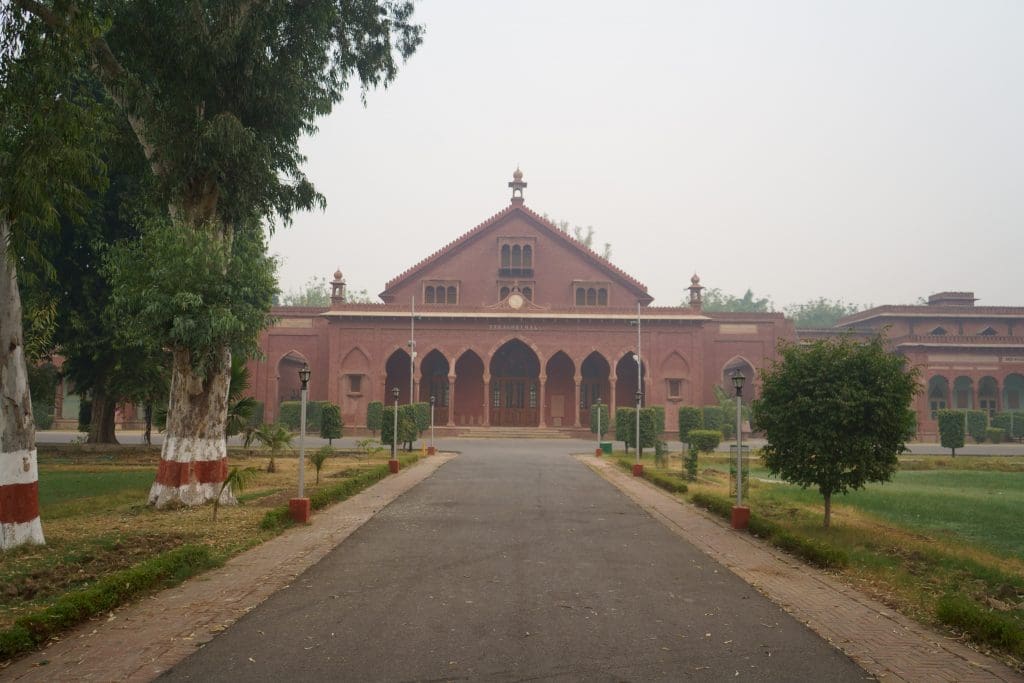
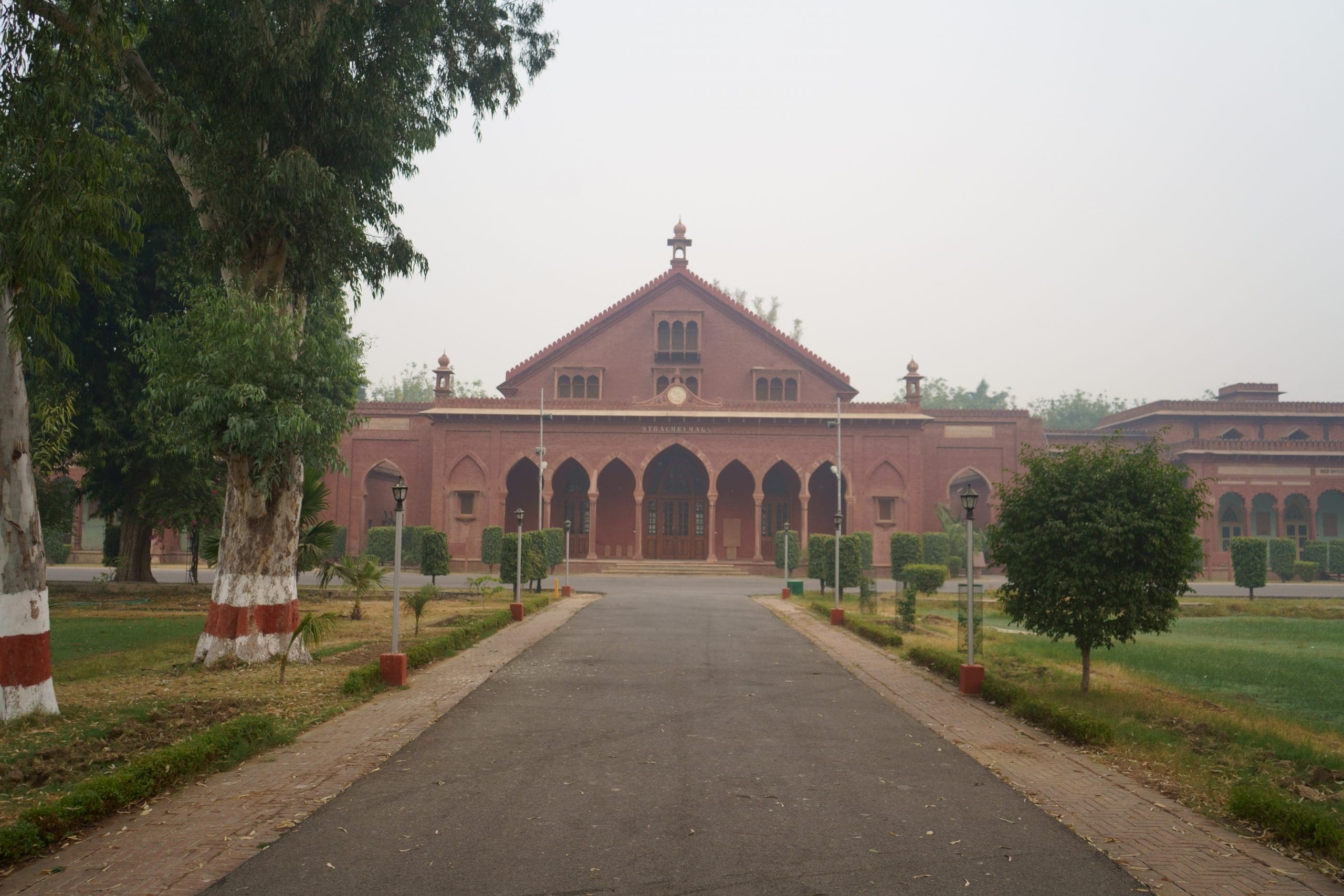
At the outset of late September, on a windy fall evening at the Maulana Azad Library Canteen of Aligarh Muslim University (AMU), conversing with my peers about the shifting threshold of political consciousness on campus—how it revealed itself both at sites of dissent and its impact on everyday student life. Amid our exchange came a bittersweet remark about the quietist acceptance surrounding the statewide protests on the ‘I Love Muhammad’ campaign. Another addition to the conversation, a point was made about campuses like Jamia Millia Islamia (JMI), Maulana Azad National Urdu University (MANUU), University of Hyderabad (UoH), etc., which have managed to sustain an irrepressible spirit of demonstration on subjects like Palestine even under the administration’s curbing. Upon reflecting on the challenges posed by the AMU administration, one cannot help but sense a perplexing entanglement—a tussle between two forces: on one hand, the incremental impact of right-wing authoritarianism enveloping the minority central universities, and on the other, a sweeping apolitical wave that numbs the fabric of dissent and deliberation.
Even the current discourse surrounding AMU's contemporary socio-political landscape tends to focus on a few aspects of campus dissent or inherent contradictions expressed through opinionated debates and surface reports. There are a few theoretical frameworks that are available to navigate the virtue of social collectivity during these disassociative times—much like a vessel adrift on uncertain tides without a compass—within the student community, a microcosm of civil society. The deliberative agency among students remains underutilised as a counterbalance to administrative lapses. And, in my supposition, the reinstatement of a cohesive body politique/politic could further restore the balance of influence, putting administrative practices at par with the student sphere.
Outlining the body politic of the campus
The metaphor of the body politic held a descriptive status in the medieval era, serving as an analogy to the human body, which was considered organic and living in nature. It differed in essence from the modern mechanistic view of political order, which centres on legal frameworks as the foundation for regulating society—a realm where order precedes deliberation. Some facets of the organic perspective place primacy on the social domain as a fundamental driving force, envisioning the political body as a living entity sustained by a social fabric.
In essence, universities have their own unique social sphere where students' consciousness sustains a juncture for thriving deliberation. But for consciousness to thrive effectively, it requires political momentum, charged forward through student bodies (formal and informal), to effectively push narratives both within and outside the walls of the universities.
Notably, AMU underwent a turbulent transition with the dissolution of Aligarh Muslim University Students Union (AMUSU) at the end of the last decade, the chaotic events surrounding the CAA-NRC protests, and finally, the sterile conditions caused by COVID-19. The element of social collectivity among students witnessed a stretched lapse, causing the student sphere to become a nominal extension of politics, and not something as a binding force of political consciousness. In effect, the administrative hold managed to dissolve its fundamental obligations towards the student body in the absence of any checks and balances from the student sphere.
Upon his visit, in March 1940, Muhammad Ali Jinnah addressed the crowd at the Aligarh Muslim University. Jinnah, making a case for a desirable shift vis-à-vis the attitude of the Muslim populace, underlined the foundational difference between two images of the Indian Muslim community: a helpless minority and a conscious political force. In his address, he remarkably accounts for the pivotal status of the university across the nation with this quote, where he claims, “What Aligarh thinks today, Muslim India will think tomorrow.” (M.A. Dyan, ‘Whither Aligarh?’, The Muslim University Gazette, 1 November 1940). Jinnah’s quote highlighted the esteemed attribution of the AMU as a body politic which carried and continues to hold the potential for moving the consciousness of the Muslims across the nation. Extending the discussion on the body politic, the head aptly marks the consciousness of society—in this case, the student consciousness—which is expected to effectively articulate the community’s welfare and advocate for its fair share.
The consciousness becomes crucial in observing the social, economic and the political relevance of the body politic in respect to the community. In essence, the rhetorical motto of the university, ‘enter to learn and depart to serve’ directs an invitation for the students to condition their intellect through the teachings imbued with strategic relevance. And also, to meet the economic challenges of their time, while at the same time inculcating student consciousness to register the community’s presence in the national imagery of politics.
Negotiating representation and civility through consciousness
To replicate the metaphor of the body politic, the attribution of limbs and joints appears to coincide with the functions of judgment and accord. As earlier implied by Hobbes—an absolutist—and Rousseau—a populist—at first, the overlap exists on the subject of creating a conscious will (Rousseau) and a covenant (Hobbes). Theoretically, the primary stage of action necessitates the enlightenment of social consciousness at first, within the body politic under a mutual social agreement. Be that as it may, the significance of ‘people coming together’ remains a priority to materialise any further action within the discourse of a body politic. A kind of praxis where the articulation of social consciousness turns into a coherent exercise with the effect of collective action—a mutually reinforcing commitment within the student sphere, voicing concern and demands of the community.
During an address to the Aligarh Muslim University Students Union (AMUSU), Minister of State for Defence Moharir Tyagi confirmed concerns previously expressed by Prime Minister Jawaharlal Nehru and Sheikh Abdullah regarding the declining representation of Muslims in the armed forces. The student union’s role perpetuated a living consciousness to gauge the condition of Muslim representation—a move to ensure stakeholding in the national imagery.
Moreover, the body politic is not limited to serving as a channel for representation to achieve numerical recognition; it also serves the civic responsibility to maintain social harmony by negotiating differences and conflicts, persuading peacefulness. On a more committed tone of preserving social harmony—a motif to sustain any body politic, the participation of AMUSU in the 1978 violence in Aligarh demonstrated a wider dedication to maintaining the university as a space for dialogue and peaceful coexistence. Mohammad Furkan, a notable student leader at Aligarh Muslim University, gained recognition in the late 1970s while serving as vice-president and then president of the AMU Students Union played an instrumental role, supporting initiatives to re-establish academic order and communal peace.
Thus, historically, the AMUSU served as a civic platform that facilitated community representation, establishing the political relevance of its leadership and enabling participation in national stakeholder processes, influencing state elections, fostering leadership development, and more.
Immanent necrosis of consciousness
In 1988, the Students’ Union of Aligarh Muslim University, led by Sarwar Husain, expressed a shared concern about the declining spirit of campus life. In his speech to the students, Husain lamented that the ‘institution of seniority’—which had been regarded as a fundamental part of AMU’s traditions—had, in his view, turned into ‘a dead body’. Reflecting on the metaphor of a dead body or corpse, it can be inferred that the invocation of seniority as a vital fabric of the institution does not merely represent tokenism of aesthetics (limited to dress codes or general mannerism) but signifies the passing down of political ideals that bind the student consciousness to strengthen a living body politic.
In biological terms, necrosis refers to the death of body tissue. When the cells within your tissues die, it can affect various parts of your body. Applying the same organic logic, the body politic consists of different parts. In my argument outlined earlier, I have prioritised the role of the head in the guise of students’ political consciousness. The necrosis has taken place over the decades, eroding the political corpus, succumbing to the consciousness which appears to be caused by misreading the history of campus politics.
The romantic plunging of the past apparently becomes a defence against student consciousness emerging under a reading of history that is conformist to community consciousness (qaumi-shaʿoor) but clearly detached from the contemporary discourse of political crisis.
In ‘Between Nation and Community, Laurence Gautier gave an account of the Students’ Union vice-president, who in his Union address, Meerajuddin Ahmad, characterised Aligarh Muslim University as the “Red Fort of culture” and the “Taj Mahal of civilisation (tamaddun),” bearing the legacy of Mughal heritage and its romantic projection on the Muslim civilisation in the subcontinent.
Johann Wolfgang von Goethe’s critique of romanticism stands as one of the compelling expressions in world literature. For Goethe, the projection of history under a romantic light could possibly breed a speculative detachment caused by a longing for the past. A point of resonance where the past and the present don’t appear to be directly in contact but bridged upon something (a drift from reality of affairs), which is the opposite of reality (‘what is natural’), can ultimately lead to dissonance.
The ornamental use of Mughal establishment metaphors obscures the student consciousness from meeting the currents of contemporary political crises. Notably, the conformist reading of history leads to an epistemic mismatch of two starkly different ethos (living conditions of Muslims under the Mughal rule and under the current regime). The sickness of romanticism pervades the discourse of the campus body politic, insinuating necrosis at the core in the form of ill-equipped passive rhetorics—a sort of entitled ideological comfort vested within history.
Glancing at the compatriots
The ideological weightage within AMU possesses significant potential, with an observable conscious Muslim solicitude that thrives on student political consciousness. However, it fails to make a substantial impact in the current political landscape. Possibly due to the absence of a coherent course of activism, deterred by an ideological atrophy hindering the progression of student discourse in praxis. In contrast, students at JMI have been managing diverse political interests despite the absence of a student union since 2003. Their efforts, driven by various ideological motivations, have resulted in political actions through organisations such as AISA, DISHA, and NSUI.
In the fabric of political consciousness, students have managed to penetrate the majoritarian narrative on several instances, challenging the status quo and apathy of minorities. Although ideological domains within JMI are diverse and multifaceted, the common denominator upon which the course of actions aligns with the general student will, in combination with the praxis of campus politics. It helps to broaden the scope of activism and promotes inclusivity of approaches and the idea of student unity resisting atrophy of ideas, while facing imminent threat from the repressive means of the state every other day.
Clearly, the comparative account of AMU and JMI and their respective praxis of politics outlines the idea of a thriving political consciousness imbued within students, sustaining a print of body politic during the absence of a student union in both universities.
At JMI, the variance in ideologies of student political bodies plays a key role in sensitising and prioritising the collective student will—a remarkable feat, majorly indebted to the methods of protest and demonstration that follow a course of student activism at regular intervals, which keeps the political consciousness intact within the campus.
Observing the same pitch on student activism, the recent developments at Maulana Azad National Urdu University (MANUU) against the state government's decision to acquire university land intended for academic expansion exemplify the role of student consciousness. In 2024, MANUU students led a cohort to restore the student union, bidding for new elections against the university administration. Simultaneously, there has been a determined push to mark the student sphere as a moving force of consciousness, contesting state narratives through strategic persuasions in the public/political domain to meet their demands.
In contrast, while AMU possesses a weighted ideological force, it remains short of a sustained approach to political sensitisation in a constant tone, displaying only sporadic occurrences of dissent. Also, the negligible amount of ideological friction (not to be confused with the friction of agendas) could possibly have contributed to the political sterility within the student sphere, providing fewer avenues for praxis. Dissent (of a mass appeal nature) prone to individualistic performance is hardly of any impact, causing it to dilute or dissolve on account of a few in the form of spectacle.
As a result, the required political current on campus becomes hard to regulate; either it will become static with quiet acceptance, observing symbols of dissent at null, or it will turn out to be intensely polarised (a few-men show), shifting the discourse from the whims of a few individuals, which may or may not align with the general appeal.
The concept of agency must be acknowledged within each individual involved to critically introspect their actions during such times of a political crisis on campus. It is important to highlight how the closely knitted student body could potentially influence the administration (referring to the union protests in 2010) in its favour through deliberation and an imperative for strategic persuasion. Rather than placing blind faith in administrative practices, the principles of accountability and transparency should be integrated into every possible effort. The student sphere must be instilled with the understanding that the order the administration seeks to impose is neither democratic nor aligned with the ideals of student will.
Ariz Hasan Usmani is a student of M.A Social Exclusion and Inclusive Policy at Jamia Millia Islamia.