Politics of pleasure: Muslim “enjoyment” in the times of Hindutva
Ahnas Muhammed & Samra Iqbal
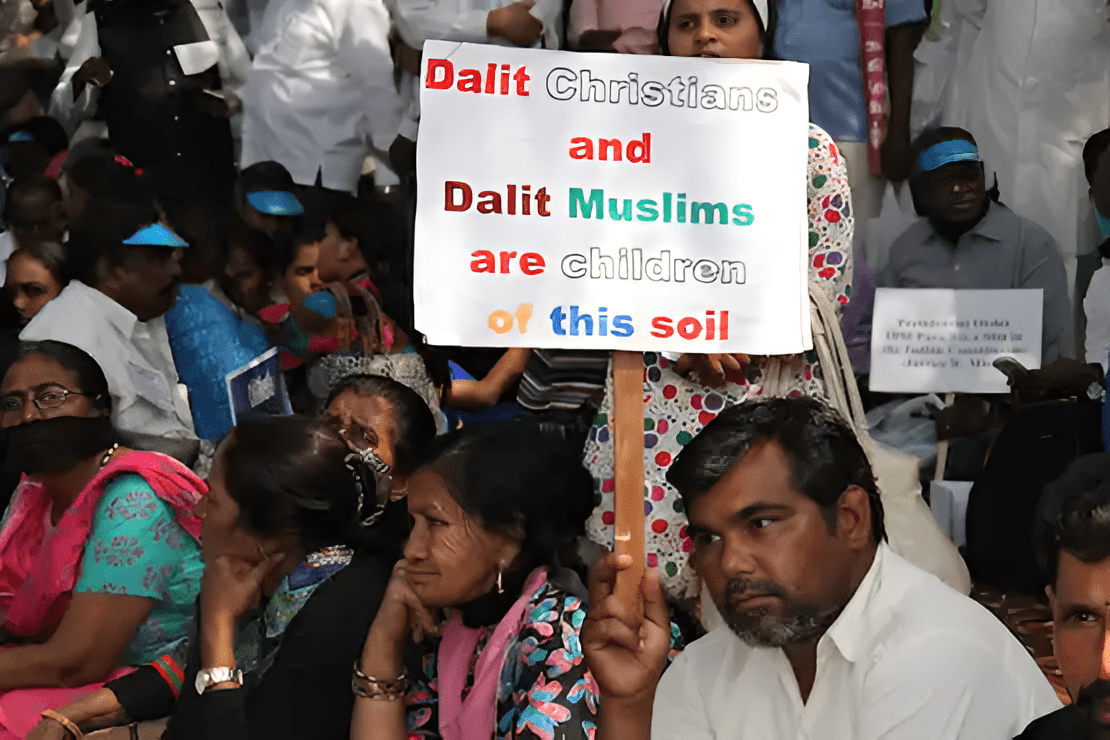
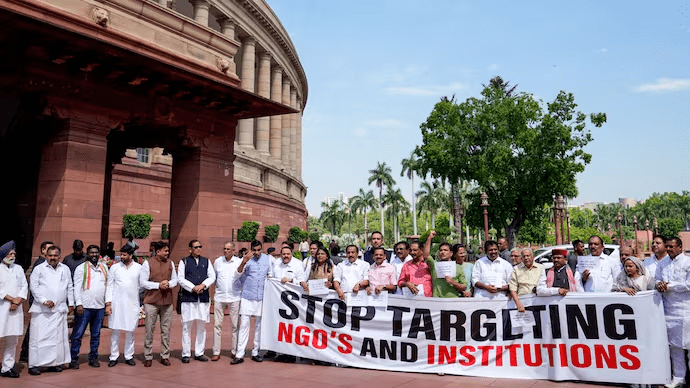
The recent shutdown of the Sri MataVaishno Devi Medical Institute in Kashmir, after demands were made by the far-right Hindutva groups due to the overwhelming number of Muslims enrolled in its prestigious course, points towards a disturbing trend. Over the years, public discourse in India has witnessed an extraordinary inflation of the term jihad. No longer confined to accusations of “love jihad,” the term now proliferates across everyday domains: land jihad, population jihad, hotel jihad, education or marks jihad and even thook jihad. Almost any instance of Muslim presence, mobility, or success is reframed as part of a covert and coordinated conspiracy. Each term marks a site where Muslim presence is reinterpreted as enjoyment that has crossed a threshold—from acceptable existence to intolerable excess.
Yet the force of these narratives cannot be fully understood if they are read only through the register of security, legality, or demographic threat; it is necessary to look beyond the language of threat and conspiracy to the affective logics that organise them. One of the fundamental characteristics of any nationalist discourse is the binary that separates the righteous Self from the dangerous, unworthy Other. And while these narratives are animated by invocations (of the vocabulary) of violence, threat, law breaking, and so on, often there is a key aspect that is elusive, overlooked, and interestingly, upon which the chunk of the discourse circumvents: enjoyment. Who is enjoying the country ‘properly’, and who is enjoying it too much? Who appears to take pleasure in spaces, relationships, opportunities, or futures that are imagined as not rightfully theirs? These questions may not always be explicitly articulated as such, but they animate much of the contemporary political imagination around Muslims in India.
The recent study done by the Centre for the Study of Organised Hate has revealed that the highest number (656) of instances of hate speech fall under the category of “conspiracy theories” of jihad. This account has also given birth to the rhetoric of “teen bacche, hindu sacche” (three kids, Hindus are the true ones), which has been increasingly used by religious leaders, fringe elements and even politicians.
To understand this dynamic, it is useful to turn to the psychoanalytic concept of jouissance, often translated as pleasure or enjoyment, though inadequately so. In Lacanian psychoanalysis, jouissance refers not to simple happiness or satisfaction, but to a form of pleasure that exceeds moderation, that spills beyond what is socially sanctioned. It is excessive, opaque, and transgressive. Crucially, jouissance is never just individual; it is always socially mediated, structured by language, fantasy, and law. And because jouissance is never directly accessible or fully possessed, subjects come to relate to it through fantasies (Lacan 1966). In this case, the fantasy of Hindutva. Fantasy functions as a structuring screen that organises desire, giving form to how enjoyment is imagined, pursued, and attributed.
When such fantasies acquire a collective form, jouissance or enjoyment becomes politically charged. Desire is no longer negotiated solely at the level of the individual psyche but is organised through shared political imaginaries. In this context, Hindutva operates as a phantasmatic political fantasy that structures desire and belonging. The surplus enjoyment it promises is accessed through participation in its rituals, affects, and practices—acts that both sustain and reproduce the fantasy itself. Enjoyment here is constitutive, where compatriots “enjoy” by inhabiting the fantasy and by enacting its symbolic and material goals.
Consider the recent controversy around Aurangzeb’s tomb in Maharashtra, as well as many incidents of the destruction of mazaars by Hindutva outfits. The outrage is not merely about historical grievances or accounts of cruelty. What is at stake is the intolerable idea that a Muslim Other, symbolically constructed as tyrannical and anti-Hindu, still enjoys the land, even in death. The tomb becomes a metonym of improper enjoyment, a sign of symbolic permanence that the Hindutva discourse cannot fully disavow. His burial in the so-called Punyabhumi (Holy Land) represents an enduring jouissance that taints the imagined purity of the nation. The land is not only being occupied, but enjoyed by the Other, and this is what fuels the desire to erase, rename, or reclaim. The rhetoric of “bulldozer justice” also works on a similar principle—to bulldoze the properties and the Right to Life of those who illegally enjoy, often cited in popular vocabulary as “infiltrators” (minorities).
The same structure animates contemporary anxieties around education. When Muslim students succeed in competitive examinations, gain admission to elite institutions, or become visible in professional spaces, their success is rarely read as individual merit. Instead, it is reframed as marks jihad or education jihad or even UPSC jihad. Here again, the issue is not numerical dominance alone but the fantasy of enjoyment: Muslims are imagined to be enjoying state resources, institutional prestige, and social mobility “too much,” and crucially, at the expense of the majority. The outrage is compounded when these numbers start to qualify for visibility in public spaces; the unbearable spectacle of Muslim enjoyment in a space coded as prestigious and national.
In yet another recent incident, Riddhima Sharma, a Hindutva activist, posted a reel on her Instagram, where she hurled abuses at a Muslim shopkeeper named Hussain at a temple in Gogamedi, Rajasthan. In a deeply enraged way, she can be seen shouting at the shopkeeper, asking him, “What’s the use of a Muslim in a temple?” She further added, “It's the nature of the Muslims to destroy our idols and then eat out of (the earnings) of our temples.” This incident yet again points to a disturbing trend where the Muslim body politic is alleged to be living and enjoying something that “belongs” to the Hindus of the nation.
It is hence how the question of enjoyment of belonging occurs—who is imagined to enjoy the nation that is not rightfully theirs? In xenophobic imaginaries, the figure of the Other is not only feared for what they might do, but resented for what they are imagined to enjoy. As Žižek argues, different communities are experienced as incompatible not because of competing beliefs alone, but because their modes of jouissance appear irreconcilable. This incompatibility generates jealousy: the fantasy that the Other has access to a surplus enjoyment from which “we” are excluded.
This does not operate at the level of facts. It operates at the level of affect. That is why these conversations are so resistant to factual correction. Even if/when demographic data disproves claims of population takeover, or when admission statistics show compliance with merit-based criteria, the anxiety persists. The repetition of speech acts—chants, slogans, headlines, WhatsApp forwards—does not inform so much as it saturates. Each utterance reinforces the sense that something obscene is happening just out of sight.
To understand this is to recognise that the current moment cannot be addressed solely through counter-factuals or liberal appeals to tolerance. The problem is not ignorance; it is fantasy and the reorganisations of desire that circumvent jouissance or simply enjoyment.
“What then is the factor that renders different cultures incompatible, what is the obstacle that prevents their harmonious coexistence? The psychoanalytic answer is: the different modes of jouissance are incongruous with each other. Such a constellation cannot help but give rise to jealousy. In jealousy, the subject creates or imagines a Paradise, a utopia full of jouissance from which he is excluded. The same definition applies to what we can call political jealousy”(Zizek 2008, 667).
This jealousy over enjoyment sits at the core of Hindutva’s xenophobic imaginaries. The Muslim Other is repeatedly fantasised as deriving improper enjoyment from the nation, its land, and its properties. Culturally marked practices, rituals, and even public visibility become the site of suspicion and political jealousy. The new stream of calls to boycott Muslims shops also comes with this suspicion embedded in the denial of “our” resources and money to “them,” the Muslims and other minorities.
It is in this context that the discourse of jihad must be understood. Take love jihad for instance—the Muslim man is not only accused of seducing Hindu women; he is imagined as stealing enjoyment itself—sexual enjoyment, reproductive futurity, and symbolic continuity. The woman becomes a stand-in for the nation or the property of the nation (from a patriarchal hyper-masculine perspective), and the sexual relation becomes a scene where the Other is imagined to access what is most intimate and most guarded. This becomes the part of a broader libidinal economy in which Muslim enjoyment is continuously mapped, multiplied, and named. Sexual enjoyment becomes reproductive enjoyment; reproductive enjoyment becomes demographic conquest; demographic anxiety mutates into anxieties about land, education, institutional capture, and many more.
The question, then, is not only who belongs to the nation, but who is permitted to enjoy it, and on what terms. Until this question is confronted, the multiplication of jihads will continue, each naming a new site where the Muslim is imagined to enjoy too much, and therefore to threaten the fragile pleasures of the nationalist self.
Ahnas Muhammed is an independent researcher and currently a Young India Fellow at Ashoka University. He completed his Master’s degree in Society and Culture at IIT Gandhinagar and holds a B.A. (Hons.) in English from Hindu College, University of Delhi. His research brings psychoanalysis into conversation with anthropology to explore questions of populism, affect, and subjectivities in contemporary India.
Samra Iqbal is currently a Young India Fellow at Ashoka University. She recently completed her undergraduate studies in English literature from St. Stephen’s College, Delhi University. She is also a freelance journalist and has previously covered stories for The Frontline, The Quint and Maktoob Media.
Works referred:
- Lacan, J. (1977). Écrits: A selection (A. Sheridan, Trans.). W. W. Norton & Company. (Original work published 1966)
- Žižek, S. (2008). Tolerance as an ideological category. Critical Inquiry, 34(4), 660–682.