Refeudalizing reason: Habermas's journey from critique to complicity

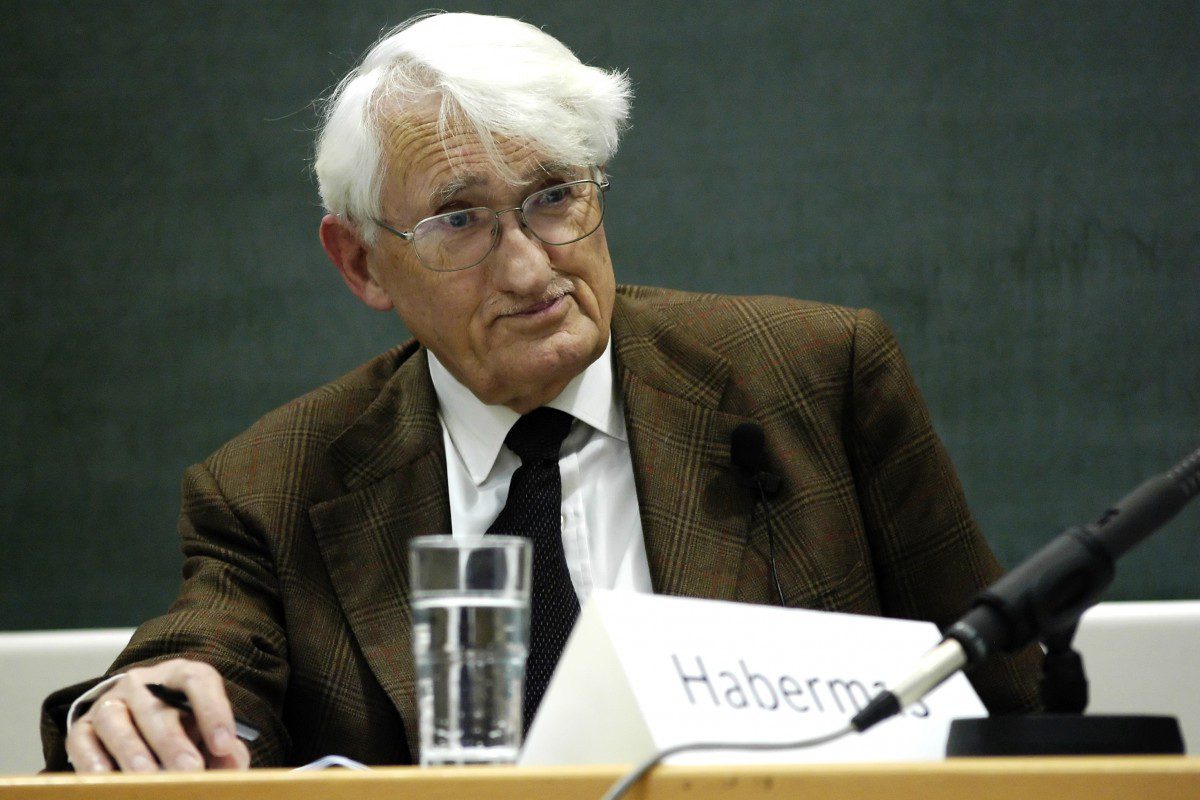
Jürgen Habermas is dead. The most influential representative of the Frankfurt School's second generation passed away on 14 March in Starnberg, Bavaria, at the age of 96, leaving behind one of the most towering, and, ultimately, most contradictory, intellectual legacies of the twentieth century. German President Frank-Walter Steinmeier declared that the country had lost "a great Enlightenment thinker." Chancellor Friedrich Merz said his "analytical acuity shaped democratic discourse far beyond the borders of our country."
The eulogies have been predictably fulsome. They are not entirely wrong. But they are conspicuously incomplete.
To assess Habermas honestly is to reckon with a career of extraordinary intellectual ambition that, over time, narrowed into an apologia for the very liberal order his early work had promised to critique. And to assess his final years is to confront something more troubling still: a philosopher of communicative reason who, when reason was most urgently needed, chose silence on some questions and dangerous partisanship on others. The trajectory from the radical young thinker of The Structural Transformation of the Public Sphere (1962) to the co-author of the notorious "Principles of Solidarity" statement on Gaza (2023) is not merely a story of intellectual aging. It is a story of philosophical self-betrayal.
Habermas arrived at the Frankfurt School as an assistant to Theodor Adorno in the 1950s, and his early work bore the unmistakable imprint of critical theory's Marxist inheritance. His 1962 habilitation thesis, published as Strukturwandel der Öffentlichkeit (The Structural Transformation of the Public Sphere), was a work of genuine radicalism. Drawing on historical sociology, Habermas traced the emergence of a bourgeois public sphere in the eighteenth century, coffeehouses, literary salons, periodicals, as a space in which private individuals could come together to reason critically about public affairs, holding state power to rational account.
Crucially, Habermas was not merely celebrating this development. He was diagnosing its structural decay. Under the pressures of advanced capitalism, he argued, the public sphere had been progressively colonised. The culture industry had converted critical citizens into passive consumers. Public opinion, rather than emerging from open deliberation, was manufactured by mass media and commercial interests. What had begun as a space of democratic reason had become a space of what he called "refeudalization,” a simulated public life serving the legitimation needs of corporate capitalism.
This was heady, politically charged analysis. It drew on Marx's critique of ideology, on Adorno and Horkheimer's account of the culture industry, and on Weber's theory of rationalisation. It positioned the intellectual as an unmasker of the false consciousness generated by capitalist modernity. It was the work of a thinker who had not yet made his peace with liberalism.
His subsequent intervention in German politics was equally combative. In the Historikerstreit, the historians' controversy of 1986–1987, Habermas intervened sharply against conservative historians like Ernst Nolte and Andreas Hillgruber, accusing them of tendencies toward historicization and apologetics that risked detaching Nazi crimes from the core of German history. Habermas saw this as an ideological manoeuvre aimed at rehabilitating German nationalism and excusing the right from confronting the singularity of Nazi atrocity. His intervention was urgent, principled, and polemically effective. It earned him lasting prestige as a guardian of historical conscience and democratic anti-fascism.
This was Habermas at his best: using philosophical resources to intervene in live political stakes, defending the integrity of democratic memory against revanchist nationalism. But even as this political reputation consolidated, Habermas's theoretical work was undergoing a significant transformation.
His magnum opus, The Theory of Communicative Action (1981), represented both an extraordinary intellectual achievement and the beginning of a fateful pivot. Where the early Frankfurt School had maintained a darkly negative stance toward modernity, epitomised in Adorno and Horkheimer's Dialectic of Enlightenment, Habermas sought to rescue the Enlightenment project by reconstructing it on the foundation of language and intersubjective communication.
The Theory of Communicative Action had, in important respects, domesticated critical theory, converting a critique of capitalism into a defence of communicative liberalism.
This tendency crystallised in his doctrine of Verfassungspatriotismus, constitutional patriotism. Developed through the 1980s and especially through Between Facts and Norms (1992), constitutional patriotism proposed that citizens of modern democratic states should ground their collective identity not in ethnic nationality or cultural particularity but in shared attachment to the universal principles embedded in constitutional law: human rights, the rule of law, and democratic procedure. The concept had genuine appeal as a response to ethnic nationalism and was explicitly developed against the backdrop of German guilt over Nazism. Habermas envisaged it, too, as the normative foundation for a post-national European polity.
But constitutional patriotism attracted serious criticism from multiple directions. From communitarians like Michael Walzer and Charles Taylor, the objection was that it was too thin, that democratic solidarity cannot be sustained by abstract principles alone, that identity needs thicker cultural roots. From the left, the critique was more structural: constitutional patriotism, for all its universalist rhetoric, was a specifically European, indeed, specifically German, resolution of a specifically European problem. It assumed a settled liberal-democratic institutional framework, leaving unanswered what emancipatory resources it offered to those outside or beneath that framework: the colonised, the economically marginal, the structurally excluded.
Most pointedly, critics like Nancy Fraser, in her landmark exchange with Habermas, argued that deliberative democracy, however idealised, systematically disadvantaged those whose claims could not be articulated in the recognised codes of rational-critical discourse. Fraser's distinction between recognition and redistribution pointed to something Habermas's framework resisted: the irreducibly material dimensions of injustice that procedural communication cannot resolve.
A politics oriented solely toward better discourse, toward more inclusive speech situations, risks becoming, in practice if not in theory, a politics of legitimation for existing capitalist institutions. This was the Habermasian blind spot that would prove politically consequential: the systematic marginalisation of class conflict and material redistribution as categories of political analysis and emancipatory practice. If Habermas's embrace of constitutional liberalism cast a long theoretical shadow over his middle career, it was his November 2023 statement on Gaza that transformed shadow into scandal.
On November 13, 2023, five weeks after Hamas's attack (Toofan al-Aqsa) on Israel and in the midst of Israel's devastating military campaign in Gaza, Habermas co-authored a statement, "Principles of Solidarity,” alongside three Frankfurt University colleagues: Nicole Deitelhoff, Rainer Forst, and Klaus Günther. The statement condemned rising antisemitism in Germany, affirmed Israel's right to exist, and, crucially, declared that Israel's military retaliation was "justified in principle." It explicitly rejected the application of the word "genocide" to Israel's actions, arguing that "the standards of judgement slip completely when genocidal intentions are attributed to Israel's actions."
The response from across the global philosophical and critical theory community was swift and devastating.
Iranian sociologist Asef Bayat, in an open letter published by New Lines Magazine, mounted what was described as an "immanent critique,” a demonstration that Habermas had contradicted his own foundational principles. Where was the public sphere, Bayat asked, when critics of Israeli policy in Germany were being silenced, their protests banned, their academic positions threatened? A "hidden sphere" was emerging in democratic Germany, citizens privately holding views radically at odds with officially sanctioned discourse, unable to express them for fear of reprisal. This was precisely the refeudalization of the public sphere that the young Habermas had analysed in 1962.
More damning still: the statement was entirely silent on Palestine's existence as an occupied territory. There was no acknowledgement of the occupation, no mention of Gaza as what critics widely describe as an open-air prison, and no recognition of decades of structural dispossession. It condemned Hamas's resistance but was silent on what numerous legal scholars, including those at the International Court of Justice, were characterising as systematic violations of international humanitarian law. As philosophers and critical theorists at the New School for Social Research and elsewhere wrote in a counter-statement: "The statement's concern for human dignity is not adequately extended to Palestinian civilians in Gaza who are facing death and destruction. Solidarity means that the principle of human dignity must apply to all people."
Scholars writing in Middle East Critique made the structural argument explicit: the statement's Eurocentrism was not an aberration from Habermas's philosophy but a symptom of it. His concept of the public sphere had been built, from the beginning, on the history of the European bourgeoisie, a history inseparable from colonialism. His universalism, critics argued, was a universalism "to all" rather than "from all,” an imposition of European normative frameworks rather than a genuine openness to diverse traditions of reason and critique. As sociologist Irfan Ahmad argued in Teaching in Higher Education, this made Habermas not a philosopher of universalism but what Ahmad called an "ethnic thinker,” one whose critical apparatus was structurally calibrated to European experience and European guilt.
The philosopher Hamid Dabashi, writing in Middle East Eye, was less charitable: he argued that the Gaza moment had not revealed a contradiction in Habermas but had clarified a consistency. Habermas had, in his view, always been "entirely consistent with the incurable tribalism of his philosophical pedigree, which had falsely assumed a universal posture."
Whether one accepts Dabashi's harsher reading or Bayat's more generous "Habermas versus Habermas" framing, the philosophical damage was real.
A thinker who had spent decades elaborating the ideal speech situation, a thought experiment in which communication is free from domination, in which only the "unforced force of the better argument" prevails, had issued a statement that, far from exemplifying communicative rationality, actively silenced Palestinian voices and legitimised the suppression of critical discourse in Germany. The gap between theory and practice had become an abyss.
This is not to erase what Habermas genuinely contributed. His reconstruction of critical theory rescued it from the cul-de-sac of Adorno's negative dialectics. His theory of communicative action opened productive research programmes in sociology, political science, and the philosophy of law. His interventions in the Historikerstreit were historically important. His critique of postmodernism kept open the possibility of rational discourse against those who would abandon it. And his anti-fascism, whatever its ultimate limitations, was sustained and genuine over decades of German political life.
But a philosopher must ultimately be judged by the coherence between their theoretical commitments and their practical interventions. And on that measure, the late Habermas failed the test that history set him. He helped theorise the conditions of democratic discourse, then contributed to its restriction. He elaborated a universalist ethics of human dignity, then applied it selectively. He built a philosophical system oriented toward emancipation, then aligned it with the interests of an occupying power.
The tragedy is not that Habermas was inconsistent. All thinkers are. The tragedy is the scale of the inconsistency, measured not in academic points but in the lives of tens of thousands of people whose suffering he declined to name, whose humanity his philosophy could not accommodate.
Jürgen Habermas deserves to be remembered as a major intellectual of the twentieth century. He also deserves to be remembered honestly: as a thinker whose work contained profound emancipatory resources that his own later life revealed he was unable to fully inhabit. His early radicalism was real. His anti-fascism was genuine. But his final years demonstrated, with painful clarity, that even the most sophisticated liberal philosophy can become complicit in exactly the forms of exclusion and domination it claims to oppose, when the excluded and dominated are sufficiently distant from the European tradition in which that philosophy was formed.
That is not a footnote to his legacy. It is its defining contradiction.
Hamid TP is a Research Fellow at Al Jamia Al Islamiya (Al Jamia Research Fellow – ARF) and serves as the Editor of the Campus Alive publications.