The Vishwaguru’s bargain: India sends billions, America sends Indians packing

While Frisco, Texas residents demand Indians “go back to your country,” India’s Reliance Industries is backing one of the largest industrial investments proposed in the United States in decades. Prime Minister Narendra Modi calls this partnership a sign of deepening ties. Many Indians living in America increasingly wonder what those ties actually mean in practice.
On February 3, 2026, the city council chamber in Frisco, Texas — a prosperous suburb north of Dallas that has become home to a large Indian‑American population — witnessed an unusually heated public meeting. Several residents spoke out against what they described as a growing “Indian takeover” of the city’s politics and economy. Videos of the meeting circulated widely online, drawing hundreds of thousands of views and sparking debate about immigration, representation, and belonging in American suburbs.
Now travel roughly 560 miles south from that council chamber to the Port of Brownsville, Texas. There, on March 10, 2026, U.S. President Donald Trump highlighted a proposed new oil refinery project expected to cost several billion dollars. The facility, which could become the first major new refinery built in the United States in decades, has attracted interest and participation from global energy companies including India’s Reliance Industries, the conglomerate led by Mukesh Ambani that operates the world’s largest refinery complex in Jamnagar.
The Trump administration described the project as potentially generating significant long‑term economic activity and thousands of American jobs in South Texas. For Washington, the announcement was presented as evidence of renewed industrial investment in the United States.
Placed side by side, however, the two developments illustrate a striking contrast. In one part of Texas, Indian‑origin residents are confronted with political hostility and suspicion about their place in American society. In another part of the same state, Indian capital and corporate partnerships are welcomed as engines of economic growth.
The question this contrast raises for India is straightforward: what exactly are the terms of this evolving partnership between the world’s largest democracy and its most powerful strategic partner?
Prime Minister Narendra Modi has frequently described India as a rising global power and invoked the idea of Vishwaguru — a nation confident in its civilisational heritage and capable of shaping global conversations. India’s diplomatic outreach over the past decade has sought to translate that idea into deeper strategic partnerships, particularly with the United States.
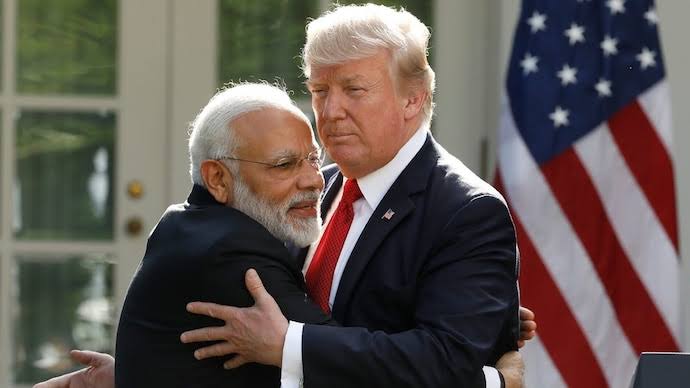
During Modi’s visit to Washington in February 2025, the two governments launched what they called “Mission 500,” an initiative aimed at expanding bilateral trade to $500 billion by 2030. Energy cooperation formed an important part of that agenda, with India committing to increase imports of American oil and natural gas as part of a broader effort to diversify its energy supply.
At the same time, political debates inside the United States have increasingly focused on immigration and high‑skilled visas — areas that directly affect Indian professionals and students. In late January 2026, Texas Governor Greg Abbott directed state agencies and public universities to pause certain new H‑1B visa petitions pending review of hiring practices. Shortly afterward, Texas Attorney General Ken Paxton announced investigations into several North Texas companies suspected of abusing the H‑1B visa system.
Such developments have amplified concerns within the Indian diaspora about the stability of their legal status and professional opportunities. Indians account for roughly 71 percent of H‑1B visa approvals in recent years. According to U.S. government data for 2024, that represents about 283,000 approvals — the majority going to engineers, medical professionals, and technology specialists working across the American economy.
Indian‑origin professionals have become deeply embedded in key sectors of the United States. Studies frequently cited by diaspora organisations estimate that Indian companies have invested tens of billions of dollars in the United States and helped create hundreds of thousands of jobs. Indian‑Americans also represent one of the highest‑income ethnic groups in the country, with median household incomes significantly above the national average according to U.S. Census data.
Their influence is visible across industries. Indian‑origin entrepreneurs have founded or co‑founded a notable share of Silicon Valley technology startups. Several Fortune 500 companies are led by CEOs of Indian origin. In healthcare, Indian‑trained physicians remain essential to hospitals and clinics across the United States, particularly in rural areas facing doctor shortages.
Yet economic integration has not eliminated episodes of discrimination or hostility. Civil‑rights organisations have documented spikes in anti‑Asian harassment and violence in recent years. Incidents involving South Asian victims have appeared periodically in news reports, reminding many immigrant families that acceptance in American society can sometimes remain conditional.
This tension between economic reliance and social suspicion is not new. Indian immigrants have faced waves of hostility before — from the anti‑Asian exclusion laws of the early twentieth century to the “Dotbusters” attacks targeting South Asians in New Jersey during the 1980s. Each period eventually gave way to greater integration, but the memory of vulnerability remains part of the diaspora experience.
For India, the broader question is strategic as well as emotional. As the world’s fifth‑largest economy and a major emerging technology power, India now possesses far greater economic leverage than it did a generation ago. Its companies are increasingly global investors. Its skilled workforce is in demand across advanced economies. Its domestic market offers opportunities that multinational corporations are eager to access.
That changing balance means India has more choices about where its capital flows, where its students study, and where its professionals build their careers. Partnerships with the United States remain enormously valuable — economically, technologically, and strategically. But partnerships are strongest when they operate on a foundation of mutual respect and stability.
The developments in Texas therefore resonate far beyond a single city council meeting. They highlight a broader challenge facing globalisation itself: how to reconcile the movement of capital and talent with political anxieties about identity and belonging.
For Indian policymakers, the answer is unlikely to be confrontation. But it may require greater clarity about expectations — including the treatment of Indian citizens and diaspora communities who contribute to the economies and societies in which they live.
India’s rise has been built not only on economic growth but also on the global mobility of its people. Engineers, scientists, entrepreneurs, doctors, and students have carried Indian talent to nearly every corner of the world.
As India’s economic and strategic influence grows, the central question becomes whether those citizens are treated as valued partners or temporary guests whose presence is tolerated only when convenient.
That question, increasingly, is one that both governments — and both societies — will need to answer honestly.