On the mandate of "Badla" in Dhurandhar

The Nazis had a Ministry of Popular Enlightenment and Propaganda, while Britain had a Ministry of Information, and the Americans an Office of War Information.
India might not have a formally declared propaganda ministry, but it has something more diffuse, and arguably more effective: a film industry that knows how to turn sentiment into consensus.
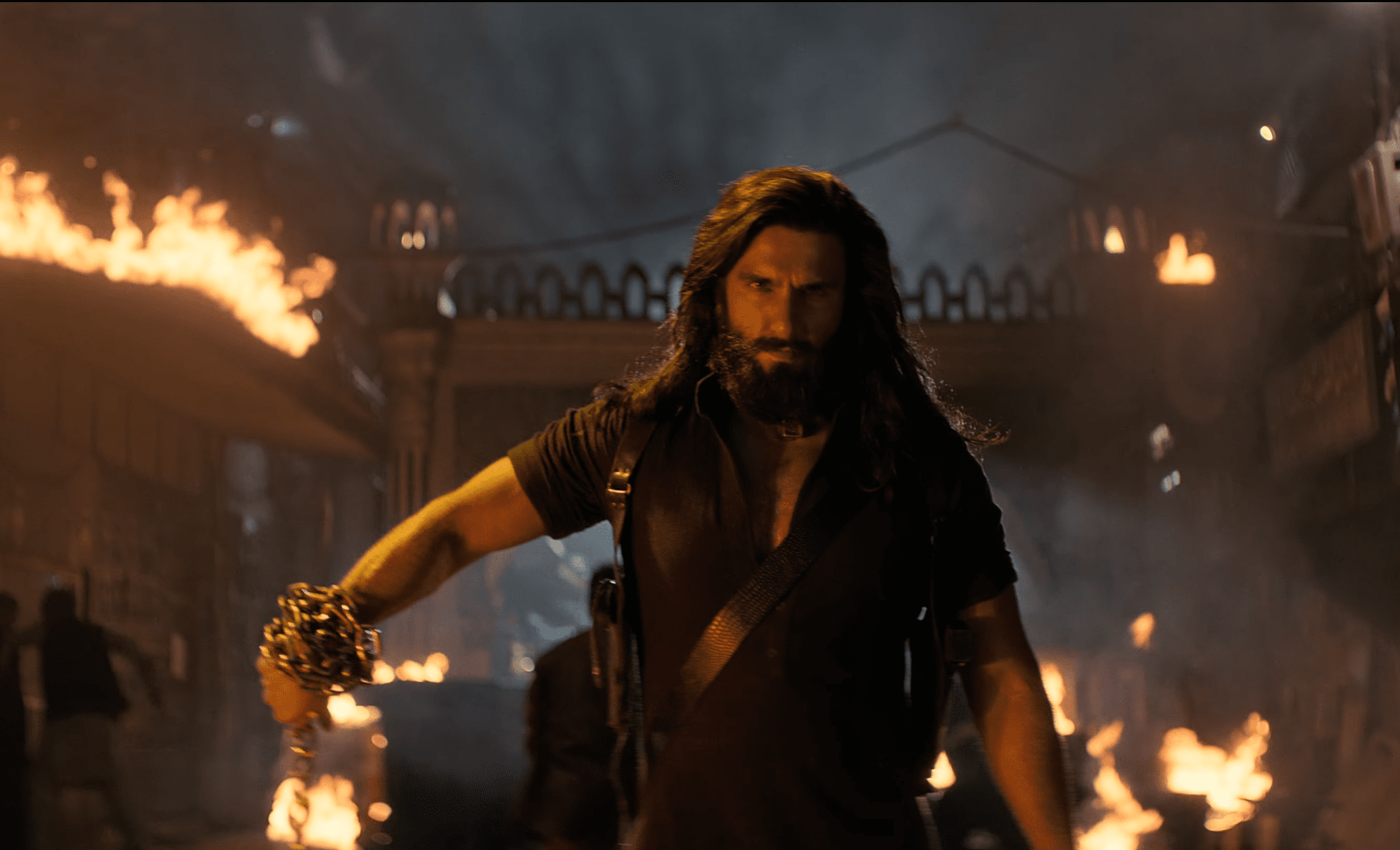
The opening credits to Dhurandhar: The Revenge contain a verse from the Bhagavad Gita, ending with an ominous call: “The battlefield summons, be relentless in action.” Much has been said about Aditya Dhar’s Dhurandhar franchise, manufacturing a limitless scope of retribution under the guise of correcting so-called “historical injustices.” In the first instalment, the Ranveer Singh-delivered line—“Ghayal hoon, isliye ghatak hoon” (I am wounded, therefore I am deadly)—splashed across the screen in stark red, crystallising this logic.
For this reason, Dhurandhar stages the humiliation of the IC-814 hijacking in 1999 and the 2001 Parliament attacks as scenes of national paralysis. Pakistani terrorists walk away unscathed, jeering at the cowardice of Hindus, while the Indian state is rendered completely passive.
“We better start preparing,” says Ajay Sanyal (R. Madhavan), a fictionalisation of NSA Ajit Doval, when confronted with the charge that the Indian state is incompetent to handle adversities such as an Islamic terrorist network operating at the heart of the country. “To land a punch, one must first make a fist,” he declares.
In the first instalment, which was released in December, this speculative desire is constantly hinted at: What if the aggressive, muscular posture of “New India” had defined the nation from the outset, rather than the perceived inertia of the UPA regime?
By anchoring retribution in historical injury, the film displaces accountability in the present. Violence is never excessive because it is always framed as a justified response. In this case, against Islamic terrorism.
But for these wounds from the past to translate to the language of violence, they need to be routinely prodded at, to make sure that the pain still rankles.
The rhetoric of vengeance in contemporary Hindi cinema carries dangerous implications. We are fed narratives—exaggerated, bloated, distorted, ad nauseam—that insist we have been wronged. What follows is the widespread normalisation of hatred against religious minorities, cast as ‘Others’ in a nation they are deemed ontologically unfit to inhabit. Spates of genocidal dog-whistling routinely follow the release of such films. Social media commentators and film pundits have already come out in open support of the film’s ideology, presenting it as a moral lesson in the repercussions of “going easy” on Pakistan, and by extension, Indian Muslims. More importantly, this discourse manufactures the ground on which material violence against Muslims becomes justifiable, even inevitable—the bête noire of New India’s cinematic landscape.
Dhurandhar: The Revenge extends these stereotypes further, implicitly locating channels of terrorism as enabled by Muslims in Uttar Pradesh. The ISI remains the central axis, around which loom the spectres of Punjab militancy, Kashmir insurgency, the spread of left-wing organisations in Kerala, and even Naxal movements.
One of the most discussed elements of the film is its political flattery of the Narendra Modi regime. The policy misstep of demonetisation is re-coded in the second instalment as a stroke of genius: “Operation Green Leaf”—an attempt at reframing a controversial event as tactical brilliance. What, in November 2016, had arrived as a sudden and disorienting announcement from Prime Minister Modi—rendering 500 and 1000 rupee notes worthless overnight—is retrospectively presented as a calculated strike aimed at choking counterfeit currency and terror financing, leaving the antagonists distressed.
These stated objectives were undercut by the Reserve Bank of India’s own data, which showed that 99.3% of the invalidated currency returned to the banking system. The promise of flushing out illicit money collapsed into a political pratfall. Meanwhile, millions of livelihoods were disrupted, and over a hundred people lost their lives.
It appears that Aditya Dhar felt that the failed policy needed a cinematic vindication after nearly a decade. But that’s not all. The intrusion of the real into the fictional is jarring, but not accidental, functioning as a rallying point for ideological consensus. The insertion of Modi’s image, in particular, invites the audience into a shared political affect, met with loud cheers in theatres.
In its opening stretch, the film leans heavily on the authority of the real. Real footage from the 2001 Parliament attack is spliced into the narrative, inciting more anger for the terrorists. Transcriptions of actual audio recordings between terrorists involved in the 26/11 attacks also appear on a red screen, invoking a documentary-like immediacy to the story of Hamza’s deep infiltration into the Pakistani terror network. At the same time, National Security Adviser Ajit Doval is recast as “Ajay Sanyal,” played by R. Madhavan, while Jaswant Singh, who served as India’s External Affairs Minister during the 1999 Kandahar hijack, is reimagined as “Devavrat Kapoor.” The names of Lyari gang members remain unchanged, even as gangster-turned-politician Atiq Ahmed—whose killing in April 2023 was captured on camera as he was being escorted by police for a medical examination in Prayagraj—reappears under the barely altered name “Atif Ahmed” in the second part. The film goes to the extent of replicating the murder scene, but leaves out the cries of “Jai Shree Ram” that the three assailants shouted immediately after committing the murder.
While the film insists on being “fictional,” it repeatedly anchors itself in recognisable reality. In the second part, archival footage of Narendra Modi is inserted into the narrative, presented twice as the “chaiwala” who had struck fear into the hearts of notorious criminals like Bade Sahab (Dawood Ibrahim) and Atif Ahmed. This plays out almost like a subversion of Brecht’s Verfremdungseffekt, wherein the unfamiliar mise-en-scènes of gang wars, international terror networks, and unrestrained violence are paradoxically made legible through the familiar political context of Modi making grand speeches on television—not unlike the breaking of the fourth wall to snap the audience back into the socio-political reality of the times they are living in.
Official social media handles of the ruling BJP government, as well as the Delhi Police, have used promotional media from the film, actively endorsing the film. In a film that already codes Muslims as suspect, this kind of amplification carries an unmistakable political message. On the day of Eid, that is, March 21, the film is set to have at least 1,980 shows in theatres across Delhi-NCR.
At this scale, and with this endorsement, the film does not merely circulate; it activates a core policy of the ruling regime, not only reflecting but also shaping the zeitgeist.
Prantik Ali is interested in the confluence of misinformation, digital propaganda, and media narratives. He holds a Master’s degree in English Literature from Jamia Millia Islamia, and interns as a fact-checker at Alt News. He has previously written for Maktoob Media, and The Quint, and The Frontline.