The silence around eid

This Eid, nothing dramatic happened in my hometown in eastern Uttar Pradesh. There were no headlines, no major incidents. And yet, something felt unmistakably different—something that did not announce itself, but could be sensed in the gaps.
It showed up in who did not come.
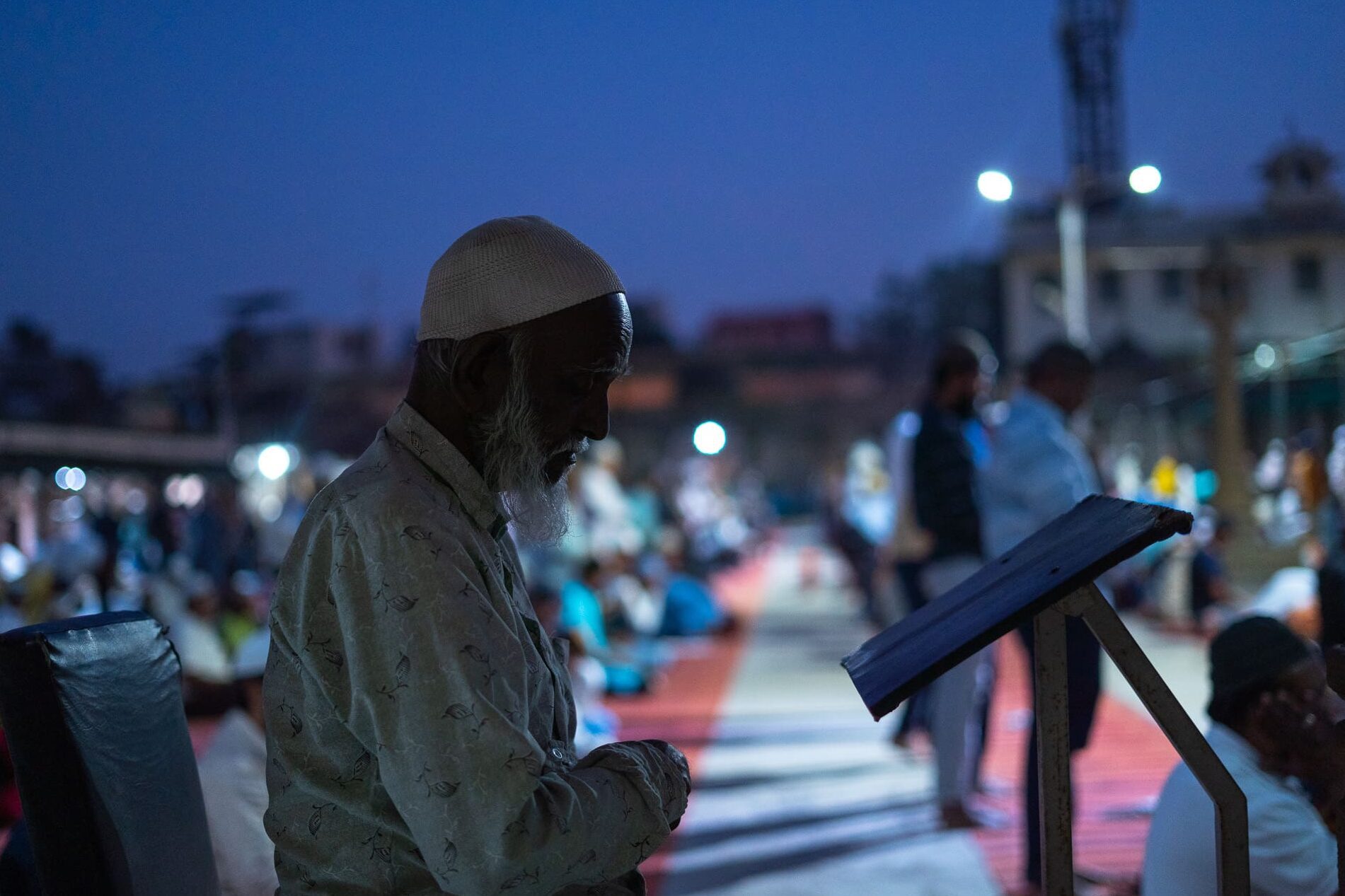
For years, our home, just across from the Eidgah, followed a familiar rhythm on Eid morning. After prayers, local officials would stop by. Police personnel stationed nearby would accept tea or water. Occasionally, politicians and bureaucrats would make brief appearances. These visits were routine, even mundane. But they signalled something important: that the festival belonged within a shared civic life.
This year, that rhythm broke further.
Since 2017, when the Bharatiya Janata Party (BJP) first formed government in Uttar Pradesh, residents say the atmosphere around festivals has grown more strained. Each year, the distance has widened. This time, no one came.
In conversations that followed, an explanation surfaced. There had been no formal instruction to avoid Muslim homes. But being seen doing so had become risky. A photograph, taken out of context, could circulate online and be reframed as political disloyalty. The safer choice was absence. Several acquaintances employed in public institutions also stayed away from family gatherings, citing work commitments—reasons that were both plausible and deniable.
What is visible here is not prohibition, but anticipation. Exclusion no longer requires explicit directives. It is shaped by the expectation of consequences. People withdraw not because they are told to, but because they have learned what participation might cost.
This marks a shift in how marginalisation operates. Where communal violence in India was once episodic and visible, it now often works through the regulation of everyday life. What unfolds is not always dramatic, but gradual—a pattern in which the possibility of consequences begins to shape behaviour in advance.
When celebration becomes regulated
This logic becomes clearer when one looks beyond absence to instances of intervention.
In Uttam Nagar, Delhi, the run-up to Eid followed a period of tension after a killing during Holi celebrations. Reports suggested that Muslims might be prevented from celebrating Eid. The Delhi High Court directed authorities to ensure security. On Eid, heavy police deployment around mosques and Eidgahs ensured that no major incident occurred.
Yet, for many residents, the presence of security was experienced ambivalently. Protection also felt like containment. The concentration of policing around Muslim sites marked these spaces as requiring surveillance and control. Celebration was permitted—but under watch.
A similar dynamic appeared in Varanasi, where a group of young men were arrested after gathering for an iftar on the Ganga. Families said such gatherings had taken place before without incident. This time, images circulated online, and the gathering drew official attention. Bail was denied, and additional charges were later added.
Cases like these suggest how the legal process itself can operate as a form of deterrence. Prolonged pre-trial detention in high-profile cases—such as those of Umar Khalid and Sharjeel Imam—has drawn criticism from civil liberties groups, including Amnesty International. Beyond individual cases, the broader effect is to signal risk. The consequence is not only punishment after the fact, but the production of caution beforehand.
In Pune, this dynamic takes a different form. According to media reports, a group of men who had gathered for Iftar near a lakeside in Oskarwadi village were attacked by a mob. Several were injured. While suspects were identified, arrests were not immediately reported.
A police response noted that such gatherings had not been seen in the area before, raising questions about their legitimacy. The reasoning is revealing. It suggests that legality is being informally supplemented by familiarity—that unfamiliar Muslim presence can itself become grounds for suspicion.
Here, enforcement appears decentralised. Vigilante actors intervene directly, while the state’s response remains uneven or delayed. The line between formal authority and informal action begins to blur. What emerges is not an absence of governance, but its diffusion—where the possibility of intervention, even when inconsistent, shapes behaviour.
When everyday interaction contracts
These processes extend into ordinary social life.
Last year, in my brother’s clothing shop, a customer put back her purchases after her husband remarked, audibly, “Don’t buy from Muslims.” A neighbour who once exchanged festive sweets declined this year, invoking familiar stereotypes. Another acquaintance refused an invitation, repeating a widely circulated slur about food contamination—an accusation with a long history in justifying exclusion.
Individually, such incidents may appear minor. But their repetition alters what can be said openly. Prejudice that was often expressed indirectly is now voiced more openly, often without consequence.
For those targeted, the effect is cumulative. One learns to anticipate friction—to reconsider where to gather, what to say, how visible to be. Participation becomes conditional, shaped by an ongoing assessment of risk.
This transformation does not appear incidental. It is enabled by a broader environment.
Political rhetoric has expanded what can be said publicly. Statements by public officials—including remarks by Uttar Pradesh’s chief minister—have been criticised for normalising derogatory language. Administrative practices, often framed as neutral measures to maintain “law and order,” often appear to concentrate surveillance in Muslim localities, particularly during moments of tension.
Digital media intensifies these dynamics. Images of everyday life—an Iftar, a visit, a gathering—can be detached from context and circulated widely. Visibility becomes exposure. Social media platforms thus operate not only as spaces of communication, but as sites where scrutiny is distributed and amplified.
In such an environment, anticipation becomes rational. Individuals adjust behaviour not in response to direct prohibition, but to the perceived likelihood of escalation—legal, social, or physical.
Seen in this light, the absence at the Eidgah is not incidental. It is part of a broader pattern.
For years, that space marked a fleeting moment of shared presence—a point where boundaries briefly softened. This year, the rituals continued, but the social field around them had shifted. Officials did not come. Neighbours remained distant. Nothing was formally withdrawn, yet something had been redefined.
That may be the most consequential change. Exclusion no longer depends on spectacle or declaration. It operates through anticipation—quietly, cumulatively, and through the actions of those who adjust to it.
The absence was not declared. But it was produced in advance—and, increasingly, lived as ordinary.