AIUDF at a crossroads: Contesting independently in Assam’s 2026 elections

As Assam prepares to hold its Legislative Assembly election on April 9, the AIUDF is contesting the election independently after failing to secure an alliance with the INC-led alliance. The 2024 Lok Sabha election was disastrous for the AIUDF. Its party chief, Moulana Badruddin Ajmal, a cleric-turned-politician, was defeated by a record margin of 10 lakh votes—the largest margin in the 2024 Lok Sabha election—by senior Congress leader Rakibul Hussein. In the coming Legislative Assembly election, the party is deploying every possible means to ensure its success in its traditional vote base.
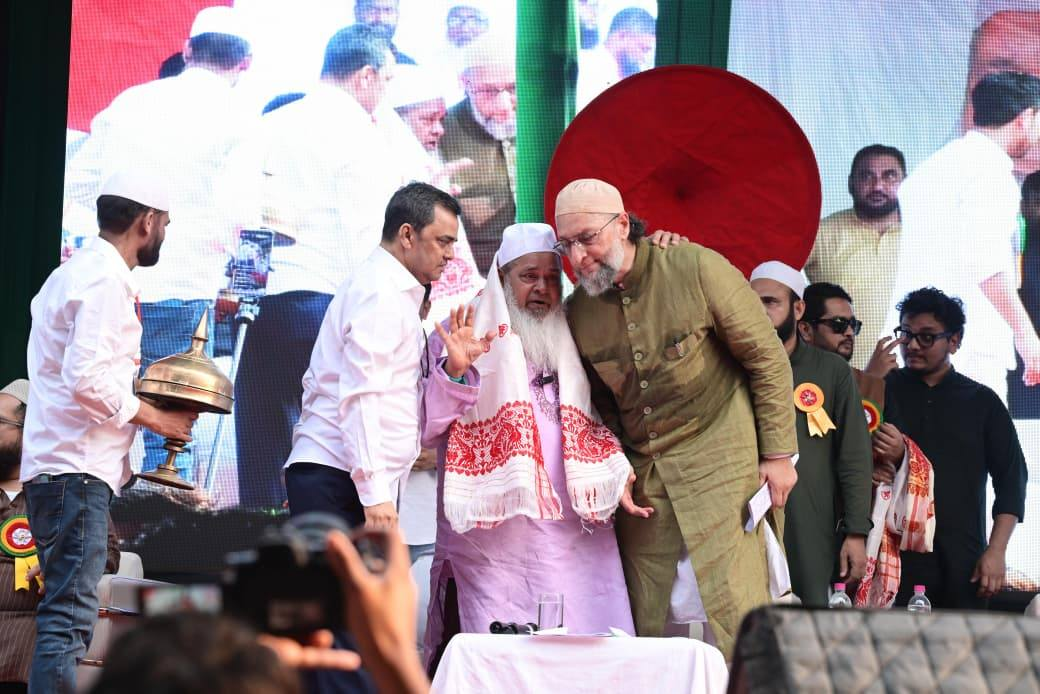
The nightmarish crushing defeat of its party chief in the last Lok Sabha election at Dhubri, where Bengali-speaking Muslims form about 75 percent of the electorate, which used to be considered the impregnable fortress of Ajmal, who has represented the constituency for the last 15 years, was an alarm bell to change the party’s working style. To regain confidence in the traditional vote base, Badruddin Ajmal has invited Asaduddin Owaisi, the AIMIM supremo and popular Muslim leader, to campaign across the state. If the crowds that turn out to its election rallies translate into votes, AIUDF hopes the party will regain its lost strength. In the last Assembly election in 2021, the party had won 16 seats. It still holds the third-largest position in the Assam Legislative Assembly, after the BJP and the Congress.
The All India United Democratic Front (AIUDF) was established in 2005 following the repeal of the Illegal Migrants (Determination by Tribunals) Act, 1983 (IMDT Act). This Act, aimed at identifying and deporting illegal migrants, was struck down by the Supreme Court in 2005. The lack of response from the Indian National Congress (INC) to prevent this left many in the Miya community feeling alienated, creating a political vacuum that AIUDF and Badruddin Ajmal, a cleric-turned-politician, sought to fill. Since its establishment, the party has participated in every Assembly election in 2006, 2011, 2016, and 2021, as well as parliamentary elections in 2009, 2014, 2019, and 2024.
Barely a few months after its formation, AIUDF contested its first election in 2006, marking an impressive debut. The party had won 10 seats. The AIUDF’s emergence had a significant impact on the INC’s Muslim support base. AIUDF’s rise was closely linked to dissatisfaction within the Muslim electorate with the Congress party. Many of the strongholds of the INC shifted to AIUDF, including South Salmara, Dhubri, Raha, Dhing, and Hojai. Other strongholds like Mankachar, Abhayapuri, Jaleswar, Barpeta, and Raha, the INC’s traditional bases, were divided due to AIUDF’s influence.
In 2009, AIUDF contested its debut parliamentary election. Though it contested 9 Lok Sabha seats, it secured only one, with Badruddin Ajmal winning Dhubri. But the election marked the party’s significant inroads into the Muslim vote bank.
In its second Assam Assembly election in 2011, the AIUDF emerged as a formidable opposition force. It had contested 78 constituencies, winning 18 seats—eight more than its previous tally—and becoming the second-largest party in the Assembly. The AIUDF had significantly improved its vote share from 9% in 2006 to 12.87% in the 2011 election. These elections established AIUDF as a credible and more stable alternative to the INC in Muslim-majority areas.
In the 2014 parliamentary elections, the BJP’s rise to power nationally also impacted Assam. The BJP had won seven out of fourteen seats, with its vote share jumping from 16.2% in 2009 to 36% in 2014. The AIUDF’s vote share dipped slightly from 16.1% to 15%, but it increased its seat tally to three—Dhubri (Badruddin Ajmal), Barpeta (Siraj Uddin Ajmal), and Karimganj (Radheshyam Biswas). The Muslim support base of AIUDF in Assam hoped that the three representatives in Parliament would ensure that their issues, especially NRC, Doubtful Voters (D voter) harassment, land-related evictions, and the BJP’s hate campaign, would be efficiently represented and tackled. But to their disappointment, the party was unable to rise to the occasion and often became a mute spectator to state-sponsored violence. The BJP constantly fearmongers the bogey of illegal immigrants to frame the Miya Muslims, and AIUDF’s failure to address these issues has created dissatisfaction among Muslims.
These dissatisfactions were reflected in the 2016 Assembly election. AIUDF’s representation in the Assembly dropped from 18 seats in 2011 to 13 in 2016. The Congress party was also making efforts to regain the confidence of Muslims, which contributed to this backlash. The rise of the BJP in Assam also helped the Congress party regain Muslim support, as many Muslim voters viewed Congress as a stronger alternative to counter the BJP.
In the 2019 Parliament election, AIUDF deployed a new strategy to counter vote splitting. AIUDF was clear about the BJP as the archenemy and chose not to gain by splitting the Congress vote base. It fielded only three candidates—Dhubri, Barpeta, and Karimganj—where Muslims constituted a significant portion of the electorate.
However, the recalibrated efforts could not succeed. AIUDF’s seat tally dropped from three to one, with only Badruddin Ajmal retaining Dhubri. The party suffered a significant setback in Barpeta and Karimganj. The decline of AIUDF’s traditional Muslim vote base became clear. The INC gained significantly from AIUDF’s loss.
In 2021, despite its origins in opposition to the INC, the political context forced them to join forces to fight the BJP in the Assam Legislative Assembly election. It entered a pre-poll alliance with the Grand Old Party. AIUDF contested 20 seats as part of the Grand Alliance and won 16 of them. The BJP did not miss the opportunity, accusing Congress of supporting illegal migrants. BJP leader Himanta Biswa Sarma was at the forefront of this hate campaign. This campaign helped consolidate Hindu votes across upper Assam, the hill districts, and constituencies near Guwahati. Congress was also reluctant to fully embrace the AIUDF; it feared backlash from the majority and distanced itself from campaigning together in the election. The alliance was more or less on paper. Both parties campaigned separately. But the BJP alliance’s victory was the final nail in the coffin. The AIUDF-INC alliance did not last.
Though Badruddin Ajmal showed willingness to join the INDIA alliance in the 2024 parliamentary election, Congress refused to shake hands due to its alleged communal image. The delimitation process before the 2024 elections further weakened the AIUDF. Key constituencies like Barpeta were restructured, reducing the concentration of Muslim voters. Party chief Ajmal’s crushing defeat was the party’s biggest setback in 2024. In Dhubri, delimitation also contributed to the magnitude of the loss; the inclusion of Chenga, Baghbar, and Jania diluted the concentration of Muslim votes, enabling the INC to secure a historic victory.
The new trend of the Muslim vote shifting towards Congress, and Congress’s isolationism—calling Ajmal and AIUDF the B team of the BJP—forced AIUDF to turn to Owaisi for campaigning. This time, AIUDF is fielding 29 candidates. Party chief Badruddin Ajmal has been named as the candidate from Binnakandi. The party has fielded candidates largely in minority-dominated constituencies across lower and central Assam, signalling its intent to consolidate its traditional voter base.