Phoolan Devi: The revolutionary Bahujan Queen

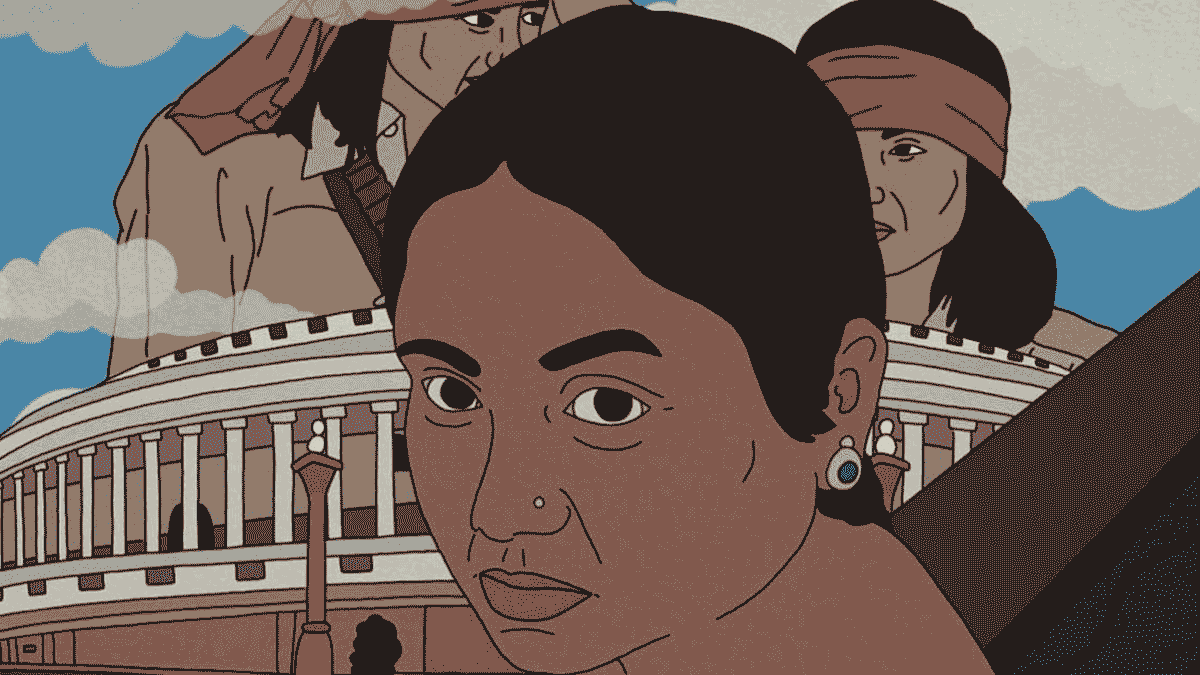
The international recasting of Phoolan Devi as a ‘bandit queen’ or ‘dacoit’ romanticises her as the armed looter Gabbar Singh from the Bollywood movie Sholay or the tribal leader Veerappan despised by the Indian government. This is far from the truth. Her aura escapes the imagination of most contemporary commentators, who try to fit her into categories she fought against vehemently. Phoolan Devi needs to be remembered as a fierce anti-caste feminist whose radical politics could not be contained or tolerated by upper-caste supremacists.
Dalit vs SC: The Problem of Nomenclature
Phoolan Devi was born in the caste ‘Mallah’, which has a history of occupational discrimination and criminalisation. Although considered as EBC or ‘extremely backward caste’, it would be more fruitful to consider the Mallah community, and by extension Phoolan, as Dalit. The Dalit Panthers proposed an inclusive definition of ‘Dalit’ in their manifesto that unites all lower caste communities that experience caste discrimination, sexual violence, and apartheid.
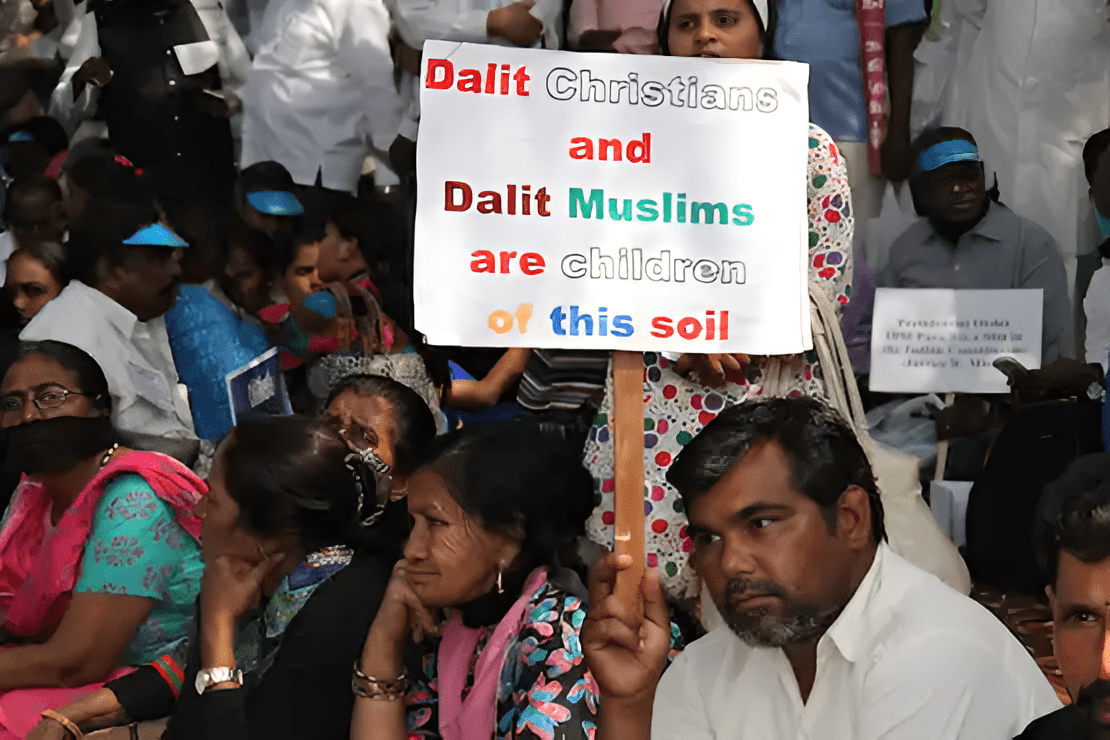
In the last census of 2011, the Indian government estimated Schedule Castes constitute 16% of the Indian population. These numbers are reductive for two reasons. First, it does not include Dalit Christians and Dalit Muslims. Second, all communities that experience caste discrimination and identify as Dalit are not codified as Schedule Castes by the government. If we take these two reasons into account, along with the absence of a recent socio-economic caste census, Dalits in India can be estimated to form 40% of the Indian population.
Phoolan Devi was born in Uttar Pradesh and lived in Madhya Pradesh, both states where the National Crime Records Bureau recorded the highest crime rate against Dalits in India in 2022. Many lower caste communities in the area have not been codified as ‘Schedule Castes’ by the government despite their experiences of caste discrimination and their appeals to be included.
Therefore, Phoolan Devi can be imagined as having roots in the Dalit community based on her life experiences of oppression. The Mallah community has been represented in the Dalit filmmaker Neeraj Ghaywan’s film Masaan, where young children are trained to hold their breath and dive in the river Ganges to retrieve coins thrown by devotees.

Criminalisation of Lower Castes
Despite being the victims of caste-based crimes, Dalits and Adivasis form the highest percentage of undertrials in prison. Recently, Madhya Pradesh diverted funds intended for the welfare of Dalit and Adivasi communities for cow welfare, the development of Hindu museums, and Brahmanical religious sites.
Hence, what we see is a nexus of governmentality and criminalisation that robs Dalits of economic means of progress, supports Brahmanical structures that socially disempower Dalits, and uses law to elongate the trauma of Dalits who have experienced caste-based violence.
The poverty of her family forced Phoolan Devi to be a child bride in exchange for a cow, which in the 21st century, Hindu supremacists perhaps consider to be more valuable than young Dalit girls. For not honouring a marriage where her consent meant nothing, Phoolan Devi was labelled as a promiscuous woman who needed to be disciplined.
Phoolan was kidnapped and raped by Babu Gujar, a dominant caste gang leader. A lower caste from the gang, Vikram Mallah, killed Babu Gujar for raping Phoolan and assumed leadership of the gang. Vikram, in turn, was killed by dominant caste landowners and allies of Babu Gujar: Sri Ram and Lala Ram, who kept Phoolan in captivity and gang-raped her for days along with other Thakur men.
The Role of ‘Anastasis’ in a Revolution
Many years later, Phoolan returned to this village, armed to kill the twenty-one dominant caste men who had raped and tortured her. In a turn of phrase, this is called the Behmai ‘massacre’. Shaj Mohan and Divya Dwivedi assert that a revolution requires ‘anastasis’, a change in the status quo that alone can challenge the stasis of caste discrimination. To call the murder of Thakur rapists a ‘massacre’ is to use Brahmanical language that portrays Phoolan Devi as an oppressor rather than a revolutionary who is fighting for the oppressed.
The iconicity of Phoolan Devi lies not in her extraordinariness but in the fact that Dalit girls from the region who experience a fate similar to hers are not allowed to become like her. In UP, a Valmiki girl was gang-raped by four Thakur men and left to die in a field in 2020, violence that was as gruesome, if not more, as experienced by the Thakur girl Nirbhaya in 2012. Yet, while Nirbhaya’s perpetrators were hanged, the Hathras girl's perpetrators are protected by the government, police, and villagers of Hathras.
Similarly, in MP, a 23 year old was molested by Thakur men in 2019, and she filed a police case against the Thakur perpetrators. Her brother was killed, her mother was disrobed and beaten with sticks in 2023, and her uncle was murdered in 2024 under mysterious circumstances. She was pushed off an ambulance carrying her uncle to the hospital in 2024. Imagine a world where these girls could have done what Phoolan did.
Bahujan Politics
After a decade in jail, Phoolan was pardoned for the revenge murders and other crimes by Mulayam Singh Yadav, the former Chief Minister of UP and leader of the lower caste Samajwadi Party. This is an instance of ‘Bahujan’ politics envisioned by the Dalit leader and politician Kanshi Ram. He believed the political solidarity of the lower caste masses that form 90% of the Indian population, namely the Bahujan, could alone bring about a revolution.
In the 2024 elections, the Samajwadi Party came to power in UP based on Bahujan politics envisioned by Kanshi Ram. The proof was in the pudding: a Dalit politician, Awadhesh Prasad, won in Ayodhya (or Faizabad constituency), where BJP had inaugurated an upper caste Hindu temple the same year.

Phoolan Devi was elected twice at the Lok Sabha as a Member of Parliament and spoke about Eklavya in one of her rallies, where she says, “Eklavya was our emancipator. Our exploiters severed his thumbs and sent him to the jungle. But now, times have changed. There are hundreds of Eklavyas. Today, if any Dronacharya tries to sever the thumb of an Eklavya, his hands will be chopped off”.
The story of Eklavya, the tribal boy in Mahabharata who was a skilled archer and forced to cut off his thumb by a Brahmin teacher, haunts the Dalit imagination. The newly elected Lok Sabha Member of Parliament, Chandrashekhar Azad Ravan, recently asked the Lok Sabha, “For how long will Eklavya’s thumb continue to be cut off?”, alluding to the continuation of 2000 year old system of caste discrimination.
The Anti-Caste Queen
Phoolan Devi is called a ‘bandit queen’ or a ‘rebel queen’ in the Brahmanical imagination that permeates international and national media descriptions of her, incapable of describing Bahujan historical figures. Rather, Phoolan Devi should be recognised as an anti-caste and revolutionary Dalit or Bahujan queen who understood early on that the ethno-national state does not seek to empower women like her and uses law not to defend but to incriminate and patriarchy not to protect but to molest.
Phoolan Devi’s autobiography is titled The Bandit Queen of India (2003), perhaps a continuation of the colloquial term coined by Mala Sen and popularised by Shekhar Kapur. Phoolan Devi says that after all that she suffered, “I alone knew what I had suffered. I alone knew what it felt like to be alive but dead”. She is describing the state of superfluity in the ethno-national state when every structure that is supposed to protect you alienates you instead.
After surrendering to the police and being pardoned, Phoolan Devi says, “In my village, they say that when the demon Kans strikes with lightning at the birth of a baby girl and kills her, she will rise up in the sky to become the lightning in her turn. The demon struck me with lightning, and I became the lightning for others”. She was assassinated on 25 July 2001 by a Thakur man who could not tolerate the militant power of a Bahujan woman. Phoolan Devi was born on 10 August 1963 and would have turned 61 this year. She should be remembered as nothing less than a legend of anastatic anti-caste politics.