Jharkhand’s controversial Land Bank is undermining rights of marginalised

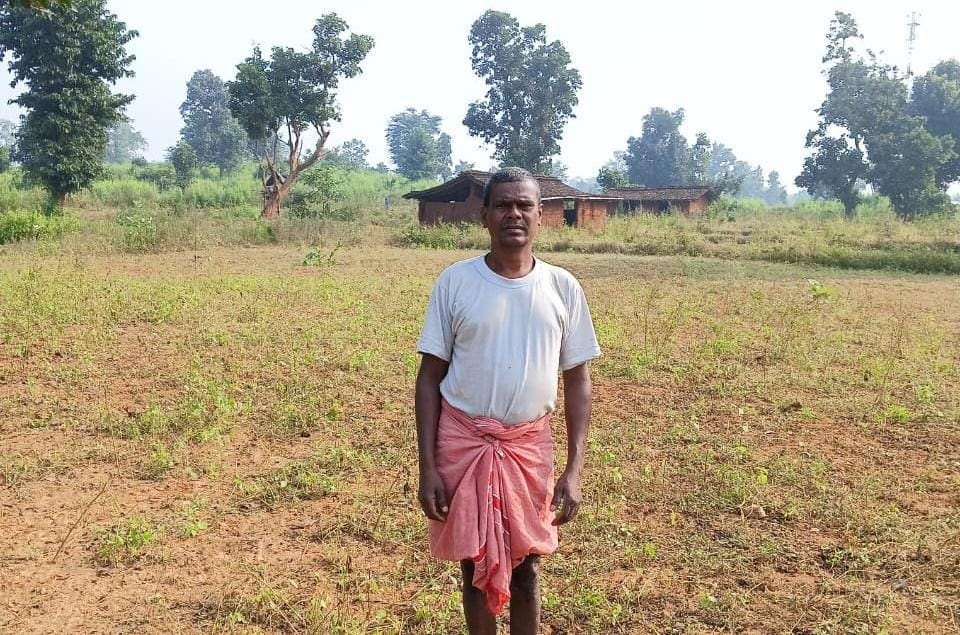
In 2021, 63-year-old Thupa Singh, an Adivasi farmer in the Daldalia village in Jharkhand’s Latehar district, found himself and eight other families in jeopardy. Thupa said that contractors and workers had arrived to construct Eklavya Model Residential School on the land they had been living on for generations. To their surprise, the portion of village land these families were living, cultivating, and paying taxes for was found to be already included in the state’s controversial Land Bank.
“It was only when they arrived for construction, that we came to know that our land is included in the Land Bank. And no consent from the Gram Sabha was taken for this,” Thupa told Maktoob.
The Land Banks are created across different states in India attracting investment and industries and making land acquisitions easy for such projects. In 2016, the then BJP-led Jharkhand government under Chief Minister Raghubar Das started developing Land Bank to facilitate land allocation to industries.
Jharkhand’s Land Bank holds 2.1 million acres of land and ever since its creation, activists, affected communities, and rights groups have been opposing it raising concerns over the land rights of the marginalised communities; mostly Adivasis and other forest dwellers in the state.
Amid the election campaign for the Jharkhand Assembly Election 2024, the demands for revocation of the Land Bank are witnessed questioning the role of BJP and the current JMM-led government in the state.
Losing land to Land Bank
Thupa and his uncle’s family are the only two families now left in the area. They fear once the authorities start the construction works for the playing field of the Eklavya School, these two families will have to face a similar fate to six other families who lost their farmland as the school building was constructed.
Thupa said that over the last thirty years, the two families paid land revenue for two plots of land; 1 acre 70 dismil in the name of Thupa’s father Somar Singh and 2 acres 30 dismil land in the name of Thupa’s uncle. The said plots of land were settled in favour of the two landless families in April 1988. However, Thupa said that the local revenue office abruptly stopped taking revenue for their land in 2014.
Veteran civil society activist George Monipally who has been working on issues related to land rights in Jharkhand explained that the state primarily has three types of land; rayyati land (Personal land recorded in the names of individuals or their ancestors, often passed down through generations), forest land and gair majarua land. The gair majarua land is of two types; gair majarua khas which could be settled and gair majarua aam which is the common land.
“Many people settled on such land after independence, which we call gair majarua land. Hundreds of thousands of people have applied for legal titles for such land, and they were paying tax for it, but the Raghubar Das government declared all gair majrua land as part of the Land Bank. From 2015 onwards, the government stopped issuing receipts for those lands, which had previously been taxed by the government. The government said they would not tax it anymore, calling it government land,” George explained.

Activist Shashi Panna said that the particular conflict in Latehar emerged as the then BJP government approved the land in question for Land Bank and then in favour of Eklavya School which he said required “20-30 acres of land” in the village.
Shashi alleged that Land Banks are created randomly without proper cross-verification.
He explained: “The land selected for Eklavya School was originally recorded as Gair Majarua (GM) land in the Cadastral Survey (CS), but it had been settled for rayyats and taxed offline until 2014. The land records were later updated based on the Revisional Survey (RS), conducted around 1991-1992 in Latehar and published by 2003-2004. However, due to mistake and negligence in the RS, the land was categorised again as gair majarua khas, and the rayyats' names were removed from the online records, paving the way for it to the Land Bank.”
Push for industries
The Industrial Policy of Jharkhand 2001 was introduced by the then BJP-led NDA government in Jharkhand that came into power after the bifurcation of Bihar in 2000 in the states of Jharkhand and Bihar. The industrial policy found the first mention of the Land Bank in the state.
“The State Government shall constitute a ‘Land Bank’ at District level to make available the required land to intending entrepreneurs to overcome the delay in the land acquisition process,” read the policy.
Gladson Dungdung, a writer and researcher, highlighted that the current Land Bank has a lot to do with how historically with the formation of Jharkhand, there were attempts to set up industries in the state that witnessed strong protests.
Gladson said that after Arjun Munda became the chief minister, he continuously signed MoUs and that during his tenure 70 MoUs were signed with different companies.
“His government faced strong resistance. Resistance was also against the Jindal, Mittal etc. Arjun Munda even got Mittal from London, alloting 25,000 acres of land in Khuti. The more MoUs were signed, the more protests were witnessed. And because of the protests, no mega industry could be established. Even TATA could not set up one. So, there was an internal commotion among the industrialists about how they would be able to set up their industries amid such a situation. Getting land acquisition became a tough deal. The political game was that unless and until a non-adivasi becomes a CM, it will be difficult,” Gladson said.
As a result, in 2014, during the Assembly election, when there was a Modi wave, Gladson said that even unknown faces won the election “but Arjun Munda lost.”
“He was made to lose. And as soon as Raghubar Das came to power, the first thing he delivered was on the Land Bank. There he declared that GM land, also given to landless families, to be withdrawn and ordered to enlist the GM land under the Land Bank. And from there began the creation of the Land Bank,” he asserted.
Gladson said that upon his research he found that starting from common land, religious land (of sacred groves), forest land and even remaining land around government offices were also included in the Land Bank. He asserted that 48 per cent of the total Land Bank is of forest land and that this "clearly violates the forest rights of Adivasis and other forest dwellers”.
“In Khunti district, 488 acres of land of 541 ‘Sarna sthal’ were added in the Land banK,” he said.
Gladson alleged that companies are now “playing around the Land Bank.”
Citing the case of Dimbuli village near Saranda in East Singhbhum, where 25 per cent of the country's ore lies, he said: “Dempo Company first got an iron ore lease here, even buying land in the village. Under the LARR Act 2013, if unused for five years, land should return to farmers. But Dempo sold it to SESA Goa, which later sold it to Vedanta. Now, Vedanta acquired 41 acres from the Land Bank and is pressuring villagers by saying it will fence the area, trapping them in. This violates Gram Sabha rights and ignores legal requirements like consent and public hearings.”
Gladson cited another case from Japut village in the Khunti district. “In that village there 7 acres and 10 dismil land was in the Land Bank where people used to cultivate. The government took that into the Land Bank, and got fake gram sabha consent, then established a power grid there. Whereas villagers were already protesting, and they were not heard at all.”
The researcher stresses that the Land Bank violates the Panchayats (Extension to Scheduled Areas) Act, 1996 and the Forest Rights Act, 2006.
“In section 4 of the PESA Act, it is clearly stated that the natural resources in the village, be it land, forest or minerals, all control lies with the Gram Sabha. PESA considers Gram Sabha eligible to manage these. Without taking consent of the Gram Sabha, adding these lands in the land bank is a kind of robbery. Can be called a land robbery,” he said. “Section 4 of the Forest Rights Act says that till the time rights over the land are completed, you cannot conduct any other activity on that land. So, this is a violation of FRA.”
Gladson further said that Land Bank also violates the apex court judgement in the case of Odisha Mining Corporation vs the Ministry of Forest and Environment and others.
“In the Niyamgiri judgement, the Supreme Court clearly said that the Gram Sabha is foremost to make decisions on the resources of the village. The major thing is that it is in violation of Articles 25 and 26 of the Indian Constitution. Supreme Court while referring to these two sections said that the way Hindus, Muslims, Sikhs and Christians have religious freedom, that way Adivasis also have religious freedom. The Supreme Court in its ruling said that if Adivasis say that their lord is in the hill then you cannot do anything with it. And the government even added Sarna Sthal in the land bank, this is an attack on religious freedom.”
Amid election, Land Bank issue reignites
During the 2019 Assembly election in Jharkhand, land bank was an issue. Even the Jharkhand Mukti Morcha had promised to revoke the land bank. Amid the election in 2019, Hemant Soren, while listing his poll promises, precisely mentioned the land bank issue along with other promises. “Handing back 21 lakh acres forcibly included in the land bank to their owners,” Hemant Soren tweeted.
However, no promise has been materialised by the party in power in the state. Amid the campaigns for the Assembly election 2024, Jharkhand Congress leaders Rameshwar Urao and Keshav Mahto Kamlesh wrote to Chief Minister Hemant Soren demanding “immediate cancellation” of land Bank “made by the BJP.”
Jharkhand Janadhikar Mahasabha, a coalition of rights organisations in the state, has also been raising the demands for cancellation of the land Bank amid the election.
Vinod Singh, CPI(ML) MLA from Bagodar, has recently, on October 7, written to Chief Minister Hemant Soren reminding the promises of cancelling the land bank.
While speaking to Maktoob, questioning the erstwhile BJP government that created the land bank, Vinod said that there have been attempts to give the GM land or similar non-rayyati land to big industrialists and that the people have seen how the government took the land of commoners and used it to cater special interests.
“The government (JMM) has not created any new Land Bank, but the struggle for the GM land that has been used for generations should be for the interest of the people and gram sabhas. The impact of Land Bank is even more significant when it comes to community or common lands that have been allocated for factories or coal mining…for instance, in Badkagaon, or the land given to Electrosteel in Bokaro, entire communities face displacement and loss of livelihood,” he said.
Vinod Singh said that the people are still doubtful, and the risk is evident unless and until the Land Bank is completely cancelled. “The issue of land needs to be scrutinised again, the rights over common land should remain with the people and the gram sabha. And people who are living on such lands should be rather legalised.”
Meanwhile, JMM in its manifesto for the 2024 Assembly elections, announced to revoke the land bank created by the previous government in the state.
“But if you see, in this election, Congress has also added Land Bank in its manifesto saying that if elected to power they would revoke the land bank. Land Bank is certainly an issue in this election. For example, the Bharat Adivasi Party is raising the issue of Land Bank and targeting JMM. They are telling people that the JMM had promised to revoke the land bank, but it did not revoke it,” said Gladson.
Meanwhile, Thupa said that though he's unsure about whom to vote for, he expresses concern saying that “it was all because of the Modi government. (pointing at the previous BJP government in the state)”
Mahmodul Hassan is a Writing Fellow with Land Conflict Watch, an independent network of researchers, which researches natural resources.