Maharashtra elections: Rising human-tiger conflict fuels political tensions

An eerie silence persists in the thickly forested buffer zone of Pench Tiger Reserve. Within eight months, six deaths were reported from tiger attacks on tribal communities living in Maharashtra's Jhinjhariya, Tuyapar, and Deolapar villages in Ramtek taluka, among other areas.
In response, forest authorities have restricted the villagers’ movements and alienated them from their farms and grazing lands—the very sources of their livelihood.
In the run-up to the assembly elections, these incidents have led to political mobilisation as the villagers put forth their demands such as strict enforcement of the Forest Rights Act, access to natural resources, relocation of tigers to other areas and adequate compensation.
In September, tribal leaders from the Congress joined this mobilisation by submitting a memorandum to Deolapar police to take action against the forest reserve officials. The Nagpur division, which includes Chandrapur district, has the second-highest concentration of tribal population in Maharashtra, after the Nashik division
Ramtek has a whopping 32.66% Scheduled Tribe (ST) population.
Leaders from tribal communities held hunger strikes and road blockades in Nagpur and Chandrapur districts. Congress is believed to continue using the issue to score political points as the election approaches.
The protesting villagers also expressed disappointment in the Pench Tiger Reserve officials who did not take action at the right time resulting in the deaths. They were angered by the absence of Ramtek MLA Ashish Nandkishor Jaiswal, who did not come to meet them and hear their concerns despite the coming election, which will decide his fate.
The Ramtek assembly constituency was once a stronghold of the Congress, represented by prominent leaders like PV Narasimha Rao and Mukul Wasnik. However, Congress lost its grip on the seat after 1991, when Shiv Sena gained dominance.
Jaiswal has since won the seat three times for Shiv Sena and most recently, a fourth time as an independent candidate. There are now reports suggesting Jaiswal might join Shinde’s Shiv Sena, setting the stage for a fierce contest between Congress, Shiv Sena (UBT), and Shinde's faction.
September tiger incident

On 17 September, a 65-year-old Meeta Kumar of Jhinjhariya village was mauled to death by a tiger. Jhinjhariya is a tribal majority village, populated by members of Gond communities.
This incident occurred only a few hours after 20-year-old Shyam Sirsam from Deolapar village was attacked and wounded. He quickly informed the Pench tiger reserved authorities, who allegedly laughed it off—villagers said that the officials told them that a tiger would not just attack and leave a potential meal.
Later, when the officials came following Meeta’s death, villagers reportedly threw stones at their vehicle out of frustration.
“The dead body was found in the tiger’s mouth. It is a very tragic death, which has left Meeta’s old husband alone and depressed. Their son had already died in an accident years ago and their daughter is married and lives elsewhere,” said a 40-year-old Rajkumar, who was a relative of their family and lived in the same village.
For the next two days, the villagers protested and demanded justice. Members from the block development council/zila panchayat, Nagpur SP Harssh Poddar, and even the Congress MP Shyamkumar Barve came to meet them.
The deputy director Prabhu Nath Shukla of the Pench forest department promised them a compensation of Rs 25 lakhs, of which only Rs 5 lakhs were given at the time. The rest of the amount never came, as per Meeta’s family.
While nothing was done even in the coming weeks despite the tigers killing and eating one cow and a boar, a notice was issued 10-15 days later.
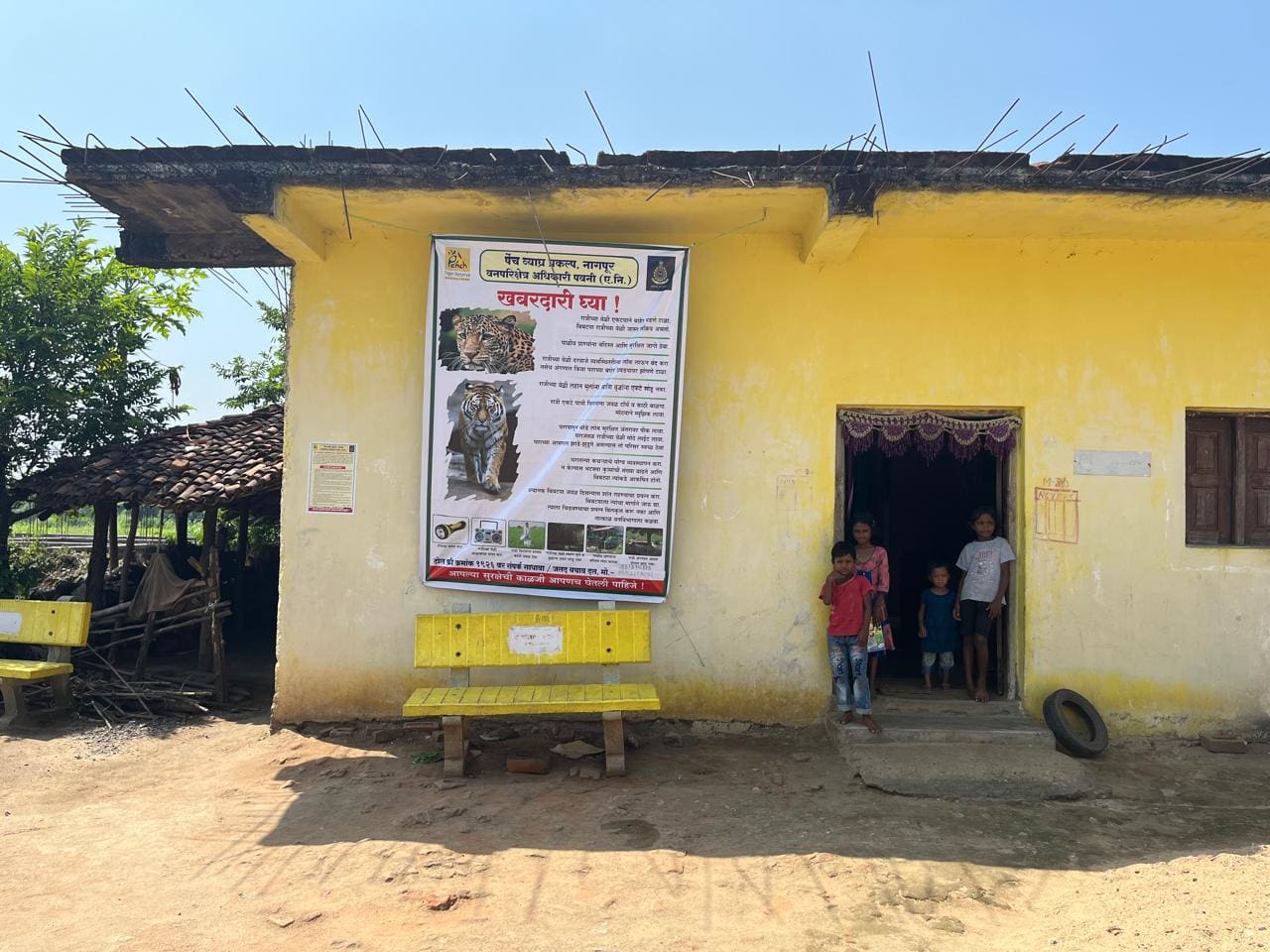
A notice, originally dated 18 September, was issued by the Forest Range Officer of Pavni buffer area to the sarpanch of the group panchayat (a collection of two or more gram panchayats that are grouped) consisting of at least 15 villages in the area asking to inform residents to take “precautions” such as not entering the forest/fields before sunrise or after sunset.
It also requested to not take the cattle for grazing near the forest or avoid taking them out altogether if there was any sighting of wild animals. They were asked to only go out and work in a group of 4-5 people, who needed to constantly chatter to evade any risk.
“We are the ones that always help the forest officials who are newly appointed. We help contain fire that emerges in the forest because our livelihood depends upon it. But this is what we get in return,” said the village sarpanch Sarika Vinod Uikey.
Public to political mobilisation – how it began
The villagers were also told that they would get to meet Dr Vipin Itankar, District Collector of Nagpur, and Sudhir Mungantiwar, Minister of Forests of Maharashtra, in a meeting held on 24 September. However, the meeting was held at Nagpur collectorate, almost 50 km away from where they resided.
The villagers decided to boycott the meeting as they could not afford to travel so far. Interestingly, the minutes of the meeting stated that villagers were present and were asked for their opinions on how to curb such instances.
Many suggestions were discussed including training villagers to distinguish between the core and the buffer areas, which have never been an issue. The villagers were enraged and held a demonstration again the next day on Ajini-Ghorpad road in Nagpur’s Kamptee taluka.
Back in the villages, posters were put up highlighting how “our safety is on our hands". Rajkumar said that the villagers already were fearful and avoided going to their fields for two weeks after the death, which resulted in the loss of about Rs 2,000 to Rs 3,000 for each family.
Around that time the Congress leaders joined the protest and amplified their demands. Earlier on 21 September, they had organised a road blockade on National Highway 7 demanding a meeting with Shukla. Later a chain hunger strike was held among other forms of protest led by district Congress chief Rajendra Mulak, Ramtek MP Barve, and businessman Chandrapal Chouksey.

In Chandrapur, another Senior Congress leader Abhilasha Gavture demanded a hike in compensation, jobs to the kin of murdered villagers, and relocation of excess tigers and leopards.
While the human-tiger conflict is not mentioned in the Congress manifesto, the leaders said that it would be a part of their local campaigning for the upcoming polls.
“Villagers have realised that the current regime is not spending money to prevent the attacks. When it all happened, our party members visited them, protested, and presented their demands. The problem is not specific to Ramtek but is faced by all the villages that exist near the forest in the state,” said MP Barwe.
While the protest simmered down a little at the beginning of October, the death of 58-year-old Sukram Saryam, a resident of Tuyapar in Ramtek tehsil on 16 October rubbed salt in their wounds. It triggered another round of agitation from locals, who tried burning the vehicle of forest department officials.
Since then, the violence and outcry in Nagpur and surrounding areas has only intensified. Just days later, villagers from Paradsinga in Katol taluka staged a 'chakka jam,' blocking roads for an hour in protest.
They alleged a rise in tiger attacks on livestock, particularly cows, and voiced frustration over the lack of timely compensation or proper medical care for the injured animals.
Sukriti Vats is a writing fellow at the Land Conflict Watch, an independent network of researchers studying land conflicts, climate change and natural resource governance in India.