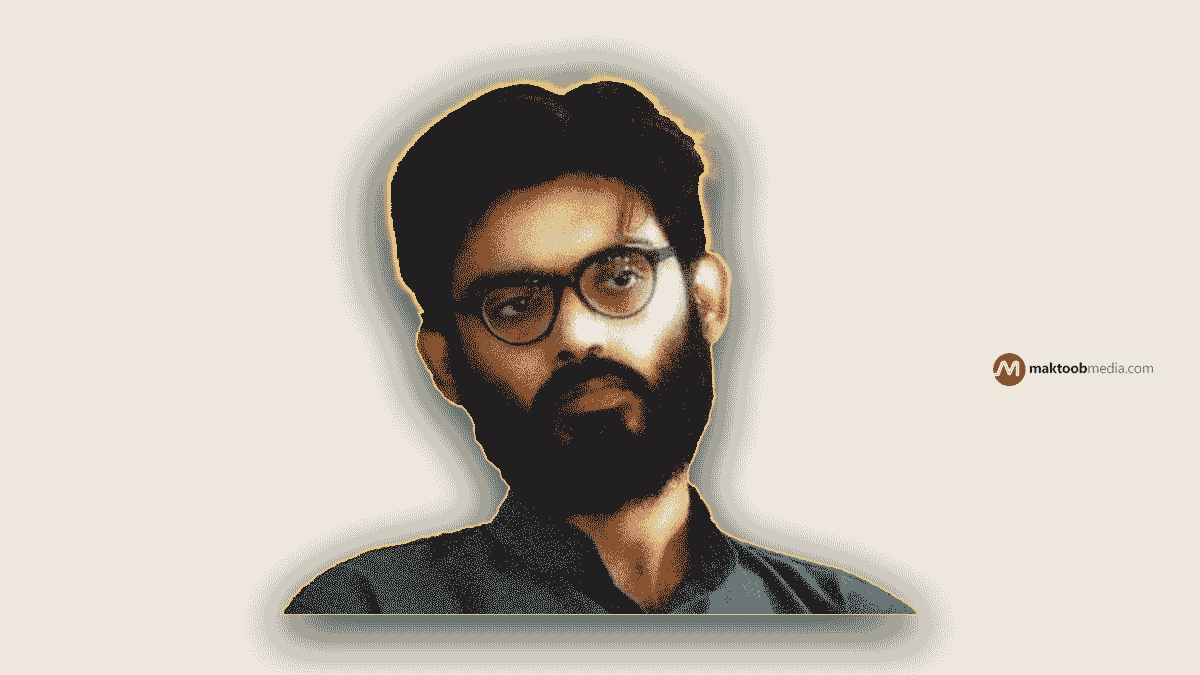
Prison notes from Sharjeel Imam: On incarceration, communalisation and Shaheen Bagh

Sharjeel Imam is a Muslim student leader jailed since January 28, 2020, as an undertrial prisoner in multiple cases related to anti-CAA protests. several UN experts called for the release of Imam and other protestors, saying that their arrests seem "clearly designed to send a chilling message...that criticism of government policies will not be tolerated."
This article was written 1.5 years ago and shared with Maktoob through his lawyer last month.
I have already spent nearly four years in jail, and while I did anticipate being imprisoned on trumped-up charges due to my involvement in Shaheen Bagh, I had mentally prepared myself for it. As Ghalib wrote, “ḳhana-zad-e-zulf hain zanjir se bhagenge kyuun hain giraftar-e-wafa zindan se ghabaravenge kya” ("Why should the prisoner fear the chains of loyalty, when those bound by love run from them?").
What I did not expect, however, was to be accused of "terrorism," especially for riots that occurred a month after my arrest. This speaks to the lengths the current regime will go to to suppress dissent and keep people like me behind bars. Majaz captured this sentiment well in his verse: “hadein wo kheinch rakhi hain haram ke pasbano ne Ke bin mujrim bane paighaam bhi pahuncha nahi skta.” ("The guardians of the holy have drawn lines so strict that no message can pass without making a criminal out of the messenger").
The only real anguish I feel in this prolonged and unnecessary incarceration is the thought of my ageing and ailing mother. My father passed away nine years ago, and since then, it has just been me and my younger brother to support her. Apart from this, I submit to God’s will and spend my time reading as much as I can. As long as I have meaningful and interesting books, I find solace, and the world outside doesn’t affect me much.
I think of Ali Shariati, the Iranian revolutionary, who spent two years in prison and was under house arrest before his death. From him, I learned this powerful dua: “O God, grant me strength to change what I can change, and accept what I cannot.”
It is with this prayer that I try to work on myself. But as the years drag on, I do worry about my mother, my brother, and the world outside. I wonder if my presence could have made any difference, or if I have missed something that can never be recovered.
Faraz beautifully captures this feeling in his couplet: “Wahshat ka sabab rauzan-e-zindan to nahi hai Mehr-o-mah-o-anjum ko bujha kyon nahi dete.” ("The cause of my loneliness is not the prison, but why do they not let the sun and moon and stars shine?").
There is nothing extraordinary about my daily routine. Most of the day is spent in my cell reading books and newspapers. In the evenings, I take an hour-long walk around my block. Hasrat Mohani, who later became a member of the constituent assembly, was once imprisoned by the colonial government. He wrote a couplet that resonates with me: “hai mashq-e-sukhan jaari, chakki ki mashaggat bhi / Ik turfa tmaasha hai Hasrat ki tabhiyat bhi” ("The exercise of speech continues, the grind of the mill is the same, both are one-sided spectacles in Hasrat’s temperament").
Although I am not required to perform mashaqqat—convict labour—since I am an under-trial prisoner, the term "chakki" is still used for the cells here in Delhi, even though there are no actual mills in the jail anymore. Thus, the couplet still applies to my situation.
I live alone in a small cell. One corner of it is designated for a toilet, separated by a low wall. My belongings are simple—some clothes, books, and utensils—but it is a quiet corner, one where I can focus on my studies. I am reminded of a beautiful couplet by Hafiz Shirazi, the great mystic, who wrote seven centuries ago: “Hafiza, dar kunj-e-fagr o khalwat-e-shab ha-e-taar, Ta buwad virdat dua / O dars-e-Qur’an gham makhur” ("O Hafiz, in the corner of poverty and the solitude of the night, let the prayer and the study of the Quran be your solace; do not mourn").
Over the years in Assam and Tihar jail, I have read hundreds of books, some of which I had read before but with a renewed perspective and deeper concentration. These books can be broadly categorized into five groups:
History & Related Fields: This includes works on European history (Hobsbawm, Anderson, Trotsky), South Asian history (Bayly, Subaltern Studies, Partha Sarthi Gupta, N.E. History), and Islamic history (Hodyson, Abraham) along with specific texts related to my PhD research.
German Literature: I had some training in German ten years ago but had become irregular in my practice. In jail, I dedicated time to improving my proficiency. I started with Kafka’s short stories, then his novels, including “Das Schloss” and “Der Prozess,” the latter being especially resonant due to its themes of arbitrary trials—an experience that feels eerily familiar in prison. I’ve also explored works by Nietzsche and other German fiction writers. Right now, I’m reading Thomas Mann’s novel “Der Zauberberg” ("The Magic Mountain").
Science & Philosophy: I’ve delved into works on relativity, quantum physics, and 20th-century developments in mathematics, along with philosophical interpretations of these fields. I first encountered these subjects during my time at IIT Bombay but have since returned to them with greater focus. I’ve read works by Einstein, Heisenberg, Schrödinger, Gödel, Penrose, Hawking, Yourgrau, and Max Jammer, as well as general philosophical texts by Quine and Samuel Alexander. Currently, I am reading “From Mathematics to Philosophy” by Hao Wang.
Islam, Religious Mysticism, and Tafsirs: I’ve revisited the works of Maulana Azad, Abdullah Yusuf Ali, and other theological texts, and explored many historical and religious works I could find, including several biographies of the Prophet, notably by Sulaiman Nadwi. The poetic works of Islamic mysticism, particularly Iqbal’s Farsi writings (Asrar & Rumooz) and the Divan of Hafiz Shirazi, have been my companions. I also reread Iqbal’s Reconstruction of Religious Thought (1930) and explored other writings of his that I had not read before.
I have read several works by Dr. Ali Shariati, including Iqbal-o-Ma (his analysis of Iqbal's ideas), Hajj (a profound exploration of the spiritual and social dimensions of pilgrimage), and the succinct yet impactful Mazhab alaihe Mazhab (Religion Against Religion). In the latter, Shariati delves into how monotheistic prophetic traditions, which are inherently humanist and revolutionary, have been co-opted by a materialist elite that opposes the interests of the people. He argues that the true conflict is not between religion and irreligion but between two interpretations of religion: "religion for the masses" versus "religion of the materialist elite." This internal struggle exists even within the same religious tradition, as these opposing forces contend for the essence and direction of that tradition. Right now, I am halfway through the Arabic text “hujjat ullah-it-Baligha” by the 18th-century theologian Shah Waliullah Dehlir.
Fiction: Writers like Saadat Hasan Manto, Munshi Premchand, Leo Tolstoy, Fyodor Dostoyevsky, Elif Shafak, Amitav Ghosh, and Arundhati Roy.
In short, I have been able to read in 3-5 years, which would have taken me at least double that time if I had been outside.
My PhD is about “Communal Riots and Cow Slaughter in Early 20th Century Colonial India”. Before my arrest, I had started writing the chapters as my synopsis had been approved by UGC in 2019. However, some archival work was pending when I got arrested, and hence, I could not finish my dissertation in jail.
Besides, the amount of primary data that I have collected runs into tens of thousands of pages and it is not possible to look through that sort of data while sitting in jail, especially since most of this data is spread across various devices in digital format — devices which the police seized although they provided us with clones eventually.
Hence, I limit myself to reading whatever secondary works I can get access to.
I had chosen this topic because communal riots seem to be one of the most if not the most important, entry point into the debate around partition. For Muslims specifically, who were and are a minority in most of colonial India, the mobilization in the name of “cow protection” since the late 19th Century- (one of the first major Bakr-Eid-related rural massacres happened as early as the 1890s in Eastern UP) posed a major threat to Muslims and especially on the eve of their most important festival.
By the 1920s, Bakr-Eid had become a contentious and often violent occasion due to the rise of cow protection movements. This persistent tension not only posed a significant threat to communal harmony but also raised critical concerns about the security of cultural practices and the preservation of religious autonomy.
Large cattle was one of the cheapest food sources for Muslims and hence this issue had resonance across classes and castes. The butcher community was particularly affected.
My M.Phil research (2015–2017) focused on the 1946 attacks on Muslims in Bihar, which occurred around Bakr-Eid and lasted for a week, resulting in the massacre of thousands of Muslims (officially 5,000, with unofficial estimates reaching 20,000). This tragic event drew my attention to a broader phenomenon that I later explored in my PhD. My work seeks to deepen the discourse on Partition and challenge the simplistic narratives of Muslim separatism and elite competition theory promoted by some scholars. These narratives often overlook critical issues such as violence, security, the professional vulnerabilities of butchers and tanners, the nutritional and food habits of the poorest Muslims, and broader concerns related to power-sharing.
These overlooked issues—violence and majoritarian legislation, professional livelihoods, and the need for cultural and religious autonomy—are deeply tied to safeguarding the rights and security of Muslims within the state. They highlight the importance of a statutory stake in state infrastructure to ensure protection against speculative decisions and systemic exclusion.
I argue that these factors played a more fundamental role in shaping Muslim mobilization against the Congress in the 1937 elections and their support for the Muslim League in the 1946 elections than the simplistic theories of elite competition or the notion of inherent Muslim separatism.
Shaheen Bagh stands as a milestone in Indian history—a peaceful sit-in protest on a major highway, led first by students and later sustained by women for nearly three months, interrupted only by the pandemic-induced lockdown. In my view, this movement represents the culmination of multiple significant trends in the recent history of Muslims in India:
The rise of an educated Muslim middle class, the increasing communalization and Islamophobia, the frustration that Muslims felt in the First part- the post-electoral system the brute majoritarian legislative adventurism of BJP which the above-mentioned factors led to such as CAA & abolition of 370 and bifurcation of Jammu and Kashmir, the indifferent attitude of “secular” parties, and finally the attempt of BJP to appear as “saviour” of Muslim women, which they rejected in overwhelming numbers.
An important feature of this protest was that, although it was spontaneous, it would not have been possible without a group of Muslim scholar from JNU, IITs & Jamia and their united effort. Scholars including me had been advocating sit-ins on highways and chakka—jams for quite a few days and without our presence on 15th December on that highway, it would have been just another juloos (march), but not a continuous sit-in.
In the initial days, every moment of the Shaheen Bagh protest was a struggle. Rogue elements, likely operating under police instructions, sought to disrupt the peaceful demonstration from the very first night, attempting to incite violence and derail the movement. The harsh winter nights added to the challenge, yet a dedicated group of a few dozen individuals, supported by an increasing number of women from the second week onward, remained steadfast.
Resistance also came from various quarters, including Resident Welfare Associations (RWA) and large shopkeepers along the highway. However, smaller shopkeepers and vendors were more supportive. Even some local ulema initially resisted the movement. Engaging with these different interest groups became an around-the-clock task, especially in the early days. Despite our commitment, we did not anticipate the protest lasting as long as it ultimately did.
The participation of women was a particularly contentious issue during the first week. Many women initially joined only in the afternoons, sitting or standing on the steps of closed roadside shops. By the second week, however, a safe and designated space for them was established near the stage, and the stage’s management was handed over to young female students to minimize conflict in that area. While achieving perfect order was challenging as the crowds grew rapidly, significant progress was made.
To strengthen morale and foster unity, two community iftars (breaking of fast) were organized during the first two weeks, alongside daily namaz (prayers) where men and women prayed together in congregation. By the second week, Friday prayers on the highway had begun, drawing thousands of participants. Men prayed on one side of the divider, and women on the other, creating a powerful symbol of collective resistance and solidarity. These efforts helped to shape the protest into a historic and enduring movement.
I was fortunate to address the congregation on both Fridays after the namaaz – a novel experience for me as well. In all of these struggles, students- men and women, professionals, workers and lawyers of Shaheen Bagh were the main supporting forces for us. They stood by like a rock during all these developments. By the end of December, it had become a sustainable and popular model, where only a small proportion of the community was required to be present at a particular time.
During the critical 18 days between December 15, 2019, and January 3, 2020, when our group had temporarily withdrawn from Shaheen Bagh, a sustainable model for the protest began to take shape. This period witnessed the remarkable coming together of highly educated Muslim youth—both men and women—from institutions like IITs, JNU, Jamia Millia Islamia, and AMU. These individuals, alongside student workers and professionals, became the backbone of Shaheen Bagh. Their efforts were bolstered by the support of Dalit and backwards-caste organizations like BAPSA (Birsa Ambedkar Phule Students' Association) from JNU, BAMSEF, and certain leftist groups.
The first ten days were particularly pivotal. At that time, Shaheen Bagh had not yet gained the momentum or visibility it later achieved. It wasn’t yet a sustainable movement or a widely recognized symbol of resistance. Media coverage was sparse, limited primarily to platforms like The Wire (December 16, 2019) and a few smaller outlets. Despite this, the dedication of this collective of Muslim scholars, supported by grassroots mobilization and allied organizations like BAPSA, transformed Shaheen Bagh into a landmark in Indian history.
By December 25, Reuters had extensively covered the protest, bringing Shaheen Bagh into the global spotlight. This triggered widespread attention from Indian media and politicians, marking the turning point of the movement. What followed was a historic ripple effect, as Shaheen Bagh inspired similar protests across the nation.
This was perhaps the first autonomous, large-scale act of collective resistance led by an educated body of Muslim youth in Indian history. It showcased their ability to independently organize, inspire solidarity, and energize the masses, leaving an indelible mark on the country’s social and political landscape.
As Ghalib aptly wrote:
"Dikhaaoonga tamasha dee agar fursat zamane ne
Mera har daagh-e-dil ik tukhm hai sarv-e-Charagan ka"
("I will reveal a spectacle to the world, if time allows;
each wound of my heart is a seed of the cypress of lights.")
I hope Shaheenbagh conveys a simple yet powerful truth: resistance to authoritarian regimes is not only possible but can also be achieved peacefully through the collective action of the masses. History shows that in times of crisis, people overcome their internal contradictions for the greater good. Another key message I hope it delivers is the vital role of organic leadership—particularly that of educated youth from within the community.
There exists a segment of people who label themselves as progressives but remain wary of independent, educated Muslim voices. These individuals often dismiss the contributions of such leadership, claiming that Shaheen Bagh was unplanned, leaderless, or a reflexive, spontaneous movement. This narrative erases the hard work, foresight, and dedication of the Muslim scholars—both men and women—and their associates who were involved not just from Day 1 but from Day 0. I hope to challenge such dismissive attitudes and give due credit to those who laid the groundwork for Shaheen Bagh.
It’s crucial to emphasize, even at the risk of repetition, that without the leadership and vision of a few Muslim scholars from MSJ (Muslim Students of JNU), IITs, and Jamia, Shaheen Bagh would not have become the historic movement it did. Processions and rallies alone do not sustain such movements—what is needed is an autonomous group of educated Muslim youth with a deep understanding of the modern history of Islam and South Asia, as well as the internal challenges facing Muslim communities in India.
Allama Iqbal’s observation in 1909 remains strikingly relevant today: the Muslim community suffers from a “double caste system”—the sectarian divisions of religious caste and the entrenched social caste system. Addressing these layered issues requires precisely the kind of informed, organic leadership that Shaheen Bagh demonstrated. It is a model that should inspire future movements and efforts toward justice and equality.
These are scholars with a scientific temperament, a democratic and egalitarian vision for the future, and a clear, principled stance rooted in the Qur’anic rejection of sectarianism, casteism, and obscurantism. At the same time, they firmly oppose majoritarianism, territorial nationalism, and Islamophobia. They possess the courage to articulate these values and advocate for democratic and structural reforms that are crucial for the upliftment of Muslims and other oppressed communities.
We need more such educated and inspired men and women from our community—individuals with the conviction to work towards real change. I can say with certainty that during our time at Shaheen Bagh, I was fortunate to be a part of such a group. This is the flame that Shaheen Bagh has ignited—though it may seem faint at present, it is, nonetheless, one of the greatest contributions of the movement to the future of Muslims in India. It represents the possibility of us becoming equal citizens and forming a modern Muslim community.
As Faiz Ahmed Faiz so eloquently put it:
“Halqa kiye baithe raho is Shamma ke yaron
Kuchh raushni baaqi to hai, har chand ke kam hai”
("Stay gathered gather around the lamp friends, for some light still remains even if very faint.")