32 years on, remembering the Babri Mosque demolition

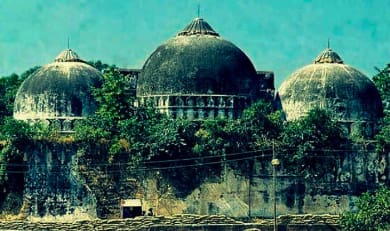
On this day 32 years ago, thousands of Hindu nationalist men and women tore down Babri mosque, a 16th century mosque in Uttar Pradesh’s Ayodhya.
The mosque was reduced to rubble by Hindu nationalist mob who claimed that an ancient Ram temple stood at the same site.
The demolition of the medieval mosque, which was constructed under the rule of the first Mughal Emperor Babar, triggered anti-Muslim violence in parts of India that continued for months. More than 2,000 people were killed, in the worst anti-Muslim riots since India’s independence in 1947.
This came after Hindu nationalists group ran a campaign alleging that the 16th-century mosque, named after Mughal emperor Babur, was built on the location of Ram’s birthplace in Ayodhya.
Three years ago, a special court Lucknow has ruled that the demolition of the historic mosque in 1992 by Hindu rioters was not preplanned, acquitting senior leaders from the governing Bharatiya Janata Party (BJP) over a lack of evidence.
The trial court of the Central Bureau of Investigation (CBI) announced the verdict in the case involving 32 accused, including former Deputy Prime Minister Lal Krishna Advani, 92, – a one-time mentor of Prime Minister Narendra Modi.
All the 32 people were accused of criminal conspiracy and inciting a mob to tear down the Mughal-era mosque.
Other senior leaders among those acquitted were former ministers Murli Manohar Joshi, Uma Bharti, Vinay Katiyar and former Chief Minister of Uttar Pradesh Kalyan Singh.
Five years ago, Supreme Court of India awarded the mosque site to Hindus, handing the BJP a victory to drive home its Hindu nationalist and anti-Muslim agenda.
In its ruling in 2019 November, the top court ordered the entire mosque area of 2.77 acres to be allocated to Hindus for the construction of the temple though the top court did say the demolition of the mosque was a criminal act.
In 2020, Modi inaugurated the construction of the temple, which was one of the promises the BJP made when the party was founded in the 1980s. The party rose to national prominence on the back of the temple movement.
This year, on 22 January, Prime Minister Narendra Modi has opened a Hindu temple built on the ruins of the historic Mughal-era mosque.’ The consecration of the temple, dedicated to Ram, embodied the triumph of Modi’s muscular Hindu nationalist politics and marked an unofficial start to his re-election campaign in general elections happened later this year. “January 22, 2024 is not merely a date in the calendar but heralds the advent of a new era,” Modi had said, speaking outside the temple after the consecration.
Most of opposition parties, including the Indian National Congress, declined the invite to the event, saying it did not befit a secular India.
Babri was not destined to be the only mosque to be demolished; rather, it was only the first of many Muslim landmarks and monuments that were to follow.
The slogan, “Babri to bas jhanki hai, Kashi Mathura baki hai” (Babri is only a sneak peek; Kashi and Mathura are yet to happen), attests to the longing that persists even today. A list of such monuments marked for demolition has been in broad public circulation for quite some time.
Hindu groups have challenged the continuing existence of historic mosques in Mathura and Varanasi (also known as Kashi) through court cases.
This month, as part of a Hindu nationalist campaign in Uttar Pradesh’s Sambhal, a historic mosque named Shahi Jama Masjid was targeted by a Hindutva group. A court-ordered survey was conducted there, and at least six Muslims were allegedly killed in police action. Local Muslims were protesting against the survey team, which was accompanied by a mob chanting “Jai Shri Ram.”
The Hindu nationalists also launched a campaign claiming that the historic Jama Masjid in the national capital, Delhi, and the Ajmer Dargah in Rajasthan were originally temples.
Watch Maktoob’s documentary on Babri.
Places of Worship Act, of 1991 under attack
Activists and politicians have been blaming former Chief Justice of India DY Chandrachud for opening the floodgates of the Places of Worship Act of 1991 with his Gyanvapi judgment. They argue that this has made it easier for lower courts with Hindutva inclinations to order investigations into the existence of temples beneath mosques.
The Places of Worship Act 1991, is an Act to prohibit conversion of any place of worship and to provide for the maintenance of the religious character of any place of worship as it existed on August 15, 1947, and for matters connected therewith or incidental thereto.
The act had been passed against the backdrop of communal strife that had enveloped India in the wake of the demolition of the Babri Masjid in Ayodhya in 1992.
The criticism arose due to his involvement in judicial decisions that were believed to have opened the door for actions like the survey of Shahi Jama Masjid, following Hindutva groups’ allegation that the Mughals demolished a temple to build the historic mosque.
In August 2023, The Supreme Court Bench comprising CJI D.Y. Chandrachud allowed the Archaeological Survey of India to conduct a scientific survey of the Gyanvapi mosque premises, rejecting the contention of the Muslim litigants.
The survey was first ordered by a Varanasi district court on July 21 on a petition by a group of Hindu litigants seeking the right to hold prayers inside the mosque compound.
During the hearing on the Gyanvapi case, in October 2023, Chandrachud had orally remarked in court, in response to the contention that the Gyanvapi suit was barred by the 1991 act: “The Act says you can’t alter or convert the nature of the place. They’re not seeking conversion of the place. The question is what is the status of the place as of August 15, 1947.”
This is in contrast to the stance on the 1991 act taken in the Ayodhya judgment, which was co-signed by Chandrachud.
In August 2021, five Hindu devotees filed a plea before a Varanasi civil court seeking permission to offer daily prayers at the Gyanvapi mosque, which the devotees claimed housed several Hindu deities.
When this was appealed by the mosque committee, the Supreme Court, on May 17 last year, directed that Muslims be allowed to access and worship in the mosque. It also transferred the case to a district court in Varanasi, ordering the court to decide first on the maintainability of the suit.
Bharatiya Janata Party leader and advocate Ashwini Kumar Upadhyay, in 2020, also filed a petition before the Supreme Court challenging the constitutionality of the 1991 law.
In 2022, CJI Chandrachud-led Supreme Court bench accepted the petition challenging the constitutionality of the Act. The bench also granted the Union government more time to file an affidavit in response to the petition.
While hearing the plea in July 2023, A bench comprising Chief Justice of India DY Chandrachud, Justice PS Narasimha, and Justice Manoj Misra said that it cannot take recourse to the Places of Worship (Special Provisions) Act of 1991 for ordering a blanket stay on various suits and legal proceedings that remain pending in different courts across countries.
In December 2023 also, the Supreme Court refused to stay the Allahabad High Court’s order allowing a survey to be conducted at the Shahi Idgah mosque in Mathura, Uttar Pradesh to examine whether the mosque is built on a temple. Earlier, the Supreme Court had greenlit a similar survey to be carried out at the Gyanvapi mosque in Varanasi by refusing to interfere in the Allahabad High Court’s order permitting the same.
Many journalists, academics and lawyers have alleged that D.Y. Chandrachud has made it easier for anyone to demand a survey of mosques, thereby paving the way for turmoil by weakening the Places of Worship Act, of 1991, which was intended to provide closure to such disputes.