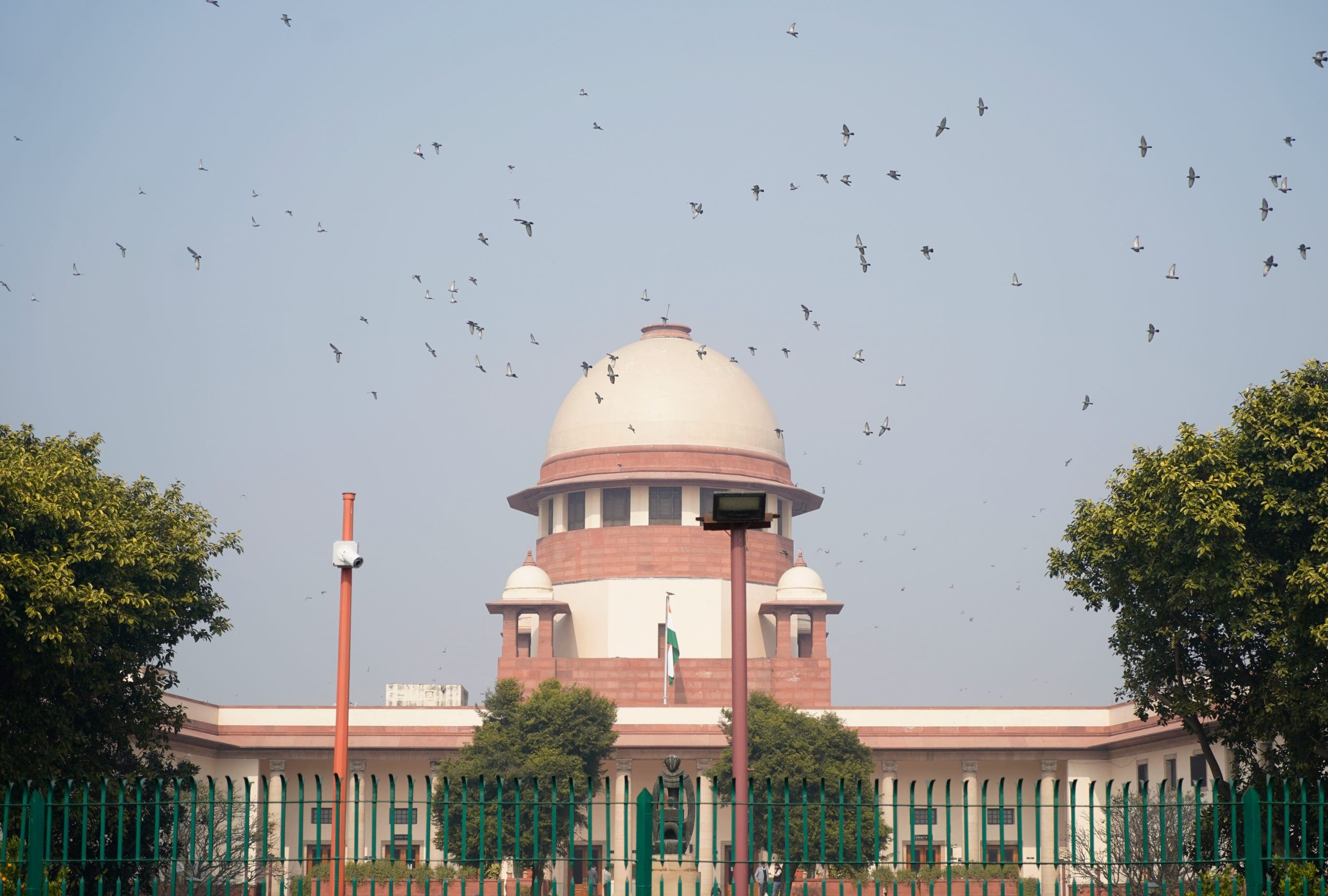
Supreme Court stay surveys, fresh suits against religious structures

On Thursday, the Supreme Court of India directed trial courts across the country not to pass any effective orders or surveys against existing religious structures in suits filed disputing the religious character of such structures while hearing pleas challenging the constitutional validity of the Places of Worship (Special Provisions) Act.
This would include the Gyanvapi dispute in Varanasi, the Krishna Janmabhoomi temple dispute in Mathura, and several others. The court was informed that such suits are pending in at least 10 places.
The top court commenced hearings on a batch of petitions challenging and supporting the constitutional validity of the Places of Worship Act, which prohibits the conversion of the religious character of places of worship from their status as of August 15, 1947.
A three Bench, led by Chief Justice of India (CJI) Sanjiv Khanna, Justices PV Sanjay Kumar, and KV Viswanathan, is examining the law's scope, ambit, and validity.
"Our direction includes that no other court shall pass any specific directions of surveys, no effective interim order shall be passed till the court concludes this case", said CJI Sanjiv Khanna.
The crucial intervention of the Court came amidst rising concerns about the filing of multiple suits in the country claiming ownership of medieval mosques and dargahs.
In November, tensions erupted in Uttar Pradesh’s Sambhal when locals resisted a court-ordered survey team accompanied by a Hindutva mob chanting “Jai Shri Ram.” The Uttar Pradesh Police reportedly opened fire on protesters opposing the survey of the Shahi Jama Masjid in the Western UP town, resulting in the killing of six Muslims, sparked controversy. The survey was initiated following a petition alleging that a temple had been demolished to construct the mosque.
The court stated, "As the matter is sub-judice before this Court, we deem it appropriate to direct that while suits may be filed, no suits would be registered and proceedings undertaken till further orders of this Court. We also direct that in the pending suits, the Courts would not pass any effective interim orders or final orders, including orders of survey till the next date of hearing.".
However, the Court refused to stay the proceedings in the suits that are presently pending against places of worship like mosques/dargahs. The Court further asked the Union Government to file its counter-affidavit in the petitions that question the Places of Worship Act within four weeks from the day of judgment. The copy of the Centre's counter-affidavit has been directed to be uploaded on a website from which any person can download it.
The Union Government is yet to file its counter-affidavit in the matter, despite several extensions given by the Court.
The bench was informed that at present 18 suits are pending in the country against 10 mosques/shrines.
Prominent cases include the Gyanvapi Mosque in Varanasi, the Shahi Eidgah Mosque in Mathura, the Shahi Jama Masjid in Sambhal, the Ajmer Dargah in Rajasthan, Jami Masjid and dargah of Shaikh Salim Chishti at Fatehpur Sikri, Atala Masjid, Jaunpur, Quwwat-ul-Islam Mosque, Qutub Minar, Shamshi Masjid, Badaun, Juma Masjid, Magaluru, Malali Mosque,
During the hearing, Justice Viswanathan told Solicitor General Tushar Mehta, "The plea challenges the constitutionality of the Act..one view is it is only an effective reiteration of already embedded constitutional principles...Civil courts can't run a race with the Supreme Court. That is why there has to be a stay. You have a judgment of 5 judges..."
The Places of Worship Act 1991, is an Act to prohibit conversion of any place of worship and to provide for the maintenance of the religious character of any place of worship as it existed on August 15, 1947, and for matters connected therewith or incidental thereto.
The act had been passed against the backdrop of communal strife that had enveloped India in the wake of the demolition of the Babri Masjid in Ayodhya in 1992.
The lead petition was filed by Bharatiya Janata Party leader and advocate Ashwini Kumar Upadhyay, in 2020 challenging the constitutionality of the 1991 law.
A writ petition filed by Jamiat Ulema-i-Hind seeking the implementation of the Act was also listed today. Several intervention applications have been filed by various political parties like CPI(M), Indian Union Muslim League, DMK and RJD MP Manoj Kumar Jha, NCP (Sharad Pawar) MLA Jitendra Awhad, etc, seeking the protection of the Act.
Senior Advocate Dushyant Dave and Advocate-on-Record Mansoor Ali Khan represented Jamiat Ulama-i-Hind. During the hearing, Advocate Dushyant Dave requested the court to stop hearing all pending cases against places of worship. It was brought to the court's attention that 18 cases were currently pending against 10 mosques and dargahs across the country. However, the court refused to hold the hearings of these already pending cases.
In a press release issued by Jamiat Ulama-i-Hind welcoming the Supreme Court decision, president Maulana Mahmood Madan stated, “We want the effective implementation of the Act for the safeguard of unity of the country.”.
"Those who obsess over finding temples behind mosques are enemies of the unity and integrity of our country. Jamiat Ulama-i-Hind has always opposed communalism and consistently urged those in power to close the doors through which the serpent of communalism sneaks in. It was through the relentless efforts of Jamiat Ulama- i-Hind that the 1991 Act was enacted, and, we will ensure its effective implementation, he added.
The Court appointed Advocates Kanu Agarwal, Vishnu Shankar Jain, and Ejaz Maqbool as nodal counsel to make compilations on behalf of the Union, the petitioners and the parties supporting the Act respectively.
Many applauded the court’s decision, journalist Saurav Das took to X, stating “The Supreme Court of India has come to the rescue of India’s tearing secular fabric today. Its order on places of worship will have the effect of stabilizing our country to an extent and restoring a semblance of harmony. What was wrongly allowed by CJI Chandrachud—the passing of survey orders by courts—has been set right by CJI Sanjiv Khanna—by reversing this and disallowing courts to pass survey orders. A happy day for the nation!”
Recently, the judiciary has come under fire from many journalists, academics, and lawyers for opening the floodgates of the Places of Worship Act, of 1991, with the Gyanvapi judgment.
Critics accused the Supreme Court bench, comprising former CJI D.Y. Chandrachud, of making it easier for lower courts with Hindutva inclinations to order investigations into the existence of temples beneath mosques by allowing the survey.