Love, labour and sacrificial rooster: watching ‘Victoria’

Sivaranjini. J’s ‘Victoria’ premiered at the Malayalam Cinema Today section at the 29th International Film Festival Kerala on Saturday. Produced by Kerala State Film Development Corporation, the young director’s debut film is the story of Victoria, a beautician in a suburban beauty parlour and a day in her life filled with a few women, a family, a lover and a rooster. Set in Angamaly, the film starts with Victoria (played by Meenakshi Jayan) getting entrusted with a sacrificial rooster for a church dedicated to St. George by her neighbour. Though hesitant at first Jeena, the beauty parlour owner becomes convinced as if it is an affair of punyalan, or the saint. Victoria, while smiling outside, is suffering inside from the physical and mental abuse she had to suffer from her conservative parents after a violent confrontation regarding her love affair with a guy from another religion. Deciding to elope with her boyfriend, she arrived at the parlour with a few clothes and conviction. The film unfolds as the parlour gets busy on a weekend day with a few frequent visitors and some new ones.
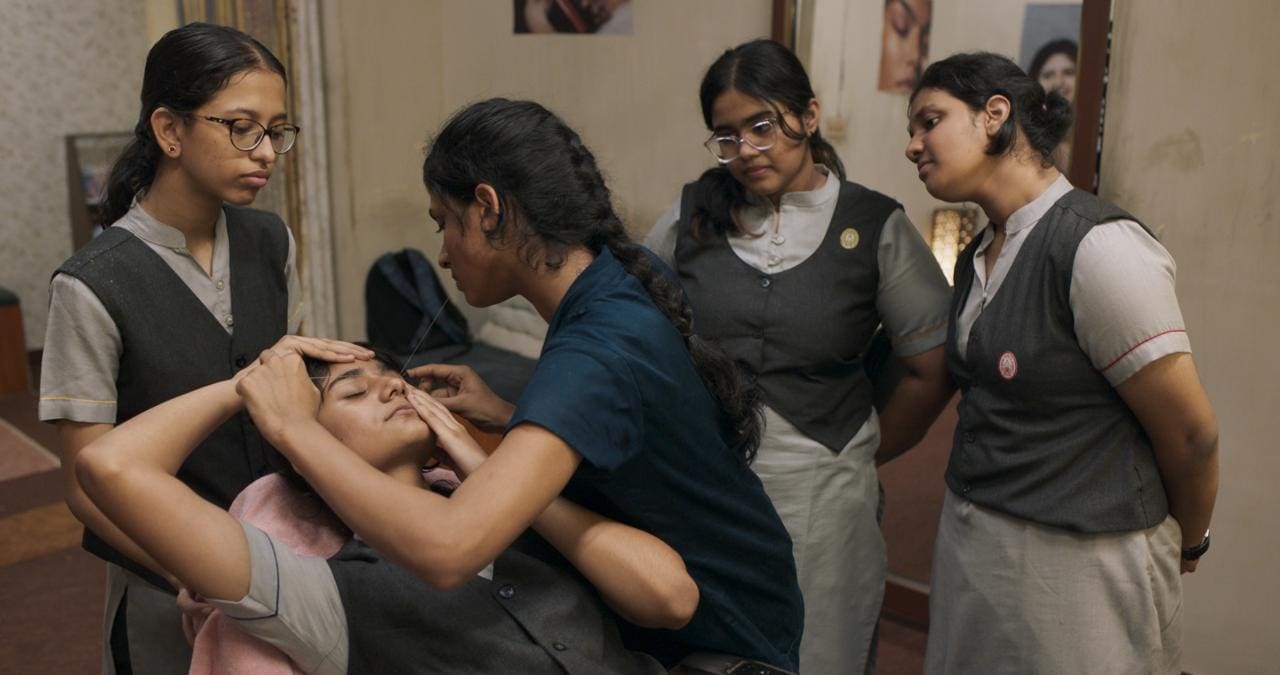
The congested space of a not-so-posh beauty parlour becomes the revealing venue for Victoria’s inner turmoils, the chit-chat of the clients and the rooster's active vocal presence. As Victoria struggles to keep up with the chatter of the clients and the careless behaviour of emotionally unsure boyfriend, the film takes its own pace. The unease presence of the rooster elevates her crisis as the clients are not so sure about the rooster’s presence inside the parlour. The customers are from interesting backgrounds; a rural upper-class pharmacist who is there for some enhancements before her brother’s betrothal, a middle-aged mother who had to come to the parlour under the compulsion of her NRI daughter whom she is visiting, another middle-aged daily wage worker who finds a pleasure in the monthly parlour intimacy and a group of female school band singers. Each of them blends into the intimate space of the parlour as conversations go around anything and everything; from everyday toils to eventful miracles. The performances of the actors within that limited-repetitive space, especially the one who performed the pharmacist, was a treat to watch as it is very crucial since such a space comes with the danger of getting the audience unhooked from the plot.
While the parlour is filled with conversations and crowing, Victoria is walking around the space, constantly using the congested washroom as an excuse to find a breathing space. Her attempts to convince her boyfriend gets nowhere as she gets aware of her parents’ new moves, which unsettles her. As the story moves on, we see Victoria’s struggles to keep up with these minute inner conflicts getting to a point of acute crisis, often like a boiling bowl of water, rising at times. The events that unfold after that involve further stories of miracles and a lately found conviction of Victoria, smoothly getting eased out by an unexpected affective female intimacy in the darkness of that parlour room.
Thus, the story shows the body as an effective medium of interaction. Each touch at the parlour is a sense of solace for some, comfort and pleasure for some and confidence for a few. The functions of the parlour are treated with a focus on these bodily engagements, whether it is the act of threading, bleaching, pedicure or hair dyeing. Body or body parts are involved in each of these acts, which are done with careful affection, that is transmitted and reciprocated. The body is not shown only as a recipient of positive effects of care, as the bodily marks of physical abuse Victoria had to suffer are shown with sonic intercuts during an act of waxing. But the wounds of the body are healed by the presence of Other bodies and bodily intimacies, knowingly or unknowingly.
The presence of the rooster, while read as an allegory for male presence and many other things as it should be, also shows us an opening to the realm of the spiritual as well. Though the impending sacrifice is evidently present, Victoria’s journey to her inner self and conviction is aided by her catching the rooster after it tries to run around the room. The narratives of miracles unfold around it, while the rooster stays silent, aware of the weight of its ritualistic function.
Meenakshi Jayan’s performance as Victoria is excellent as she easily embodies the behavioural traits of a young suburban beautician while carrying the internal contradictions and external crises equally. She elevates certain scenes as the narrative subtlety of the film heavily depends upon her emotional subtlety, which should unfold itself only at a time of acute crisis. Meenakshi excels in this job with finesse. The camera movement of the film is essentially a tracking of Victoria walking around the length and breadth of that space while engaging with the group of clients, which is efficiently pulled off considering the amount of effort for a film that is essentially built on long takes of the everyday mundane inside an eventful beauty parlour. Handheld shots enforces us to not forget Victoria’s shaking inner self. The film, recorded in sync sound, effectively captures the sonic scape of the space which is filled with vocal cues of different themes — of pleasure, pressure, chatter, and crisis.
Victoria offers us a visual peak to the eventful and the everyday at the same time– it provides us with the visual and vocal narratives of actual labour and leisure; the parlour being the space where the curious combination of both happens. It maintains a fine balance between portraying the labour and narrating it while touching upon the questions of morality, beliefs and miracles, without the audience getting pied with any of these loaded themes. It shows the formal grip of the filmmaker who has to actualize an eventful space that affords her physical and mental space to explore the themes that she wants to explore through the every day of a working-class woman for which she even lends out a space of dream beyond that limited physical space out of imagination. The technical support of the film, particularly the art, sound and camera, aids this adventure very well. Thus, Victoria comes out as a strong but subtle statement, in a place where strength is often associated with loudness.
Afeef Ahmed is a PhD candidate at Harvard University.