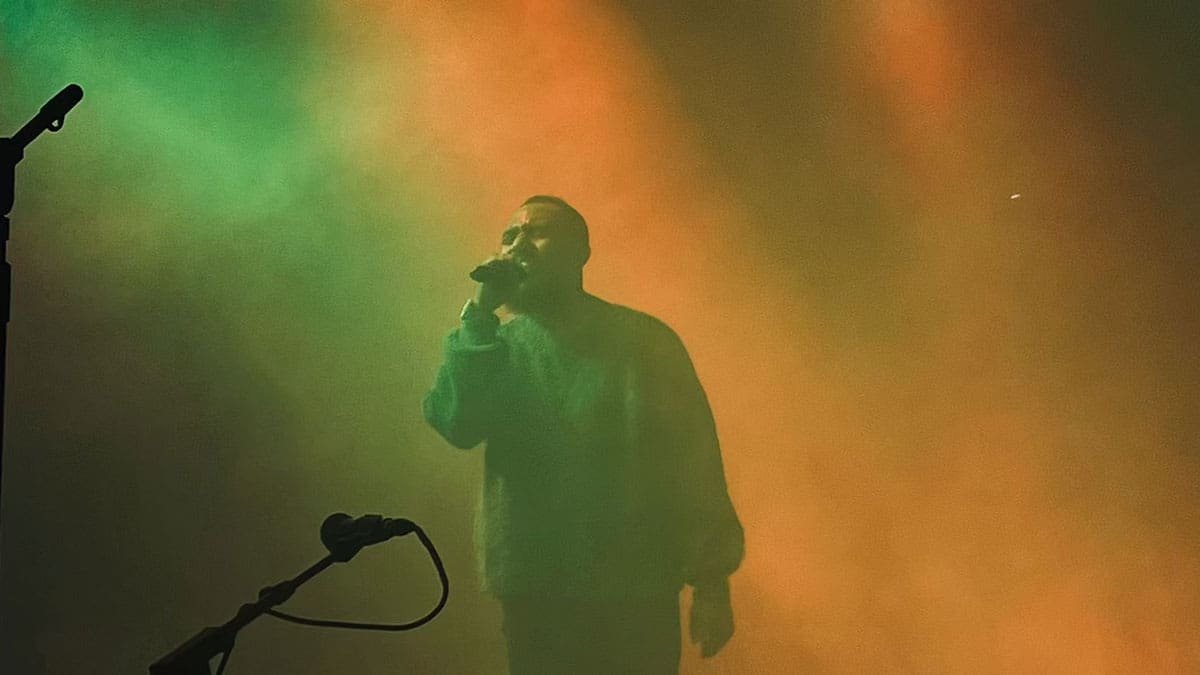
Pasha Bhai fronting the Dakhni Renaissance in Bengaluru

From Neelasandra’s Streets to Bengaluru’s Spotlight, Pasha Bhai’s formidable journey belongs to his reckoning with art as much as it belongs to the fraught linguistic and cultural history of Dakhni.
When asked if the lack of recognition for Dakhni as a language in its own right concerns him, Pasha Bhai, otherwise known as Mohammed Affan Pasha, the frontman of Dakhni hip-hop group Clan Bokka Phod, coolly dismisses any crusading tendencies “You’re not the messiah,” he states. “You’re not saving the language; it’s saving you. It’s embedded in my identity as an artist—I carry it everywhere I go.”
There’s a quiet intensity in his words, a sense that Dakhni is less of a cause and more of a constant—dynamic, organic, and inseparable from his being. For Pasha, Dakhni isn’t something to prove; it simply is.
In the heart of Neelasandra’s labyrinthine lanes, lined with food kiosks, and specks of meat stalls, lies Pasha Bhai’s studio, tucked away, aptly named Dakhnistan. Perched on the fourth floor of an unassuming building in the predominantly Muslim ghetto of central Bengaluru, the spiral staircase leads to a space that is as unpretentious as it is alive. The studio’s bareness belies its creative pulse. A carrom board strikes as its most lively feature, taking centre stage, surrounded by endless animated matches, while Shabnam, their ever-present cat, scurries from one room to another.
As you venture deeper into the studio, the recording room is fervently absorbed by the voices of Pasha Bhai, Syed Ahmed, Imraz Ahamed, and other members of his band ‘Clan Bokka Phod’ – A Dakhni phrase for ‘ball-breakers’. A name that speaks to their dual-edged ethos, Syed explains that it isn’t just a moniker for how they tackle challenges with outsiders — It’s also a nod to the cheeky, relentless banter that flies within the circle. “It’s not just for the one in front of you, it’s also directed at the self”, the crew laughs, gathered in the room. For Clan Bokka Phod (CBP), the name captures both their audacious defiance and the camaraderie that keeps them grounded.
The Clan Before the Music
“The music came later; the Clan was always there,” Pasha Bhai says, exchanging grins with the crew as they recall their beginnings. “We lived so close to each other, and as we started bunking college, our bonds grew stronger.” Pointing to Syed, Pasha adds cheekily, “Everyone told us he used to sing well, but we didn’t believe it.”
“We had no clear ambitions back then. As kids, we’d dream of being pilots or engineers, but they were never realistic. Then, when we started skipping class, more realistic ambitions came into play—like deciding to open up a tarkaari stall ” The group erupts in laughter as Pasha jokes. Having failed in Class 12, and a year of hard work in a garment factory, he found himself wanting the opportunity of pursuing his education. He returned to enrol himself in Evening College.
The room is filled with playful mirth, shared between a group that is akin to very intimate brotherhood and a sense of belonging fraternity amongst themselves, but beneath the humour lies a sense of evolution. “I started off singing other popular Hindi artists’ raps,” Pasha explains. “They’d hype me up, telling everyone their brother’s a rapper. It was half-mocking, half-encouraging. Maybe that’s when I realized I could make my music.”
Despite the jesting and tongue-in-cheek comments, the crew approaches their craft with unwavering dedication. “We’ve always taken our work seriously,” Pasha says. “It’s not about us deserving more—it’s the music that deserves more. No external criticism can ever surpass the relentless ragging that goes on here”
Rooted in Dakhni’s Literary Past
In contemporary times, Dakhni literature has thrived not through written texts but in conversations. “In the absence of a script, dialogue has sustained Dakhni,” Pasha explains. Their music carries the weight of this oral tradition, weaving deep and meaningful Dakhni proverbs into their lyrics.
“When you sit down and really listen, there are indiscernible layers of complexity,” Pasha says. The proverbial influences of Dakhni literature—born from classical texts that condensed wisdom into sharp, resonant sayings—remain relevant and relatable today. Clan Bokka Phod’s integration of these elements has grounded their music in cultural history, while carrying the oral tradition forward, in the nascent scene of Dakhni Hip Hop.
With Clan Bokka Phod fronting the two editions of ‘Ghalat-e-Dakhnistan’, at the Museum of Art and Photography in Bangalore and several performances across the city, including Pasha Bhai’s opening act for Raftaar, his popularity as an artist is soaring.
When Pasha Bhai, sings the lines, “Modi, Godi’k godan’m daalek hallako sab hoga/ Benglur hip hop ku mai angli pakdak challako sab hoga” in a track part of his debut album “Bangalore Ka Potta’, the rap effortlessly intersperses itself with the cutting lyrical composition of an up and coming star in the making.
Growing up on the flip side of the teeming metropolis, entrenched in the grim milieu of violence (Ghusako antadyan me nikaales phasrs plik dekhyun – I have seen guts (intestines) being pulled out and the mess being displayed.) and urban ghettoization there are distinct reasons for Pasha Bhai’s success. His lyrical convictions are grounded in the political and economic marginalization of the Muslim ghettos like Neelsandra in Bengaluru. It is reminiscent of early Black hip-hop artists, and his conscious use of his mother tongue, Dakhni, is an inseparable cornerstone of his identity.
The earliest recorded literary work of Dakhni is “Kadam Rao Padam Rao”, attributed to Fakhruddin Nizami of Bidar, written around 1421 CE, much before the birth and proliferation of Urdu. Both Dakhni and Urdu have roots in Old Dehalvi (Old Urdu) Dakhni is a mix of Persian, Dehalvi, Kannada, Marathi, and Telugu, it traces its genesis to the reigns of the Bahmani and Deccan Sultanates between the 14th and 17th centuries. The lingua franca of the Deccan Sultanate Dakhni Literature only began to dwindle after their fall, as the Mughal Patronage relentlessly demanded a linguistic shift towards Persian. Many Dakhni writers switched to writing in Persian, but Poet Hashmi’s couplet from 1686 rings true to the contemporary status of Dakhni speakers in the country even to this day —
‘Tuje chakri kya tu apnich bol, Tera sher Dakhni hai, Dakhnich Bol’ (What is your worry, Speak as you will, Your verses are Dakhni, Let Dakhni be your tongue)
Today, Dakhni has constantly evolved, branching into regional dialects. Despite its deteriorating literary influence, it persists in the tongue of several south-Indian Muslim and Muslim communities alike. Often subjected to the ill-informed reputation of ‘Broken Urdu’ and a ‘dialect of Urdu’, the language and its speakers are dispossessed in dominant cultural discourse. Dakhni is mischaracterized as ‘Hyderabadi Urdu’ despite Dakhni today being spoken across the cities of Hyderabad, Bidar, Bangalore, Mysore, Chennai etc.
Acutely aware of this context, Pasha Bhai addresses the fraught tensions between Urdu and Dakhni and the myth of a broken dialect with cutting precision, both through his music and his authentic cadence. Dakhni is often categorized as an ‘unclean’ and ‘crude’ tongue, in comparison to the romantic celebration of Urdu as the universal language of love and ‘tehzeeb’ (Etiquette) — The liberal elite of the nation have engaged themselves in producing a culture of heralding an almost clean and depoliticized rendition of Urdu, while Dakhni is reduced to a criminalized afterthought, fragmentary offshoot, unworthy of preservation and study. Despite this reverence, the institutional support for Urdu is dwindling while the sites of Urdu and Islamic education (Madrasas) are often denigrated. When Urdu, despite its romantic reverence, stands at the risk of institutional disenfranchisement under the saffron state, Dakhni is even more so under the threat of erasure and misrecognition, compelled to be reduced to a mere ‘dialect’ of a larger language; despite being spoken by a large section of the southern states.
This tension however is one of false consciousness, Pasha Bhai cheekily undercuts this binary with one of his moorings, “Tume bohotich paak, Humein behadd galeez” (You are utterly pure, and we are extremely filthy). To him, Dakhni and Urdu are bound by lineage, drawing a familial parallel between the two wherein Dakhni is not only the historical predecessor but a significant force in developing the Urdu literary canon. The tragic rise and fall of the Dakhni literary tradition is kept alive in his music, locked into incisive and piercing verses that are breaking into the culture.
Dakhni Hip Hop, Neelsandar and the city of Benglur
“Dakhni has been invisibilized for the longest time. I see this when people demand that I rap in Kannada alone, the irony is that Dakhni has been a part of the cultural landscape ever since the birth of Bangalore.” Pasha says. From several Sufi shrines catered to local Dakhni residents to Tipu Sultan’s patronage of Dakhni literature — Dakhni has, in all likeness, encompassed the fabric of Bengaluru for centuries now.
Neelsandar gives a glimpse into the origin story of how Mohammed Affan Pasha became Pasha Bhai while growing up in a towering city, engulfed in Neelasandra’s underbelly of violence and urban institutional marginalisation. Notoriously feared by many Bangaloreans, the neighbourhood was known for crime, sheltering many rowdy sheeters and its animosity with neighbouring areas that according to legend took generations to settle. Neelasandra’s space in the city is also a testament to the communal grit and fortitude, rooted in the multiculturalism of the city — a stark contrast and respite from the bourgeoise technocratic imagination of the city.
In the song, Pasha Bhai speaks about growing up in Neelasandra, recalling the past from the time he was born till the passing away of his father. The story is of an unsuspecting young boy whose circumstances compelled him to grow up way before his time as well as an ode to the neighbourhood that continues to shape the person he is becoming.
Pasha has explored music in several languages but the conscious choice of arriving at Dakhni as his own has been an act of reclamation and authenticity. A coveted act during the Anti-CAA protests in Bengaluru, Pasha Bhai has established himself in the legacy of dakhni artists revitalizing the language’s materiality and essence.
His unorthodox love letter to the city, “Bangalore ki Dastaan” has amassed abundant acclaim, self-reflective in parts, ultimately satirizing the contradictions and the internal politics of his community, the track captures the essence of a rap underdog — coolly nonchalant yet in possession of an undeniable presence, delivering a performance that’s as raw, cocky and authentic as it is effortlessly suave.
The Affordances of Dakhni – Where Levity, Satire, and Political Intent meet
“There are liberties I can take with Dakhni”, he jests, “There is no official structured vocabulary here, the music we make adds to the record of the language.” Pioneering the syntax of a contemporary Dakhni lexicon, Pasha Bhai is India’s first Dakhni rapper and his discography is a masterclass in ingenuity.
“Hip Hop has been the tool and medium of fighting oppression, fighting White Power. As a Muslim man, things are happening around us that we simply cannot ignore, they translate into our music regardless, It is impossible to sever the two”, he says, reflecting on the politically charged theatrics of his tracks. Pasha’s influences are steeped in the intrinsic anti-establishment authoritarian history of African American Hip-Hop.
In Takbeer, a potent track decrying the occupation of Palestine and the power of the people’s movement and martyrdom. He doesn’t back down from joining the oeuvre of formidable anti-establishment artists, as Takbeer harkens and bears witness to a sharp parallel to Babri masjid.
On one hand, Aidavalli, speaks to the survival of a young Muslim in a rapidly communalizing Bangalore in the aftermath of the Tablighi Jamaat and DJ Halli violence (dubbed Bangalore riots) that followed soon after in August 2021. On the other hand, using the rituals part of Muslim wedding functions as metaphors, the song challenges practices that have held the community back in various ways.
Tumare Bawa is a Dakhni slang term that describes this flippant attitude that becomes a byproduct of epistemic violence against Muslims. The song encompasses the crux of police brutality and its aftermath, writing in the hardships brought on by working-class oppression inseverable from Pasha’s deeply personal ruminations. So much more to his discography, his body of work is a testament to one of the most profound ideations of our time.
In a milieu where the symbols of a marginalized faith and community are hiding in plain sight, constantly under threat—bulldozed, erased, and violently wiped out by the regime— the enmeshing of Faith and sufi mysticism dominates Pasha’s music. In their seminal track, Khuda Gawah, Clan Bokka Phod masterfully intertwines the concept of God-bearing witness (Badi Taanashahi, Mera Khuda Gawah Hain/ Great Tyranny, My God is Witness), with visuals and poetic segments that evoke the depth of Sufi lyricism. While the fusion of Dakhni rap with traditional Sufi elements may come across as an unconventional aberration to purists, Clan Bokka Phod is pioneering a new genre of Sufi music that resonates with the 'flavor of Neelasandra.'
“Until now, reproductions of Sufi art have always focused on sanitized language and pristine imagery, but our reimagination comes from the local language we speak,” says Imraz Ahmed, a member of CBP. Pasha Bhai elaborates, “The song is steeped in spirituality, yet it’s punctuated with our comedic interjections and stories. There's a sense of relatability and humanization, extending to the common man. It’s a track that acknowledges our relationship and consciousness with the creator while infusing it with the comedic and honest aspects of our lives. The listener is introspecting his relationship with God, and with our comical elements, they know that we come from the same place they come from.”. Pasha Bhai believes that the humour that accompanies Dakhni culture holds a mirror to the lives we live every day.
Hato saab hame chodti ni zarri jaga, Chaabdaltin gud nai so nalli taka
Fronting Dakhni Rap with Humor, Resistance, and Depth
Comedy is the intoxicating vessel through which Pasha Bhai's music satirizes pain and the afflictions of despair. "We don’t lament over our struggles in our music; we explore them with a touch of levity and comedic amusement. It’s almost a way of saying—look at how interesting our lives are!" Pasha explains. What distinguishes their art from conventional tropes and easy typecasting is this infectious light-heartedness, which permeates even their most hard-hitting social commentaries. Clan Bokka Phod’s rap defies easy categorization, rendering itself almost impossible to pin down and pigeonhole, refusing to be confined to pre-existing genres of expectations—constantly straddling the line between the clarity and the complexities of pain, while embracing a lucid and carefree composure — reminiscent of a distinctive emerging star.
When asked whether this levity stems from the language itself, Pasha readily acknowledges that Dakhni inherently carries an impeccable comedic essence. However, he is quick to point out the problem: “The representation of Dakhni in popular culture has produced this stereotype that comedy is all there is to our lives, that we are incapable of seriousness. But that isn’t the case, with Dakhni, there is poetry, there are bars, and comedy isn’t all there is. In Takbeer, it is five minutes of hard-hitting poetry, the music encounters the contradictions and the hypocrisy entrenched in the system, and you don’t find a moment to laugh there. The song is rife with an Inquilabi Jazba (revolutionary fervour), and many stereotypes are being broken along the way”
The caricaturisation of Dakhni-speaking Muslims has long been a staple in various corners of the internet, where they are often reduced to sources of laughter, occupying the role of the proverbial court jester. Many unknowingly invoke what is disparagingly referred to as "Shivajinagar Urdu" to craft cartoonish parodies, turning Dakhni-speaking Muslims into hollow stereotypes devoid of depth or complexity. In this process, the figure of the parodied "Dakhni Muslim" emerges, stripped of sentience and reduced to a punchline. What seems like harmless exaggeration, ends up reinforcing a new axis of invisibility for Muslim lives. By relegating an entire community's linguistic and cultural identity to mere comic relief, such portrayals erase the full spectrum of their humanity. Pasha’s smooth discography, a mix of both funky absorbed tracks like Kumbhakarna, Raju Supari, and Adikass with grave nuanced contemplations in collaborations like Khuda Gawah and Ye Hai Siyasat pose an incriminating resistance to such pervasive stereotypes.
Despite the simmering elitism within India’s contemporary hip-hop scene, Pasha Bhai has carved out a distinct niche, steadily earning the spotlight with his recent releases. “There’s a lens of casteism and classism through which people see us—they look down on us,” he says, his voice unwavering yet calm. “But we’ve accomplished so much in such little time.” Pasha’s confidence is rooted in his journey and the transformative power of hip-hop. “That’s the power hip-hop grants us—it allows us to come from nothing and make a name for ourselves.”
The India Foundation for the Arts awarded Pasha a grant in 2021 to keep the Dakhni language and culture alive through the art and practice of hip-hop The project aims to embody Pasha’s deeply personal materiality with the culture of Dakhni that grounds itself in the city’s history. With his soaring popularity, from his tracks for an Amazon web series to the Kannada film industry, Pasha has taken the plunge into becoming the smooth yet rugged poster boy of Dakhni rap. His audacious talent and spunk seem to only be the beginning of a Dakhni renaissance waiting to be ushered in.
This pulsing rhythmic, cocky segment from the piece ‘Pasha Bhai’ best exudes his electric persona and the magnetic allure of his music —
Taakit dene ain so, konse acche yhan zamane wale? Paet bhare admiyan hame, hadh se zyada
khane wale Thas-se-mas hue ni kabbi, thakge ja bhaganewale Hamna gadaa khodko, khud ich
dabge yhan dabanewale
(How good is this world that preaches manners to me? We’re beasts with bellies full, yet always wanting for
more Never flinched an inch, even those pushing are now tired Those trying to dig my grave have themselves fallen into it)
Rida Fathima is a student of Literature and History at Azim Premji University.