Remembering Shahid Azmi on his 15th Death Anniversary

“I’ve died a hundred times, and if death did come knocking, I would look it in the eye.”
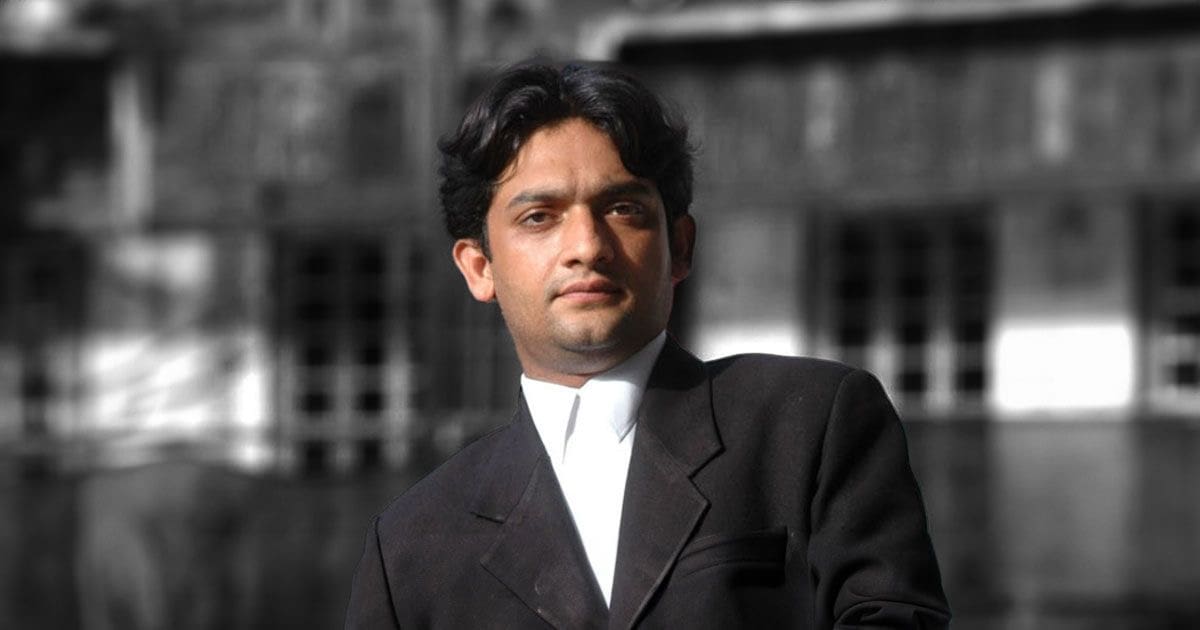
These are the words of the brave lawyer Shahid Azmi, who was shot dead 15 years ago on this day in his chamber in Kurla Taximens Colony.
Shahid Azmi, known as the “crusader for justice,” was only 32 years old when bullets pierced his chest for his determination to dismantle systemic injustices.
On February 11, 2010, assailants disguised as prospective clients shot him at point-blank range. He was rushed to the hospital, where he was declared dead.
Born and raised in Shivajinagar, Mumbai, Shahid Azmi lost his father at a young age. At 16, he was deeply affected by witnessing the 1992 Mumbai anti-Muslim riots and the way Muslims were targeted in India.
His lived experiences led him to leave Mumbai and join a separatist organization in Kashmir, but within a few months, he distanced himself from the group and returned to Mumbai.
Later, Azmi was arrested in 1994 by the Special Investigation Team (SIT) of the Delhi Police on charges of allegedly conspiring to kill a prominent politician in India. He served seven years in prison until he was acquitted of all charges and released in 2001.
Azmi later revealed that he was subjected to brutal torture by the Delhi Police during his remand and forced to confess to false statements.
While awaiting trial in Tihar Jail for a crime he never committed, he completed his 12th grade and obtained a Bachelor’s degree in Arts. After his acquittal, he returned to Mumbai and earned his law degree from KC College.
His struggles with the legal system inspired him to practice as a defense lawyer, defending those falsely accused of terrorism—a pursuit that labeled him a “terrorist lawyer.”
In 2008, Azmi filed a petition in the High Court against Swati Sathe, a jail superintendent, accusing her of torturing the accused in the 7/11 Mumbai train blasts. The subsequent inquiry confirmed the allegations, bringing Azmi into the limelight.
In his seven-year practice, Azmi fought numerous cases, representing those he believed to be wrongly accused in high-profile “terror cases” in Mumbai—a task marked by immense difficulties, danger, severe allegations, drawn-out trials, and societal prejudice.
Notable among them was Faheem Ansari, who was arrested by the Mumbai Crime Branch for allegedly aiding Pakistani militants during the 26/11 attacks.
Ansari was discharged by the court in May 2010 after 12 years of detention, just a few months after Shahid Azmi’s death in February 2010. The late Shahid Azmi, who had fought his case pro bono, did not live to witness the acquittal.
Guided by the words of Roy Black, an American civil and criminal defense lawyer—“By showing me injustice, he taught me to love justice. By teaching me what pain and humiliation were all about, he awakened my heart to mercy. Through these hardships, I learned hard lessons. Fight against prejudice, battle the oppressors, support the underdog”—Shahid helped to free dozens of Muslim youths accused of terrorism over the years, who otherwise might still be languishing in jail for crimes they never committed.
Shahid was involved in defending the accused in the 2002 Ghatkopar bombing, the 7/11 Mumbai train blasts, the 2006 Aurangabad arms haul, and the 2006 Malegaon bombing.
He secured the acquittal of 17 men charged with terrorism in just seven years as a lawyer, including the 2016 acquittal of nine Muslim men in the 2006 Malegaon blasts.
Despite receiving death threats, Shahid lived his life with vitality and courage, driven by his mission to defend those marginalized by the system. For the justice he sought, he paid the heavy price of his own life.
The accused—Devendra Jagtap, Pintu Dagale, Vinod Vichare, and Hasmukh Solanki—were arrested and charged under sections 302 (murder), 120B (criminal conspiracy), and 452 (house-trespass after preparation for hurt, assault) of the IPC, along with sections 3 (license for acquisition and possession of firearms and ammunition), 25 (punishment for certain offenses), and 27 (punishment for using arms, etc.) of the Arms Act. These four men were later released on bail. Another accused, gangster Santhosh Shetty, a former aide of Don Chhota Rajan, was discharged from the case in 2014.
“Thirty-eight witnesses have been examined so far, and more will be presented by the prosecution. It is expected that the trial will be concluded soon, as it is in the final stage,” said Naushad Ahmed, lawyer for the murderer of Shahid Azmi, hoping that justice will be served.
Shahid’s work and legacy have inspired hundreds of young people across India to take up law as a career and fight for justice for the falsely accused.
Shahid’s younger brother, Khalid, inspired by his brother, is now a practicing lawyer, fighting for the people Shahid originally represented.
Despite facing constant threats to his life—including an alleged murder plot by underworld gangs in April 2011 and a threat from an assistant registrar in November 2011 to meet the same fate as his brother for handling such cases—he continues to follow the path Shahid set.
“He has been everything to me. He has supported me in everything, and he never disappointed me,” said Khalid, remembering his brother.
Abdul Wahid Shaikh, who was acquitted nine years later in the Mumbai train blast case, has now acquired a law degree. Having been represented by Shahid Azmi in his case, he now campaigns for those wrongfully jailed, including the other twelve accused in the 2006 Mumbai train blast case alongside him.
At The 8th Advocate Shahid Azmi Memorial Lecture, organized by Innocence Network—an NGO established by Wahid Shaikh and other family members of the falsely accused—speakers alleged that Shahid’s assassination is emblematic of the deep state’s complicity in silencing voices of dissent.
“His death underscores the lawlessness and planned targeting of those who challenge the state’s oppressive machinery. Shahid stands among the martyrs of democracy and human rights, a symbol of resistance against a system that seeks to suppress justice,” says Wahid Shaikh.
Even after 15 years, Shahid Azmi’s legacy continues to shine as a beacon of hope in the fight against systemic oppression and for a more just society.