Discipling dissent: How Jamia campus is forced into submission

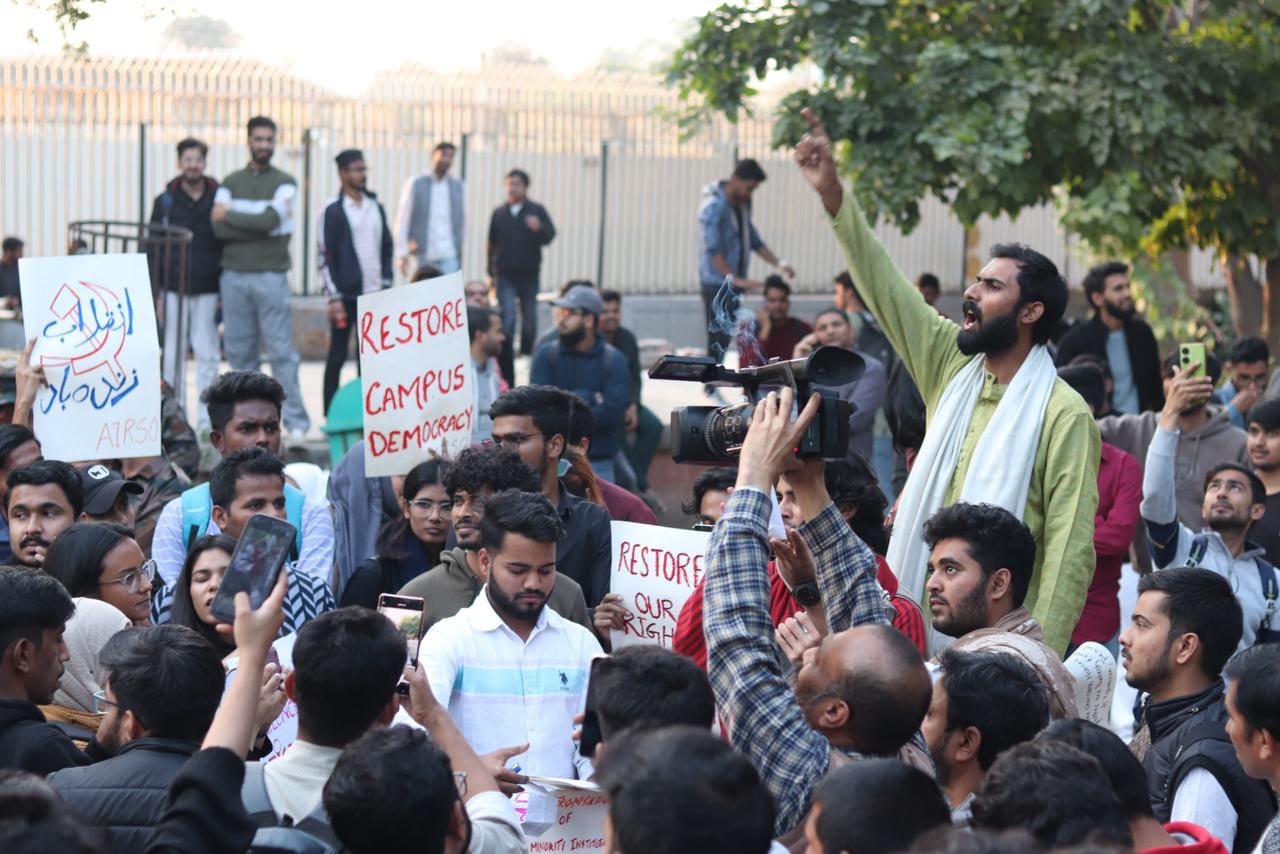
Every year on December 15, Jamia Millia Islamia becomes a site of remembrance as students gather to mark a moment that remains an indelible stain on the credibility of the Delhi Police—the violent crackdown on anti-CAA protesters in 2019. But in today’s political climate, remembrance itself is treated as defiance. This year, as students put up posters across campus and social media, the administration moved swiftly to suppress any sign of dissent. A week before the event, the Proctor’s office issued a notice warning against demonstrations, threatening disciplinary consequences for those who refused to comply.
Then, in a move as transparent as it was calculated, the administration abruptly shut down the campus, including the library and administrative offices, citing “maintenance.” No one at Jamia was fooled. The timing was too convenient, the intent too obvious. Rather than instilling fear, the notice became a meme—a symbol of the university’s increasing subservience to state directives. In today’s saffronised academic spaces, repression arrives not only through police batons but also through bureaucratic manoeuvres that preempt protest before it materialises. But students understand the game. And they remember.
Jamia’s repressive restructuring must be seen within the broader context, where universities are systematically disciplined into submission. The recent appointment of a new Vice-Chancellor, after nearly a year of administrative limbo, coincides with a series of measures designed to neutralize campus activism. The criminalization of graffiti under the Delhi Prevention of Defacement of Property Act (2007) and the unprecedented appointment of a former police official as Security Advisor reflects a deliberate shift toward securitization. These developments are not incidental; they are part of a state-led imperative to eliminate universities as spaces of resistance.
Jamia occupies a unique position in India’s political history. Founded in 1920 as an anti-colonial project against British-controlled education, it has remained a recurrent site of political contestation. From the anti-emergency movements to the anti-CAA protests, the university has been at the forefront of student resistance. The December 15, 2019 police crackdown—where students were brutally assaulted inside the library—was a stark reminder of how the state now perceives universities: not as spaces of critical thought but as threats to internal security. The intensified surveillance and punitive mechanisms that have followed are part of a deliberate effort to foreclose the possibility of future mobilizations.
What is unfolding at Jamia is not merely an administrative tightening of rules; it is the restructuring of a university into a securitized, depoliticized space. The convergence of bureaucratic and law enforcement apparatuses within the institution mirrors the larger authoritarian project of transforming universities from spaces of intellectual ferment into factories of ideological conformity. This erosion of academic freedom is not unique to Jamia—it is part of a national trend where campuses are being turned into laboratories for state-led discipline and control.
The recent ban
Jamia Millia Islamia’s latest crackdown on student dissent marks a new chapter in the authoritarian reconfiguration of university spaces. Days after students voiced opposition to Sambal violence, the administration issued an order banning protests, dharnas, and slogans against constitutional dignitaries, explicitly warning of disciplinary action. This directive does not merely prohibit demonstrations; it effectively criminalizes student activism and signals a broader project of institutionalizing repression. The timing of the decree—alongside enhanced surveillance and financial penalties for graffiti and posters—reveals a calculated strategy to excise dissent from the campus landscape.
This coercive turn must be read within the larger state project of depoliticizing universities, where student resistance is increasingly framed as a law-and-order concern rather than a democratic exercise. The sharp condemnation from the All India Students’ Association (AISA), which accused the administration of acting as a “mouthpiece for the BJP-RSS agenda,” underscores how institutions are being structurally aligned with the ruling regime’s ideological imperatives. The crackdown at Jamia mirrors similar measures at Jawaharlal Nehru University (JNU) and Aligarh Muslim University (AMU) —spaces historically known for their radical intellectual traditions, now transformed into controlled environments where dissent is preemptively stifled.
The university’s imposition of fines up to ₹50,000 for defacement, the invocation of the Delhi Prevention of Defacement of Property Act (2007), and the use of the Bhartiya Nyaya Sanhita (BNS) to justify legal action against student activists reflect an emerging punitive framework. These measures are not about maintaining campus decorum; they represent a deepening juridical assault on student resistance. The administration’s alignment with state imperatives is evident in the increasing securitization of campus, the growing surveillance apparatus, and the strategic use of bureaucratic tools to control expression.
Jamia’s transformation into a securitized space is a direct continuation of the repression that followed the anti-CAA protests of 2019. The administration’s shift from episodic crackdowns to an enduring architecture of repression reflects a broader political project—one that seeks to eliminate universities as spaces of organized opposition. The gag order on student voices is not an anomaly; it is a blueprint for the future of dissent in Indian academia.
The Militarization of Jamia: Surveillance, Policing, and Fear
Jamia Millia Islamia today bears the unmistakable marks of a securitized campus, where the presence of police and surveillance structures shape the daily experiences of students. The Delhi Police and paramilitary forces have become a permanent fixture around the university, their deployment intensifying whenever the administration anticipates unrest. The pattern is predictable: ahead of politically sensitive dates—such as the anniversary of the Babri Masjid demolition, the commemoration of the anti-CAA crackdown, or national events that students might respond to—the police presence swells. Barricades are erected, patrols increase, and students entering and exiting the university are subjected to scrutiny. What should be an institution of learning increasingly resembles an occupied territory, where dissent is framed as a security threat rather than a fundamental right.
Beyond visible policing, the administration has institutionalized subtle but effective mechanisms of control. During student-led events or protests, entry and exit points are locked down, creating an artificial siege that isolates students and prevents gatherings from gaining momentum. Even routine movement between departments has been turned into a bureaucratic ordeal. Notices affixed to university gates make it clear that digital copies of ID cards are unacceptable, and any student who forgets their physical card is denied entry—effectively sent home, regardless of distance. These measures, justified under the guise of maintaining order, serve a deeper function: discouraging congregation, frustrating collective action, and ensuring that any form of mobilization is met with immediate logistical barriers.
This repressive architecture was on full display when students attempted to screen the BBC documentary India: The Modi Question. The screening was swiftly shut down, and students involved were detained—a stark reminder that even an act as simple as watching a film critical of the Prime Minister is considered a punishable offence. The administration’s response was neither spontaneous nor reactionary; it was part of a well-calibrated system designed to eliminate even the possibility of organized defiance. The events surrounding the documentary screening are not an isolated aberration but a clear manifestation of the university’s broader transformation into a space where repression is the norm.
The shift in Jamia’s policing and surveillance mechanisms must be seen within the larger framework of state control over student activism. The administration’s increasing alignment with state security forces reflects an authoritarian impulse that extends beyond Jamia to university spaces across the country. The securitization of student life, the criminalization of political expression, and the active policing of intellectual discourse together constitute a deliberate project: to neutralize campuses as sites of critical engagement. The presence of police outside Jamia’s gates is not just a deterrent; it is a warning, a permanent reminder that students exist under watch and that the consequences of dissent are immediate and severe.
The transformation of Jamia into a militarized site is not incidental but structural. What was once an institution known for intellectual resistance is being steadily re-engineered into a space of submission. The state’s intent is clear—to ensure that students do not merely comply with the rules but internalize the cost of defiance. Fear is not a byproduct of repression; it is its primary objective.
From a University to an Obedient Institution
The systematic repression unfolding at Jamia Millia Islamia is not merely about campus discipline—it is part of a larger ideological project to hollow out universities as spaces of critical thought. The university, historically a battleground for political discourse, is being restructured into a domain of controlled obedience, where students are expected to absorb knowledge without questioning power. This transformation is not unique to Jamia; it is emblematic of the larger shift, which seeks to delegitimize dissent and reconfigure educational institutions into sites of ideological reproduction rather than intellectual resistance.
At the heart of this project is the shrinking space for academic freedom. Universities have long functioned as incubators of debate, spaces where ideas—especially those critical of the state—can be nurtured and challenged. But when political expression is criminalized, when student activism is framed as a security threat, and when administrative crackdowns become routine, the fundamental nature of higher education is altered. The presence of police, surveillance, and punitive measures creates an atmosphere of self-censorship. Students begin to weigh the risks of political engagement, not just in terms of disciplinary action but in terms of their futures—placements, scholarships, and even personal safety. The chilling effect is deliberate: if universities can be turned into spaces where questioning the state becomes too costly, then an entire generation can be depoliticized before it enters the public sphere.
The consequences of this repression extend beyond individual students to the very function of student movements in shaping political consciousness. Historically, student activism has been at the forefront of political change in India—whether in the anti-colonial struggle, the JP movement of the 1970s, or the protests against caste and religious discrimination in recent decades. By silencing student voices, the state is not only stifling immediate resistance but also severing the pipeline of future dissidents, activists, and thinkers. The transformation of Jamia into a controlled institution is part of a broader state strategy to create universities that produce compliant citizens rather than engaged intellectuals. The ideal student in this new framework is one who excels academically but does not question the world beyond their syllabus.
By erasing political engagement from campuses, the regime can foster a culture where ideological conformity is normalized. The imposition of bans on protests, the criminalization of political expression, and the surveillance of students all serve a singular purpose: to create institutions where obedience is not enforced but internalized. In this framework, universities cease to be sites of knowledge production and become instead instruments of state discipline, manufacturing not critical thinkers, but passive subjects.
Resisting the Takeover
If universities are sites of knowledge production, they are also terrains of struggle—spaces where the battle over ideological hegemony plays out in deeply contested ways. The increasing repression of student activism at Jamia Millia Islamia cannot be understood in isolation; rather, it must be framed as part of a larger struggle over the nature and purpose of higher education in an era of authoritarian consolidation. The BJP-RSS project of saffronizing academia—through curricular revisionism, administrative purges, and institutional policing—is not merely about controlling dissent but about reconstituting universities into obedient instruments of state ideology. In such a climate, student resistance is not just an act of defiance; it is an existential necessity.
In response to the latest prohibitions on protests, student groups such as the Fraternity Movement, Students India Organization (SIO), All India Students’ Association (AISA), and the Students’ Federation of India (SFI) have launched sharp critiques of the administration, calling for broader mobilization. These organizations have framed the clampdown not as an isolated administrative decision but as part of a systematic effort to dismantle the political agency of students. Their analysis aligns with the Gramscian understanding of hegemony, wherein coercion operates alongside consent, and institutions of civil society—including universities—become key sites for manufacturing ideological conformity. By resisting these prohibitions, student movements directly challenge the state’s attempt to produce a depoliticized, acquiescent academic sphere.
Historically, organized student resistance has been one of the most potent forces against authoritarian encroachment in India. From the anti-colonial movements of the early 20th century to the anti-emergency protests of the 1970s and, more recently, the anti-CAA mobilizations, students have played a crucial role in resisting state oppression. In each of these instances, universities functioned as nodes of political radicalization, enabling the cross-pollination of ideas and solidarities that extended beyond their campuses. This is precisely why the current regime views student activism as a direct threat—why it seeks to transform institutions of higher learning into depoliticized training centres for market and state imperatives rather than spaces of intellectual and political ferment.
If Jamia’s securitization and silencing measures represent an attempt to neutralize dissent, they also contain the seeds of their own resistance. Already, solidarity networks between Jamia, Jawaharlal Nehru University (JNU), Aligarh Muslim University (AMU), and other campuses are forming, echoing previous moments of collective student insurgency. This inter-university solidarity is crucial—not only because it broadens the scale of resistance but because it disrupts the state’s strategy of isolating dissent within individual institutions. The crackdown on student movements is not a Jamia-specific phenomenon; it is a national project aimed at reconfiguring education as an apolitical, technocratic domain. In recognizing this, students must frame their resistance not merely as a reaction to administrative policies but as part of a larger struggle against the transformation of universities into sites of ideological and political subjugation.
The fight for campus democracy, then, is inseparable from the fight for democracy itself. If universities are laboratories for the ideas that shape society, their saffronization signals a broader attempt to normalize authoritarian governance, where state legitimacy is beyond question and dissent is recast as sedition. The challenge before student movements is not just to resist individual policies but to assert an alternative vision—one where education remains a space of critique, contestation, and radical imagination. The legacy of resistance at Jamia and other universities suggests that such a vision, though under siege, is far from extinguished. The struggle continues.
Huzaiful Reyaz is a student at Jamia Millia Islamia with a keen interest in religion, history, and politics. He explores the intersections of these fields.