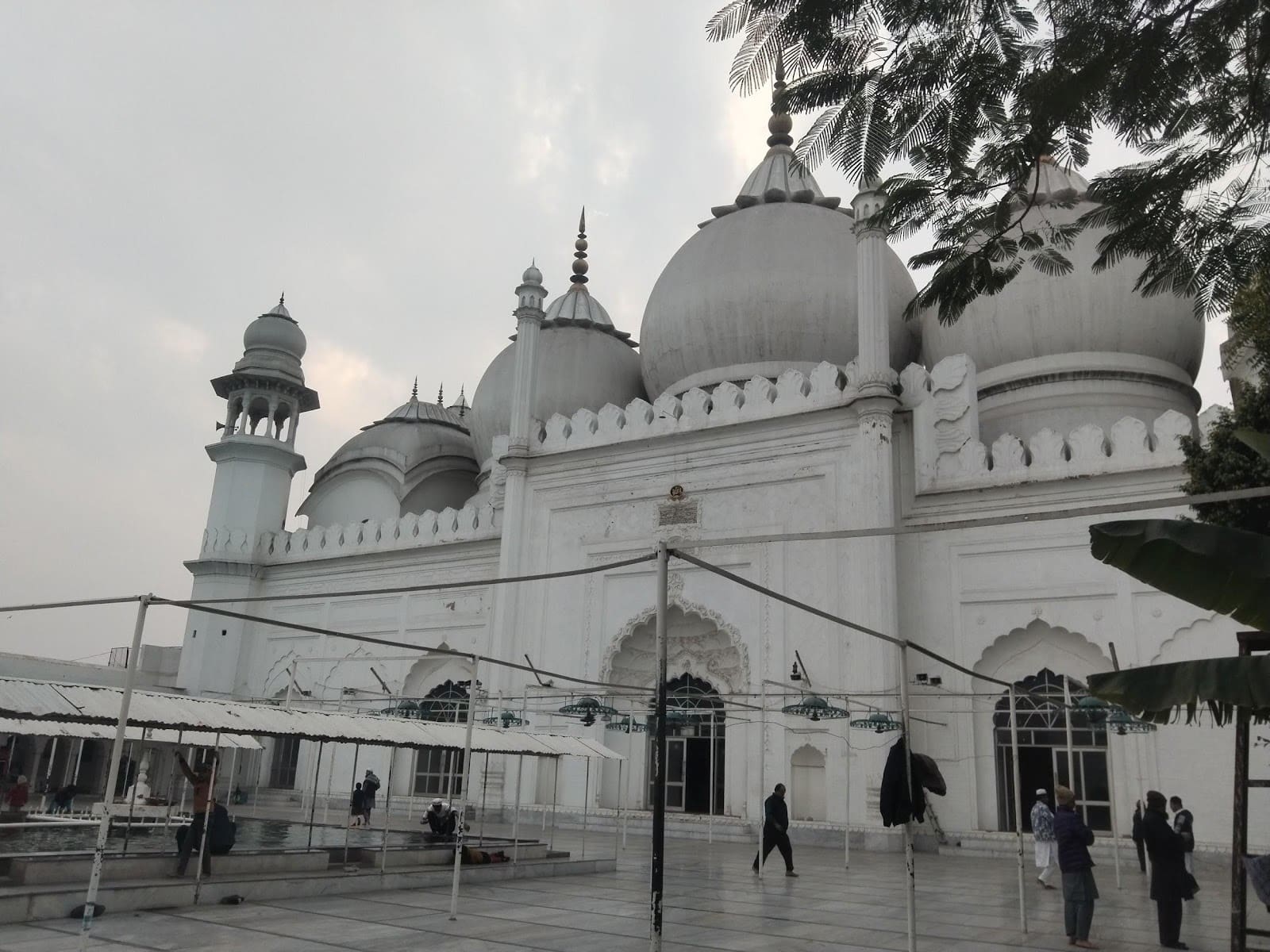
Aligarh Jama Masjid petition: Disputed narratives, historical fallacies

In June 2021, Pandit Keshav Dev Gautam, a self-styled ‘anti-corruption activist’ and national Chief of Bhrashtachar Virodhi Sena (BVS), filed a petition with the Municipal Corporation of Aligarh under the Right to Information Act, 2005, demanding information about the Jama Masjid of Aligarh. He claimed that the response revealed that the Jama Masjid of Aligarh, situated in Upperkot, was constructed on “Public Land.”
In a letter to the Chief Minister of Uttar Pradesh, Yogi Adityanath, in May 2022, demanding a probe, stating that he would approach the court if his demands were not addressed. However, the Aligarh Municipal Corporation had already dismissed those claims.
“I am a Sanatani, social worker, and RTI activist. I follow the thoughts that arise during moments of dhyan (meditation) each morning and night. I focus on what draws my attention during dhyan and write it down”, Keshav Dev introduced himself to me when I interviewed him at his office in Banna Devi, two kilometres away from the Jama Masjid.
Following the response from the Municipal Corporation, he also wrote to the District Magistrate demanding the demolition of the mosque.
In 2022, he said that two FIRs were registered against him when he first made his claims public surrounding the controversial Petition. “The cases are still ongoing, the administration said I was attempting to incite violence. The charges will be struck down soon,” he said confidently.
Pandit Dev filed a petition in the Aligarh district court on January 6, 2025. The petition claims that the mosque occupies public land illegally and was built over a Shiva temple. The hearing is set for February 15, 2025.
Facts and Fabrication
Citing Jahangirnama, the autobiography of Jahangir, written between 1610-17, Pandit Dev claimed that the mosque had been built on public land by Sidha Khan, who ruled Aligarh on behalf of the Mughals. He wanted to build a palace on a hilltop, which the locals resisted as it breached their privacy.
According to the Hindutva activist, when the Mughal emperor visited the site following complaints by the locals, Khan said he was building a mosque and not a palace.
However, Jahangirnama, precedes Sidha Khan’s time, who ruled the region during the time of Aurangzeb (1658-1707), hence, such a mention in Jahangirnama can be contested for its fabrication. When confronted with this argument, Dev altered his earlier statements, exposing inconsistencies in his arguments.
"There was no Masjid in 1753 during the time of Raja Surajmal."
However, it was during the reign of Mohammad Shah (1719-1728) that the construction of the Jama Masjid began under Sabit Khan, the Governor of Kol, in 1724. His gravesite still lies 700 meters away from the mosque. The construction took four years, and the mosque was completed in 1728.

Reja Muhammad, wrote one of the first prominent accounts of the city in Persian, in 1740, called Akhbar-ul-Jamal. In his account, Reja noted that the total area of the Jama Masjid constructed by Sabit Khan was 4,004 square yards at that time.
A senior Professor of History at Aligarh Muslim University Syed Ali Nadeem Rezavi who also serves as the secretary of the Indian History Congress said, “The mosque does not belong to Jahangir's period at all. There may have been several mosques, including structures in the old city of Kol and the Upperkot area, which date back to the early Sultanate period. There is also a tomb from the time of Babur, along with structures from the Khilji, Tughlaq, and other periods.”
When questioned Dev regarding the correct timeline of the Mosque's construction, he claimed that the mosque was occupied by the Muslims in 1938, according to the RTI response he received.
“As far as the Jama Masjid of Kol is concerned, it is the last of the Mughal monuments which is also associated with the revolt of 1857. They neither know anything about the history of this period nor are they concerned about it.”
During the 1857 rebellion, the mosque’s Imam, Maulana Abdul Jalil, led teachers, students, and locals in fighting the British. A total of 73 people, including Maulana Abdul Jalil, were martyred. The northern section called “Ganj-e-Shaheedan” (Cemetery of Martyrs) of the mosque holds the graves of some of these martyrs.

The Aligarh Fort: Architecture, Myths and Conflicts
The main fort of Aligarh, built on a small rise, on the northern side of the Aligarh Muslim University at Barauli road was first constructed by Raja Budhsen of the Dor Rajput dynasty, who ruled from the 11th century to the early 12th century.
After Budhsen, several rulers renamed the city, remodelling the fort after their names. Muhammad, the Governor of Kol (modern-day Aligarh) during Ibrahim Lodhi's reign, re-constructed the fort in 1524–25 and named the city Muhammadgarh after himself.
Later, Sabit Khan, Governor of the region, during the reign of Mughal emperor Farrukhsiyar (1713–1719) and Muhammad Shah (1719–1748) rebuilt the old Lodhi fort and renamed the town Sabitgarh after himself.

In the 1753 Battle of Ghasera, Jat and Pathan rulers fought the Rajputs. Bahadur Singh, the ruler of Koil, was killed by Jat ruler Surajmal's army in Ghasera village, 14 km from Nuh on the Nuh-Sohna road. With patronage from Jai Singh of Jaipur and the Muslim army, Surajmal occupied the fort of Koil, marking the end of Rajput influence.
Dev’s mutually exclusive claims also assert that “the property of the mosque was the inheritance of Raja Surajmal since 1753”. Surajmal occupied the Aligarh Fort, (the seat of commanding power in the region) and renamed it Ramgarh. In 1776, a Persian Mughal Shia commander, Najaf Khan, captured Ramgarh from the Jat ruler of Bharatpur, Raja Jawahar Singh, and renamed it, giving it its present name, Aligarh.
It was later captured by Lord Gerard Lake's British army in the battle of Ally Ghur in 1803. Currently, Aligarh Fort is under the care of Aligarh Muslim University as a protected site of the Archeological Survey of India.

Another claim made in the petition states that a minaret, known as Minar-e-Koil, once stood next to the mosque. The petition stated that this minaret accounts for the history of the Kol. However, it was erected by Balban in 13 century CE to commemorate the victories of his master, Nasir-ud-din Mahmud, with an inscription engraved on it.
Abhishek Kaicker, an Associate Professor in the Department of History at the University of California, in his article “Petitions and Local Politics in the Late Mughal Empire: The View from Kol, 1741”, states that Sultan Nasir-ud-Din Mahmud had intended a grand structure, rivalling the Qutub Minar in Delhi. In 1861, the minar was taken down on the orders of Sir George Edmonstone as improvements to the Jama Masjid were carried out.
The fort which existed in the vicinity of the old town, around the Jama Masjid, was referred to as the Bala-i-Qila, or the Upperkot as the region is still called, which Pandit Dev stipulated to be occupied by the Mosque.
“They say that the mosque was constructed in the Mughal Period, by Governor Lodhi, all these are false tales”, Dev said, further contradicting his assertions.
Dev goes on to say that the Department of Archeological Survey, Agra circle, in its response to the Petition, wrote that “A mound, resembling a Shankar, approximately 700 meters long (north to south) and 300 meters wide is located near an ancient fort. A section of it appears to be the remains of a Buddhist stupa or temple”.
He described the Shankar mound as a road extending north to south, starting from Baradwari Road to the peak of the mosque's existing structure, implying it signifies a Shiva temple.
Professor Rezavi explains that Aligarh, in the ancient period, was known as Kol, named after a demon who was killed by the brother of Lord Krishna, Balarama, according to the legends.
“If you go back to the origins of Kol, and what happened during that period- you learn that Dors and other things are legends for which we have no proof at all. The Dor fortress, or the Bala-i-Kila was one such structure near Kol.
For example, Aligarh fort was named by the Marathas after Najaf Ali Khan, the commander of the fort. It came to be known as Aligarh by the Marathas, and eventually, the name stuck with the British, who used it for the entire area. There was another fort before Aligarh called Sabitgarh. There are numerous 'garhs' around Delhi, so to arbitrarily select one without any historical records is nonsensical," Rezavi highlighted.
In the entire Aligarh region (which previously included Hathras District), a close examination of the major ancient remains reveals that all of them are of Jain origin.
“Temples, as we recognize them today in North India, began to appear only from the Gupta period onwards. The ancient period, in contrast, lacks these so-called temple structures entirely. The earliest remains are actually Jain in origin, which were later adapted into Vaishnavite or Shaivite temples—a transformation for which we have ample evidence throughout the country”, he said.
Concerning the alleged resemblance of the site with a Shaivite temple, he emphasized that “it is difficult to distinguish whether a structure is Vaishnavite or Shaivite since they're unique in character until one examines the idols and its icons.”
“The architectural remnants discovered throughout the area are exclusively Jain, with no Shaivite or Vaishnavite structures found or identified”, Professor Rezavi highlighted.
Among the many claims Dev asserts based on his understanding of history, he stated that the central minarets of the mosque are constructed with nearly 500 kilograms of gold, a feature he argues is characteristic of Hindu temples.
“Gold was only used in the Hindu structures, Muslims infiltrators occupied Hindu Forts and looted the Gold. This construction was laid out by Budhsen who used Gold in the minars,” he said, distorting historical facts.
Architecture and Culture constantly interact with each other, but the recent phenomena surrounding the dispute over a religious place, aim to produce a reaction contrary to the established identity of the place, and is often used as a caveat to support the claims. “One can't necessarily assign religion to architectural symbols, but veering otherwise since 2014. For instance, a swastika might entail its own symbolism for a person. But to me, it's a geometrical pattern,” Professor Rezavi said.
The adaptation of architectural elements and their parts, irrespective of the religious character, has been a common occurrence in history. From the fourteenth century onwards, the swastika, a symbol of Hindu rituals and architecture once exclusively used in the temples, later on, was incorporated in secular structures and mosques too and was commonly used in the mosques in Ahmedabad, Bombay, and other adjoining regions.
Awaiting Judicial Reckoning
The upcoming hearing holds the potential to shape the trajectory of similar cases across the nation. Many fear that a favourable ruling could open the floodgates for petitions not just endorsing surveys of mosques but also legitimizing dubious historical claims.
“Let us not delve into history. The Supreme Court upheld the Places of Worship Act of 1991. However, the issue lies with lower courts admitting petitions that undermine this ruling to bully the minorities of the country”, Professor Rezavi said.
On the other hand, Pandit Dev claims that the issues he raised were supported by the rashtrawadi (nationalist) and dharmic (religious) factions.
“The court has not prohibited us from filing petitions. It is not a Mandir-Masjid dispute. It is about how Muslims have illegally occupied the structure.”
On December 12, a Special Bench led by Chief Justice Sanjiv Khanna and Justices Sanjay Kumar and K.V. Viswanathan heard a set of petitions challenging the Places of Worship (Special Provisions) Act, 1991 in the aftermath of a lower court’s decision to order a survey of a Shahi Jama Masjid in Sambhal on November 24, 2024, prompting widespread violence which claimed five lives during police shooting.
CJI Khanna ordered that while suits can be filed seeking surveys, district courts are prohibited from registering any further surveys while the case is pending. He also stated that no proceedings would take place until further orders are issued, preventing district courts from passing any "effective" interim or final orders, including those related to surveys, until the next hearing on February 17 2025 or until further orders are passed.
Pandit has also been contesting elections independently. In 2017 and 2022, he contested in the UP assembly elections from the Sheher seat. Most recently, he contested the Lok Sabha elections of 2024 independently, with shoes as his election symbol.
"The BJP won't give me a ticket because I'm not very popular. My career started as a member of the Bahujan Samaj Party (BSP) in Rajasthan, but when I didn't see any promising results, I left in 2013 to do something of my own”, he said.
Meanwhile, the Imam of the Jama Masjid, Mufti Mahmoud Qasmi, said, “15th February isn't far away, Allah is merciful to us and we will face it in court”.
Manzoor Ahmed, a 90-year-old resident of Upperkot has been praying in the mosque since he was 10. “I spend most of my time in the mosque. It's almost like it's a part of my heart. There is not a single thing claimed in the petition which can be verified by facts or history, if justice is the virtue of the court, it will dismiss the petition”, Manzoor said, while making wudu for the prayers, hope brimming from his eyes.
The mosque is currently being managed by Majlis e Intezamia Jama Masjid, Aligarh. Refuting the claims made by Pandit Dev, committee member, Sufiyan said, “We'll fight the case in the court, even though it is motivated in the aftermath of the Sambhal Mosque survey. We have faith in the court. The claims not only lack evidence but also are not maintainable given the Supreme Court's ruling on the barring of such petitions”.
Mohammad Ahmad, a committee member, dismissed the arguments of public land as baseless.
"The mosque existed long before there was any Municipal Corporation or formal ownership of land. The Transfer of Property Act, enacted in 1882 during colonial rule, formalized property ownership and transfer. Before this, land ownership largely followed the principle that whoever conquered the region became its de facto owner,” he told Maktoob
Syed Affan is a writer and independent journalist based in Delhi. He focuses on Human rights and land conflict.