Despite Supreme Court verdict, 'bulldozer justice' continue

The bulldozer has become the embodiment of Hindutva state violence. It is so intertwined with Hindutva politics that open and direct references to bulldozer violence and calls for demolitions are routinely made by far-right political figures and Hindutva outfits to flex majoritarian might and invoke fear among minorities in equal measure. But the bulldozer is also a symbol of the impunity with which state and political violence are inflicted upon citizens in an India crumbling under Hindutva’s weight, where due process and the rule of law, increasingly, are mere suggestions for the state to take or leave.
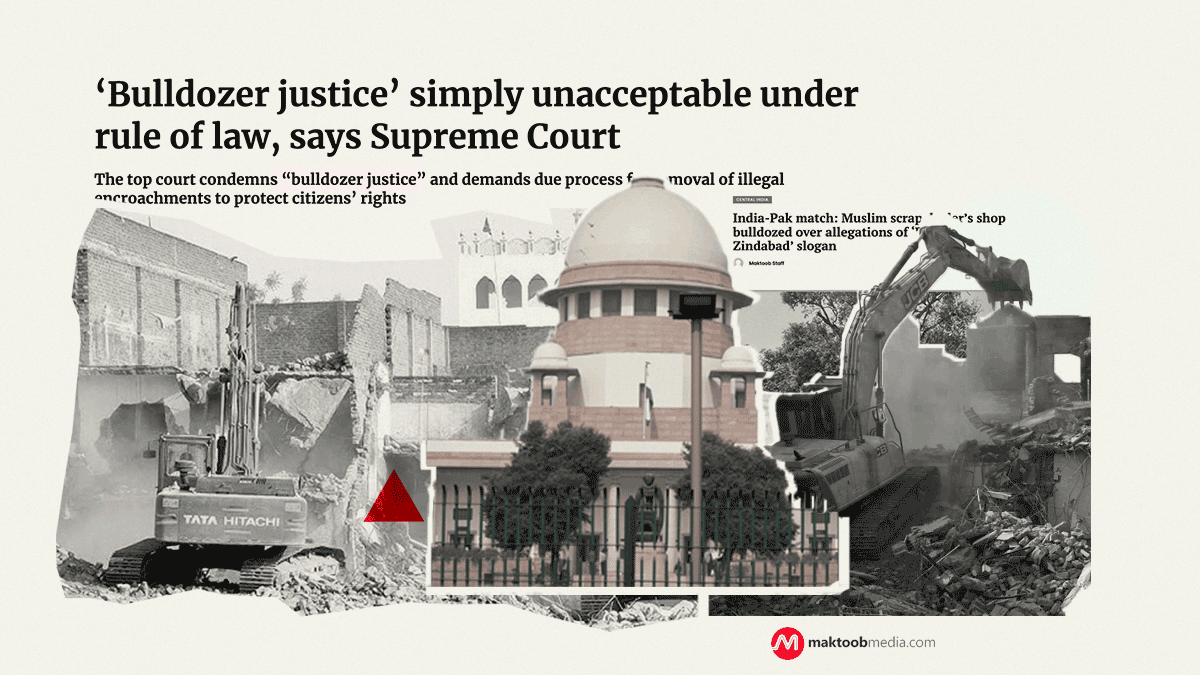
Bulldozer action is often used as an extrajudicial punishment against those accused of a crime, but the recipients of this form of state violence have disproportionately been minorities, especially Muslims. The reason cited on paper is often encroachment of municipal land or problems with zoning and land use. However, in November 2024, after years of bulldozer violence being inflicted in the garb of addressing illegal encroachments, the Supreme Court found bulldozer actions meant to act as extrajudicial punitive measures unconstitutional. However, such demolitions across various states didn't cease following the Supreme Court decision.
Just last week, several demolition notices were sent to Muslim households, a mosque, and a cemetery in a locality in Rajasthan’s Beawar over a case of alleged sexual assault of minor girls and forced conversations, which was termed 'love jihad' by local law enforcement and Hindutva outfits. Following demands of ‘bulldozer action’ by Hindutva groups, portions of the house belonging to one of the accused was razed before the Rajasthan High Court stayed further demolitions, with the bench remarking that the government and local authorities seem ‘hell-bent to demolish their construction without taking a decision on their response [to the demolition notices].’
The same week, in Maharashtra’s Malvan, the municipal corporation demolished a scrap shop belonging to a Muslim man after allegations by a Vishwa Hindu Parishad worker that the former’s son had chanted ‘Pakistan Zindabad’ following the India vs Pakistan Champions Trophy match. Another shop belonging to the boy’s uncle was demolished as well, and a vehicle used by the family for their scrap business was damaged during the demolition.
However, a mere claim with no proof and dubious legal merit sent the Malvan Municipal Corporation into overdrive. If the communal motive behind the demolition was ever obfuscated behind claims of illegal construction, the entire case is premised upon what a worker of a Hindutva organisation claims to have heard a Muslim boy saying. This claim not only cost two families their livelihoods but also led to the arrest of the boy’s parents. The demolition is unequivocally a form of extrajudicial punishment in direct contravention of the Supreme Court ruling, however, area MLA Nilesh Rane of the Shiv Sena (Shinde faction), in a tweet posted on X (formerly Twitter), not only vowed to drive the family out of the district, but felt emboldened to openly position the demolition as a consequence of the alleged sloganeering.
Supreme Court Judgment and Demolitions Following It
A division bench of the Supreme Court found arbitrary demolitions carried out by the state to be violative of the principles of natural justice, right to shelter, and separation of powers by allowing the state to overstep and take on an adjudicatory role of determining the guilt of an accused and imposing punitive measures against them. The court further issued pan-India guidelines to be followed before any demolition, which included the issuance of show-cause notices and allowing the owner/occupier of the property time to respond and the right to be heard.
Violation of the guidelines would amount to contempt of court, and the officials involved in any such illegal demolitions will be liable for the restitution of such property, the costs of which will be recovered from their salaries. The bench went on to note that such demolitions are unconstitutional because they infringe on the right to shelter enshrined in Article 21 and are also discriminatory because they target properties belonging to those accused of a crime by stating illegal encroachment while ignoring similar illegally constructed structures in the vicinity.
However, dubious bulldozer actions didn’t cease following the Supreme Court decision. Behind the veil of addressing illegal encroachments, and in some instances, in open defiance of the judiciary, bulldozers have ploughed down homes, businesses, and entire neighbourhoods since November 2024. Even in the Malvan incident, a member of the district administration told the Times of India that no notice was served to the owner of the shop or the landowner, in violation of the Supreme Court guidelines. However, in an India in the clutches of Hindutva, arbitrary and malicious state action is the norm and due process a distant reality.
In early December 2024, a fornight after the Supreme Court ruling, a BJP MLA from Telangana speaking at a mahapanchayat organised by Hindutva groups in Uttarakhand urged Pushkar Singh Dhami, Uttarakhand’s Chief Minister, to ‘learn from Chief Minister Yogi [Adityanath]’ and ‘bring in some bulldozers to answer the land jihadis in the language they understand.’ Days later, Gujarat’s Minister of State for Home, Harsh Sanghavi, said that Chief Minister Bhupendra Patel’s ‘bulldozers will roll out in the days to come’ to act against illegal encroachments.
In January this year, four homes belonging to a rape accused were demolished in Jamnagar. The district administration claimed the homes were built on municipal land, and a show-cause notice was issued, but no evidence was presented before them. In early February, a mosque was demolished in Uttar Pradesh’s Khushinagar, claiming the structure was illegal. The municipal administration claims they received no response to three show-cause notices sent to the mosque committee. An interim stay was issued by the High Court in the matter, but the morning after the stay order had lapsed, the mosque was demolished.
The same day, in Bhopal's Moti Nagar, an impoverished and predominantly Muslim-area, 110 shops and 381 homes were demolished to make way for railway and infrastructure projects. Although, as per India Today, just across the street from the demolished shops, a makeshift liquor store has opened up on the footpath, which wasn’t subject to any such action. Currently, a stay has been issued by the Madhya Pradesh High Court barring further demolitions.
Last week, the Amdavad Municipal Corporation (AMC) carried out demolitions in Gujarat’s Gomtipur, which included 115 commercial, 45 residential, and two religious structures, citing road widening as a reason. While the administration claims show-cause notices were sent, Gomtipur’s councillor told the Times of India that legal procedures weren’t followed.
On March 5, a dhaba belonging to a drug peddler was demolished in Punjab’s Jalandhar. This is the ninth of such demolitions since the state began a new anti-drug campaign last week. Punjab is governed by the Aam Aadmi Party. The next day, another demolition drive took place in an impoverished area along the Yamuna riverbank in Delhi. The Indian Express quoted one of the residents saying they were informed only the night before the demolitions that they were to leave.
In December 2024, after the ‘discovery’ of an ‘ancient’ temple following an anti-encroachment drive, Muslim residents had taken to demolishing their own homes in hopes that they could salvage some belongings before the administration inevitably tore down their homes in communally charged Sambhal. The prospect of demolition looms over another Muslim family in Sambhal. A family living next to a recently ‘discovered’ temple told The Wire that they were pressured by the district administration to vacate their home because it prevented Hindu devotees from performing parikrama (circumambulation).
At the administration’s insistence, they also demolished their balcony, fearing the entire house would be demolished if they didn’t comply. Mohammad Mateen, the owner of the house, was also arrested on charges of disturbing peace in the area. The family claims the arrest was a tactic to intimidate them into demolishing their house.
Hindutva Lawlessness and the Paucity of Judicial Oversight
The judiciary has largely been ineffective in combating Hindutva lawlessness, particularly with regard to bulldozer violence. To proponents of Hindutva, the rule of law remains a mere suggestion; therefore, blatant disregard and malicious non-compliance with judicial pronouncements are seen as viable options. An executive that runs amok has hardly been restrained by the judiciary.
The Supreme Court, in its judgement, noted that the state cannot use excessive and arbitrary force, even against those accused of a crime. In taking on an adjudicatory role, the state is overstepping into judicial terrain and diluting the principle of separation of powers. In refusing to comply with judicial rulings, the state also compromises the integrity of the system of checks and balances, ultimately weakening democratic integrity. And when the state is intent on playing judge, jury, and executioner, the judiciary’s ability to curb such overzealous and malicious state actions isn’t just a test of judicial sovereignty and integrity, but also a test of democracy – one in which India is faring poorly.
The Supreme Court verdict on bulldozer violence was also limited in its focus, missing the political and ideological motivations underpinning bulldozer actions. While the Supreme Court’s view of the state overstepping and taking on an adjudicatory role is accurate and fair, it’s important to reckon that this isn’t necessarily the state’s goal but a consequence of it Several instances of the bulldozer action before and after the Supreme Court verdict were carried out as extrajudicial punishments, but the aim isn’t necessarily to punish those accused of violent crimes but to target and penalize Muslims and other marginalised groups.
While non-Muslims accused of violent crimes have been the recipients of bulldozer violence, a majority have still been Muslims and often those named or accused in communal tensions like in Nuh and Khargone in 2023, where Muslim homes were selectively targeted for demolition by the district administration following communal violence.
A narrow view of bulldozer violence will only allow for judicial remedies that are prone to be exploited by the state by obfuscating its motives behind local municipal laws. While the petitions before the Supreme Court only dealt with punitive state action and demolitions as a form of extra-judicial punishments, but even in instances of punitive demolitions, a communal pattern is evident, as in the Beawar and Malvan cases now and many others before that.
A Frontline report found that only a small number of demolitions carried out in 2024 qualify as punitive state action following allegations of a crime. Data collected by the publication also found that of documented cases with adequate information last year, 55 per cent involved marginalized communities. Out of the total demolitions in the year, 37 per cent were targeted against Muslims.
The Punjab and Haryana High Court, in August 2023, had noted the communal nature of bulldozer violence. Halting a demolition drive in Haryana’s Nuh targeted at Muslim residents following communal violence in the town, the Court asked the state government if the move was an ‘exercise of ethnic cleansing’ stating, ‘The issue also arises whether the buildings belonging to a particular community are being brought down under the guise of law and order problem and an exercise of ethnic cleansing is being conducted by the State.’
An Amnesty International report from the same year found that demolitions in five states – Assam, Gujarat, Madhya Pradesh, Uttar Pradesh, and Delhi – between April and June 2022 disproportionately targeted Muslims. It read, ‘The selective targeting of Muslims by the authorities in all five states, either to remove alleged encroachments or to deter them from participating in protests, squarely fails to meet the criteria of proportionality and reasonability. Rather, it is indicative of the systemic discrimination against Muslims in India.’
Bulldozers as vehicles of punitive state action and extrajudicial punishment don’t paint a complete picture. The patterns that underpin instances of bulldozer violence tell a different tale of majoritarian violence and the Hindutva hijacking of India’s institutions. In the Malvan case, the demolition was assuredly a form of extrajudicial punishment. But a distinction must be made if it was a form of punishment carried out against the accused in a crime or if it was punishment for being Muslim in a country succumbing to Hindutva forces.
Only in a minority of the demolitions since the November verdict has there been any legal intervention and the state’s open defiance of the Supreme Court’s verdict is continuing unchecked. While executive overreach and high-handedness are glaringly evident, the prospect of judicial failure, worse yet, judicial complicity looms. The recent attendance of a sitting High Cout judge at a VHP event where he made islamophobic remarks, Islamphobic comments by a Karnataka High Court judge in open court, a judge joining the Bharatiya Janta Party within months of retirement and another resigning to join the party, or former Chief Justice of India DY Chandrachud’s oral remarks during the Gyanvapi hearing that opened the floodgates for numerous suits to ascertain the religious character of Muslim places of worship (later addressed by Chief Justice of India Sanjiv Khanna in December 2024) have laid fertile ground for eroding public faith in the judiciary as a check against rising Hindutva authoritarianism in India.
If, to an ordinary citizen, the judiciary isn’t a safeguard against state-inflicted and state-backed Hindutva violence, then what good are our claims of being the largest democracy? But more importantly, if the judiciary, by mere inability or complicity, lacks the wherewithal to curb Hindutva state violence, where does one turn when they languish in prisons without a trial, when they are gunned down in the streets because of anti-establishment views, or when they stand facing rubble that once was their home?
The Supreme Court, in its November 2024 verdict, held that arbitrary bulldozer actions violate the fundamental rights enshrined in Article 21. However, if our fundamental rights are inviolate only insofar as Hindutva whims allow them to be, and if critical legal tenets of natural justice, due process, and rule of law can be sacrificed at the altar of far-right political and ideological fancies, then long shadows are cast, not only on a faltering judiciary, but on the illusion of a robust democracy.
Akshita Prasad is a writer whose work primarily focuses on women, law and policy, politics, and pop culture.