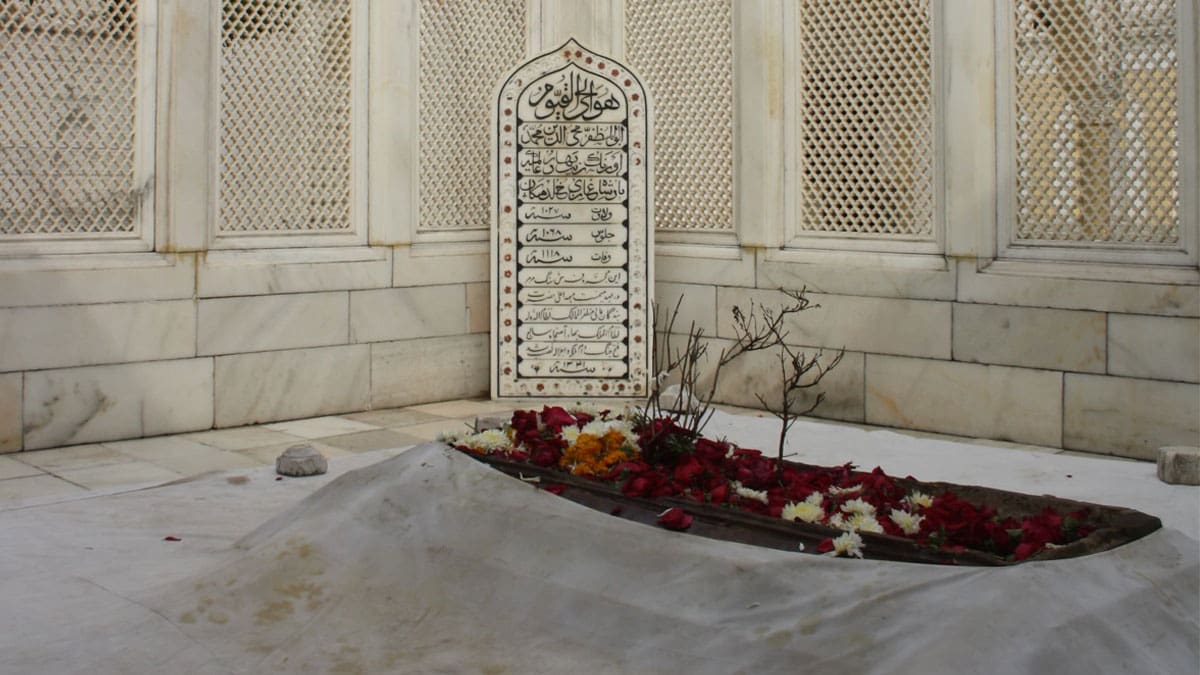
Explainer: Who wants to remove Aurangzeb's Tomb?

The growing controversy about Mughal emperor Aurangzeb has reached Khuldabad, 24 kilometres from Chhatrapati Sambhajinagar district (Previously known as Aurangabad) in Maharashtra, where he rests next to his wife's tomb, 'Bibi ka maqbara". But the vilified portrayal of the 17th-century ruler in yet another Bollywood blockbuster has spiralled into calls for the removal of the tomb.
For centuries, the site has remained a place of quiet reflection, its open-air grave surrounded by a simple marble lattice and a basil plant growing at its centre. But the demand by ruling Bharatiya Janata Party (BJP) and its ally Shiv Sena for the demolition of the historic monument has created tensions.
Feroz Ahmed, a caretaker of the tomb for generations, is anxious as there is a sudden dip in the visitors at the grave.
The 17th-century ruler has become a lightning rod for political controversy, his name invoked to fuel divisive narratives and electoral strategies. Mughals are considered invaders by the Hindutva ecosystem, while Aurangzeb is positioned as the worst 'Muslim' ruler.
The latest chapter in this saga unfolded in March 2025, when Samajwadi Party MLA Abu Asim Azmi sparked outrage by saying that “all the wrong history is being shown” about Aurangzeb. Azmi asserted that the emperor “built many temples” and was “not a cruel leader.” Azmi was reacting to the public anger stirred by the movie Chhaava, based on the life of Sambhaji Maharaj, the second ruler of the Maratha Empire who fought and got defeated by Aurangzeb.
"Aurangzeb built many temples. I do not consider Aurangzeb a cruel administrator. Also, the battle between Chhatrapati Sambhaji Maharaj and Aurangzeb was a battle for state administration. That battle was not about Hindus and Muslims anywhere," Azmi added.
Satara MP Udayanraje Bhosale, a direct descendant of the revered Maratha king Chhatrapati Shivaji Maharaj, led the charge, declaring, “What is the need for the tomb? Bring in a JCB machine and raze it. Aurangzeb was a thief and a looter.” BJP leader Navneet Rana echoed these sentiments, urging Azmi to watch the recently released film *Chhava*, which portrays Aurangzeb as a tyrant.
Bhosale was quick to clarify that the issue was not about religion. “This is not a Hindu-Muslim issue by any chance,” he said, pointing out that Shivaji Maharaj’s empire included many Muslim soldiers and administrators. Yet, the controversy has taken on a distinctly communal tone, with Shiv Sena leader Naresh Mhaske filing a police complaint against Azmi, leading to his suspension from the Maharashtra Assembly.
Maharashtra Chief Minister Devendra Fadnavis also backed the call for the removal of the tomb of the Mughal emperor.
A Legal and Historical Quandary
The calls for demolition, however, face a significant legal hurdle. Maharashtra Chief Minister Devendra Fadnavis emphasized that Aurangzeb’s tomb is a protected monument under the Archaeological Survey of India (ASI). “While there is strong sentiment against the tomb, it cannot be removed unless done through legal procedures,” Fadnavis explained.
Dr Nizamuddin Ahmad Siddiqui, co-founder of Project Mishkat, explained that the tomb is classified as an ancient and historical monument under The Ancient Monuments and Archaeological Sites and Remains Act, 1958. Sections 16, 20A, and 20B of the Act protect the religious nature of the site and prohibit any alterations inconsistent with its character.
Siddiqui also highlighted that the Places of Worship Act, 1991, further safeguards the tomb’s status. He dismissed the applicability of recent judicial trends, such as the Gyanvapi Masjid case, to Aurangzeb’s tomb, emphasizing that the “Ayodhya Logic” of conflating structure and place cannot be applied here. “Any attempt to demolish or tamper with the tomb would violate the law of the land,” he asserted.
The politicization of Aurangzeb’s legacy is not new. Shiv Sena founder Bal Thackeray was among the first to aggressively use Aurangzeb as a symbol of historical grievance in the late 1980s, particularly in the campaign to rename Aurangabad to Sambhajinagar—a demand fulfilled by the Eknath Shinde government in 2022. BJP leaders have also frequently invoked Aurangzeb in their rhetoric, with figures like Fadnavis labeling protestors as “Aurangzeb ki aulad” (descendants of Aurangzeb).
Yet, not all political voices align with this narrative. Vanchit Bahujan Aghadi president Prakash Ambedkar visited the tomb in June 2023, offering floral tributes and questioning, “What’s wrong in visiting Aurangzeb’s memorial? He was a Mughal emperor who ruled here for 50 years. Can we wipe out history?” His measured response stands in stark contrast to the polarizing rhetoric dominating the discourse.
“Khuldabad has always remained peaceful, with Hindus and Muslims coexisting for decades,” Feroz Ahmed told Maktoob. Ahmed, who runs a small bookshop on the premises, meets visitors from across India and beyond every day. He believes that only a small section of people hold negative opinions about Aurangzeb, while most visitors come out of historical or religious interest.
Ahmed also dismissed allegations that Aurangzeb misused state wealth, stating that the emperor lived a simple life, earning his livelihood by making prayer caps and writing copies of the Quran. “He never took a single penny from the royal treasury,” Ahmed said, calling the accusations a political tactic to create division before elections.